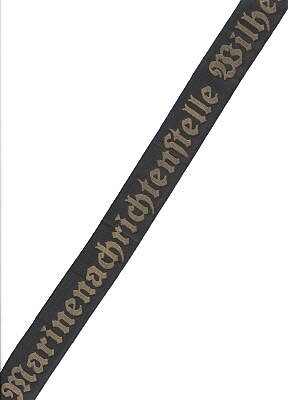
Cap Tally "Marinenachrichtenstelle Wilhelmshaven"

Metallic thread woven construction, length: 115 cm, worn condition, slightly damaged, Condition 2
36578
90,00

Cap Tally "Marinenachrichtenstelle Wilhelmshaven"

The cap ribbon of the Marinenachrichtenstelle Wilhelmshaven (Naval Signals Station Wilhelmshaven) represents a fascinating testimony to German naval history and the development of military intelligence services. This metal-thread woven execution embodies the technical precision and craftsmanship characteristic of uniform components of the Imperial German Navy and later the Reichsmarine.

The Marinenachrichtenstelle formed an essential component of the German naval organization. In Wilhelmshaven, one of Germany's most important naval bases since its founding in 1869, intelligence and communications facilities of the navy were concentrated. The city developed into Germany's largest naval base on the North Sea and housed numerous specialized naval establishments.

Cap ribbons of the German Navy served since the 19th century to identify affiliation with specific ships or units. The tradition dates back to the Imperial Navy, where by Supreme Cabinet Order of September 1, 1872, the introduction of cap ribbons with ship names was mandated. This regulation was continuously refined and extended to various naval establishments.

The metal-thread weaving technique characterizes high-quality cap ribbons, in which golden or silver metal threads were woven into the black base fabric. This elaborate manufacturing method differed from simpler embroidered or printed versions. The golden letters on a black background corresponded to the traditional coloring of the German Navy and symbolized elegance and military dignity.

Naval signals stations gained particular importance during World War I. Radio intelligence, encryption, and message transmission developed into war-deciding factors. Wilhelmshaven, as the main base of the High Seas Fleet, possessed extensive communication facilities that maintained contact between fleet command, individual ships, and naval leadership in Berlin.

In the Reichsmarine of the Weimar Republic (1919-1935), Wilhelmshaven retained its central importance. Intelligence services were reorganized and modernized, integrating new technologies such as improved radio technology. The Marinenachrichtenstelle coordinated communication between various naval establishments and was responsible for training communications personnel.

With the renaming to Kriegsmarine in 1935, intelligence services experienced further expansion. Wilhelmshaven's strategic location on the North Sea made its signals station a hub of maritime communication. Personnel of this facility wore the corresponding cap ribbon as an identification mark of their affiliation.

The length of 115 centimeters corresponds to the standardized measurements for German Navy cap ribbons, which were dimensioned so they could be tied around the sailor cap, with the ends hanging down the back. The black base color with golden inscription followed the tradition established for decades.

Cap ribbons document not only affiliation with a unit but also the organizational structure of the navy. The designation “Marinenachrichtenstelle” indicates a shore-based establishment, in contrast to ship names that appeared on cap ribbons of crews of seagoing units. This reflects the increasing specialization and growing importance of land-based support units.

World War II brought an enormous intensification of intelligence activities. Wilhelmshaven suffered severe bomb damage but remained operational until the end of the war. The signals stations played a central role in coordinating U-boat operations and monitoring Allied radio traffic.

After 1945, Wilhelmshaven was occupied by British forces, and the Kriegsmarine was dissolved. Cap ribbons like this became historical artifacts that today document the complex organization of German naval forces. They are important sources for naval history and enable conclusions about the structure and functioning of military intelligence services.

For collectors and historians, such cap ribbons offer authentic insights into military everyday life. The condition and signs of wear testify to actual use and give the object historical authenticity. The Marinenachrichtenstelle Wilhelmshaven represents a specific aspect of maritime military history that often receives less attention than combat units but was indispensable for the functioning of the navy.

r