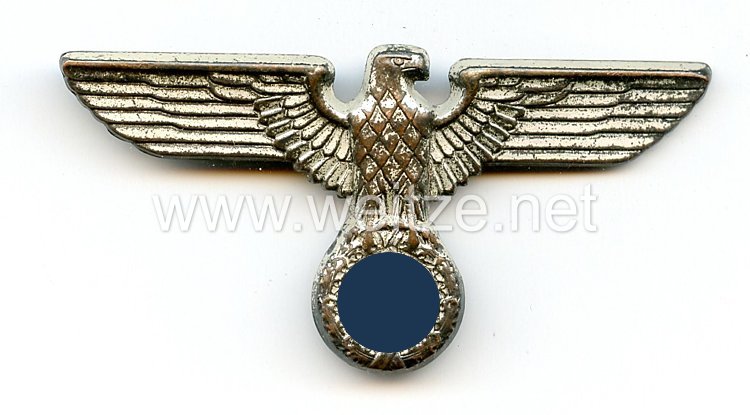
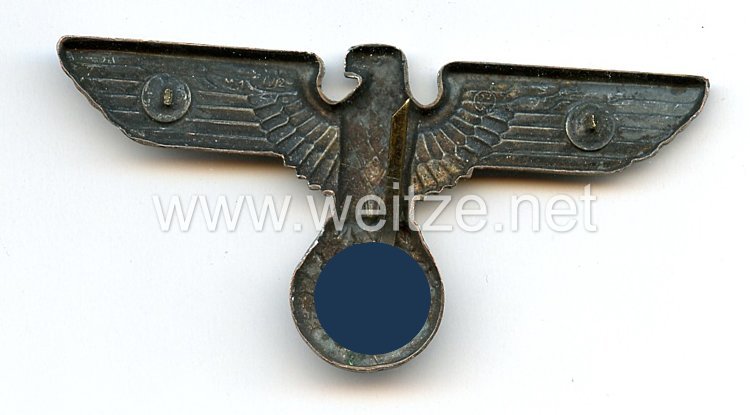
SA Hat Eagle for Shako Cap
The SA cap eagle for the Schaftmütze represents a characteristic insignia of the National Socialist Sturmabteilung, manufactured around 1941. This cockade served as an official rank insignia and was worn on the Schaftmütze, a tall cylindrical headgear.
The Sturmabteilung (SA) was founded in 1920/21 as the paramilitary combat organization of the NSDAP. Under the leadership of Ernst Röhm, the SA developed into a mass organization that already counted over 2 million members by 1933. After the seizure of power in 1933 and particularly after the so-called “Röhm Putsch” in June 1934, the SA increasingly lost political significance in favor of the SS.
The uniforming of the SA followed strict regulations laid down in various service instructions and dress codes. The cap eagle was an essential component of this uniforming and symbolized National Socialist ideology. The badge typically shows a stylized eagle with outstretched wings, holding a swastika in its talons - the central symbol of the NS regime.
The manufacture of such badges was carried out in non-ferrous metal, an alloy usually based on copper or brass. This choice of material made sense for both economic and practical reasons: non-ferrous metal could be easily cast and stamped, was relatively inexpensive to produce, and still offered an attractive appearance. Attachment to the cap was accomplished by means of split pins mounted on the reverse, which were pushed through the fabric of the headgear and then bent over.
The temporal classification around 1941 falls into a significant phase of World War II. At this time, Germany had occupied large parts of Europe, and the Wehrmacht was conducting the invasion of the Soviet Union (Operation Barbarossa, June 1941). The SA itself, however, played only a subordinate role in military affairs, as the Wehrmacht and SS were the dominant forces.
The Schaftmütze was part of the walking-out uniform and was worn on official occasions. In contrast to the peaked cap, which was worn by leaders, the Schaftmütze was typical for SA men of lower ranks. The various SA units differed through collar patches, sleeve bands, and other insignia, while the cap eagle represented a uniform element for all SA members.
After 1945, all National Socialist symbols were banned by the Allies. Control Council Law No. 1 of September 20, 1945, ordered the dissolution of the NSDAP and all its formations including the SA. Paragraph 86a of the German Criminal Code prohibits the public display of unconstitutional symbols to this day, which also includes SA insignia.
From a military-historical perspective, such objects are significant testimonies of German history. They document the uniforming practices of totalitarian organizations and the importance of symbolic representation for National Socialist ideology. Museums and historical collections preserve such artifacts as teaching aids and research objects to understand the mechanisms of NS rule and warn against the dangers of totalitarian systems.
The craftsmanship quality of such insignia varied considerably depending on the manufacturing period and producer. Early pieces from the 1920s and early 1930s were often manufactured by traditional military effects factories in high quality. However, with increasing war duration and material shortages, quality declined, and substitute materials were increasingly used.
The historical study of such militaria requires careful contextualization. These objects must be understood as remnants of a criminal regime that caused immeasurable suffering. Their collection and study serves exclusively educational and scientific purposes, preserving the memory of this dark chapter in history to prevent its repetition.