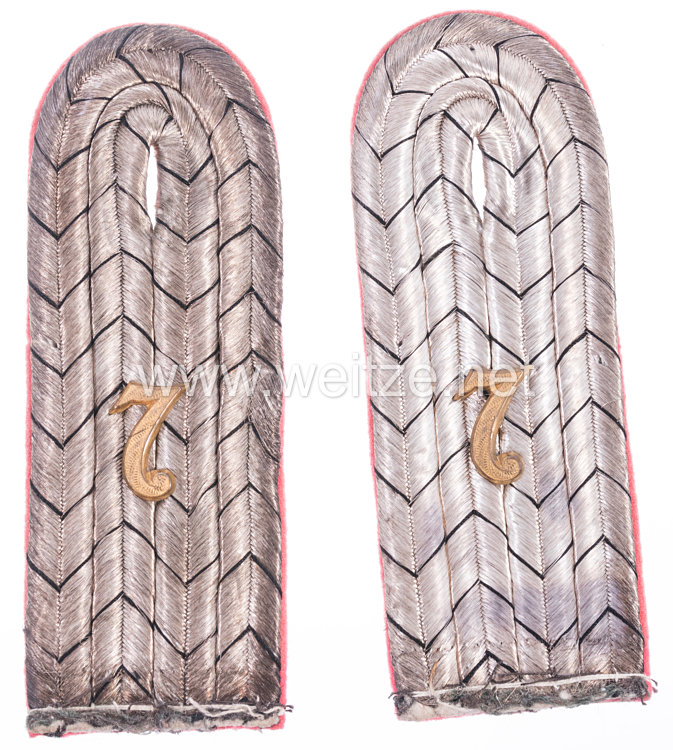
Prussia Pair of Shoulder Boards for a Lieutenant in the Westfälisches Dragoner-Regiment Nr. 7

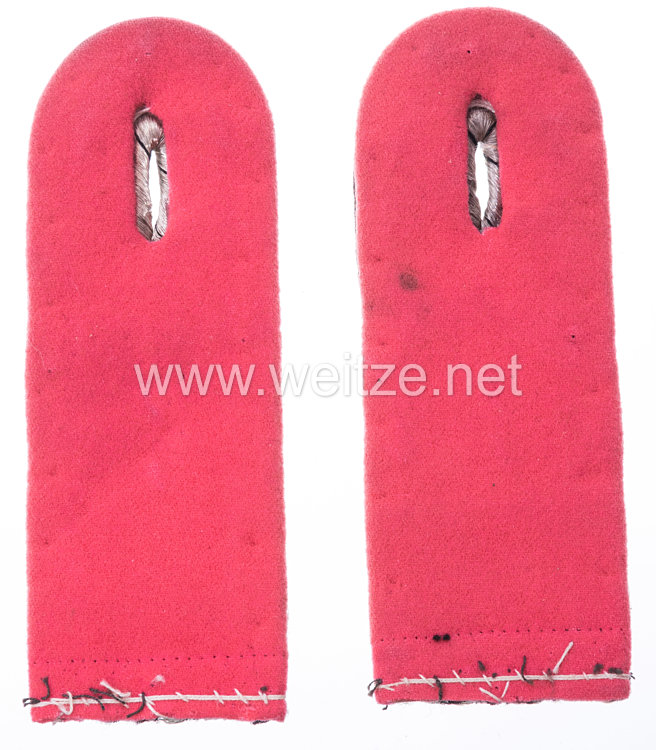
Stationed in Saarbrücken, circa 1910. Pink-red cloth base, for sewing in. Worn, condition 2.

Rare.
339077
200,00

Prussia Pair of Shoulder Boards for a Lieutenant in the Westfälisches Dragoner-Regiment Nr. 7

The shoulder straps of a lieutenant in the Westphalian Dragoon Regiment No. 7 represent a fascinating testament to Prussian military history in the early 20th century. These rank insignia, worn around 1910 in Saarbrücken, embody the complex hierarchy and precise uniform regulations of the Imperial German Army.

The Westphalian Dragoon Regiment No. 7 was established in 1815 as part of the reorganization of the Prussian cavalry after the Wars of Liberation. The regiment had its headquarters in Saarbrücken, a strategically important garrison town on the border with France. This location was not coincidental but part of Prussia's defense strategy that sought to secure newly acquired territories after 1871.

The characteristic pink cloth base of the shoulder straps was the branch color of the dragoons in the Prussian army. This coloring dates back to the uniform reforms of the 19th century and served for immediate identification of the branch of service. The dragoons, originally mounted infantry, had evolved into an independent cavalry branch positioned between heavy and light cavalry.

The rank insignia of a lieutenant during this period typically consisted of braided or woven metal lace on the colored cloth base. The lieutenant was the lowest officer rank and formed the backbone of troop leadership at the platoon level. Promotion to lieutenant occurred after passing the officer examination and several years of service as an ensign or officer cadet.

The construction “for sewing in” indicates that these shoulder straps were intended for field uniforms or daily service. Unlike rigid, slip-on shoulder boards, sewn-in shoulder straps were permanently attached to the uniform. This corresponded to the dress regulations that precisely specified which type of rank insignia was to be worn on which occasion, following the uniform reform of 1910.

Around 1910, the Prussian army was in a phase of modernization. The 1910 uniform reform brought significant changes, particularly the introduction of field-gray uniforms for wartime. However, the traditional colorful uniforms with their characteristic branch colors remained for peacetime service and ceremonial occasions. The pink shoulder straps of the dragoons were thus part of this transitional period between tradition and modernity.

Regiment No. 7 had a proud history. It participated in the Wars of Unification, particularly the Franco-Prussian War of 1870/71, and in the following decades was an integral component of the Rhine Army. The regiment's officers frequently came from the Westphalian and Rhenish nobility as well as the upper bourgeoisie.

The Saarbrücken garrison had a lasting impact on the regiment. The city was of great importance not only militarily but also industrially. Its proximity to the coal fields and steel mills of the region made Saarbrücken an important logistics center. The dragoons of Regiment No. 7 were part of the city's social life and shaped its urban character through their presence.

Service life around 1910 was characterized by intensive training and regular maneuvers. The Imperial Autumn Maneuvers were highlights of the military year, during which entire army corps demonstrated their operational readiness. For a lieutenant, this meant responsibility for a platoon of approximately 30 to 40 dragoons as well as their horses and equipment.

The preservation of these shoulder straps in condition grade 2 (well preserved with signs of use) is remarkable. Many uniform items were lost during World War I or destroyed later. The regiment itself was dissolved in 1919 as part of the disarmament provisions of the Treaty of Versailles, ending a tradition of over one hundred years.

For collectors and historians, such shoulder straps are important primary sources. They document not only uniforming practices but also the social structure and organization of the Imperial Army. The rarity of these specific shoulder straps from Regiment No. 7 makes them particularly valuable for military historical research and the reconstruction of uniforms from this era.