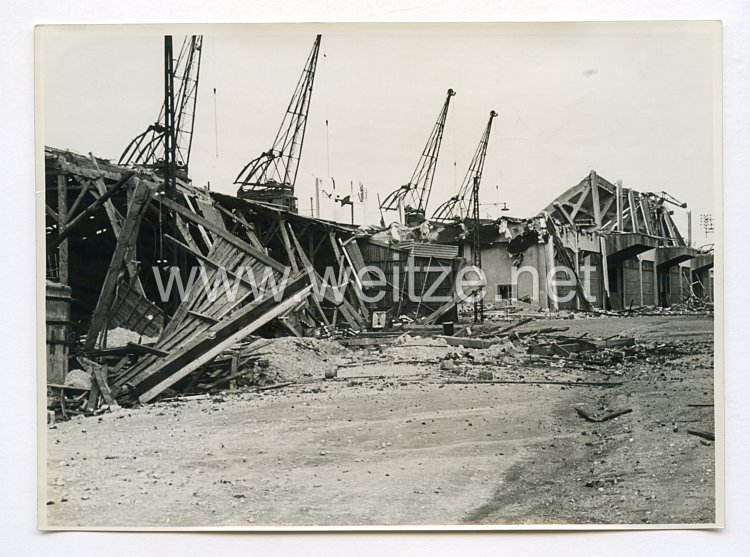
Press Photograph, Occupation of France 1940:

, approx. 13 x 18 cm, condition 2.
317577
20,00

Press Photograph, Occupation of France 1940:

Press Photography During the Occupation of France 1940

The occupation of France in the summer of 1940 represented one of the most significant military turning points of World War II. The Wehrmacht's Propaganda Companies played a crucial role in the photographic documentation and propagandistic exploitation of these events.

Historical Context

On May 10, 1940, the German Western Campaign began with the attack on the Netherlands, Belgium, Luxembourg, and France. Within just six weeks, the Wehrmacht succeeded in defeating the French and British forces. The Armistice of Compiègne was signed on June 22, 1940, symbolically in the same railway carriage where Germany had capitulated in 1918. The German occupation of France lasted until the Allied liberation in 1944.

Propaganda Companies and War Reporting

The Propaganda Companies (Propagandakompanien or PK) were established as independent military units even before the war began. They were subordinate to the Wehrmacht High Command and assigned to the Reich Ministry of Public Enlightenment and Propaganda under Joseph Goebbels. These units consisted of photographers, filmmakers, journalists, and illustrators who were to document war events at the front lines.

The PK photographers were equipped with high-quality equipment, primarily Leica and Contax 35mm cameras as well as larger medium format cameras. They wore uniforms and were full soldiers, but were entrusted with the special task of creating visual material for propaganda purposes.

Technical Aspects of Press Photography

Typical press photos from this period usually measured approximately 13 x 18 cm, which corresponded to a standard print format. This size was ideal for publication in newspapers and illustrated magazines such as the “Berliner Illustrirte Zeitung” or “Signal” magazine. The photographs were developed in photo laboratories and prepared for press distribution.

On the reverse side, these photographs frequently bore stamps from various propaganda units, censorship stamps, captions, and sometimes handwritten annotations. The images were distributed through central picture agencies and used for both domestic and international press coverage.

Thematic Focus Areas

Press photography of the occupation of France in 1940 encompassed various subject areas: victorious German troops marching into French cities, captured fortifications of the Maginot Line, French prisoners of war, destroyed Allied military equipment, and the occupation of symbolic locations such as Paris. Particularly propagandistically charged were photographs of German soldiers in front of the Eiffel Tower or at the victory parade on the Champs-Élysées.

Propagandistic Intent

The photographs were intended to demonstrate the military superiority of the Wehrmacht, strengthen the morale of the German population, and internationally suggest the invincibility of the German Reich. At the same time, they served to portray the occupation as orderly and “correct.” Negative aspects such as war crimes, looting, or the suffering of the civilian population were systematically excluded.

Collector Value and Historical Significance

Today, such press photos are important historical documents that provide insight into the propaganda machinery of the Nazi regime. They are of interest to both military historians and collectors. The condition is usually evaluated on a scale from 1 to 6, with condition 2 indicating very good preservation with minimal signs of use.

When evaluating such photographs, various factors are relevant: the state of preservation, the rarity of the subject, existing stamps or inscriptions on the reverse, and the historical significance of the depicted scene. Photographs by known photographers or of particularly significant events achieve higher collector values.

Critical Perspective

A critical perspective is essential when dealing with such material. These photographs were instruments of National Socialist propaganda and part of a system intended to legitimize war and genocide. Their historical significance lies precisely in demonstrating how images were instrumentalized for political and military purposes. Engagement with this material today serves historical research and education about the mechanisms of propaganda in the Third Reich.

r