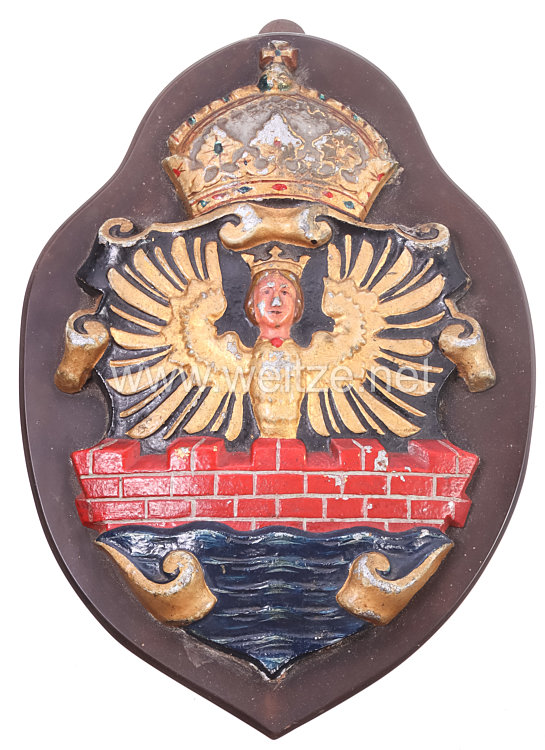
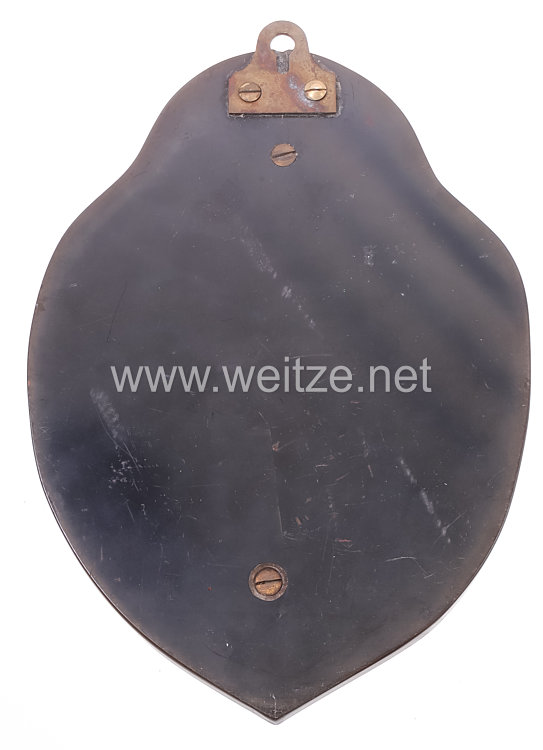
Kriegsmarine Ship’s Badge of the Light Cruiser Emden
This object is a heavy, color-lacquered ship’s badge (Schiffswappen) of the light cruiser Emden, originally mounted on a Bakelite plate, standing approximately 22 cm in height and rated Condition 2. It represents a fine example of a naval tradition that originated in the Kaiserliche Marine (Imperial German Navy), continued through the Reichsmarine, and was systematically implemented within the Kriegsmarine after 1935 under Grand Admiral Erich Raeder.
The Badge and Its Heraldry
The badge displays the coat of arms of the City of Emden, known as “Engelke up de Muer” (The Little Angel on the Wall). This motif features a harpy or angel figure standing upon a fortified wall above waves. The coat of arms was granted to the city by Emperor Maximilian I in 1495, making it a heraldic element of considerable antiquity that carried centuries of tradition into the modern German navy.
Materials and Manufacture
Ship’s badges of this type were constructed from resistant metal alloys — typically bronze, brass, or similar corrosion-resistant metals — capable of withstanding the demanding maritime environment. The color-lacquered finish provided the badge with its representational character. The mounting on a Bakelite backing plate is characteristic of the 1930s–1940s era; Bakelite offered heat resistance, electrical insulation, and mechanical stability. Ship badges were produced by various firms during the Kaiserliche Marine, Reichsmarine, and Kriegsmarine periods. Gustav Becker of Wilhelmshaven was the most prominent manufacturer, whose stamp typically appeared on the reverse of badges. These items were purchased at ship canteens and stores, or presented as gifts to departing officers and dignitaries.
Purpose and Function
Ship badges were not awards or decorations but rather representational emblems that were purchased or presented as gifts. They served multiple functions aboard ship and beyond. Large, heavy versions like this specimen were intended for permanent installation in officers’ messes, commanders’ quarters, and representative areas aboard the vessel. During official occasions and ceremonies, they symbolized the honor and tradition of the ship. Smaller, lighter variants served as portable keepsakes, farewell gifts, or exchange items during official visits. The exchange of badges between allied or friendly ships was a widespread practice. Badges could also be presented as gifts to departing officers, visiting dignitaries, or deserving crew members.
The Light Cruiser Emden — Historical Context
The light cruiser Emden was built at the Reichsmarinewerft Wilhelmshaven for the German Reichsmarine. Her keel was laid in December 1921, she was launched on 7 January 1925, and commissioned on 15 October 1925. She holds the distinction of being the first large warship built in Germany after the First World War, designed under the constraints of the Treaty of Versailles, which imposed a 6,000-ton displacement limit. The ship was the third German warship to bear the name Emden, honoring the famous World War I cruiser SMS Emden (1909).
From 1925 to 1939, the Emden served primarily as a training ship (Schulschiff) for naval cadets, undertaking extensive worldwide training cruises. Among her notable commanding officers was Karl Dönitz, who commanded the vessel from September 1934 to September 1935. Dönitz would later become Commander of U-boats and ultimately Grand Admiral. Between 1925 and 1945, the Emden served as a training vessel for numerous future Kriegsmarine officers and cadets.
With the outbreak of the Second World War, the Emden took part in the invasion of Norway during Operation Weserübung in April 1940, serving as a communications center in Oslo. She subsequently returned to training duties in the Baltic Sea. In January 1945, the Emden participated in the evacuation of East Prussia and transported the remains of Paul von Hindenburg. Damaged by British bombing raids on Kiel in March and April 1945, she was run aground on 13 April 1945 and ultimately destroyed by demolition to prevent capture by the enemy. Her wreck was broken up by 1950.
Collecting Significance
Following the destruction of the cruiser Emden in April–May 1945 and the conclusion of the Second World War, authentic Kriegsmarine ship badges became sought-after collector’s items and historical artifacts. Their value is determined by condition, rarity of the ship, historical significance, manufacturing quality, and provenance. Collectors should be aware that Gustav Becker continued producing ship crests after the war, which makes the authentication of wartime-period pieces a more complex undertaking. This particular example, with its Condition 2 rating indicating a well-preserved specimen with minor signs of use, represents an impressive piece of naval material culture from one of Germany’s most historically significant interwar and wartime vessels.