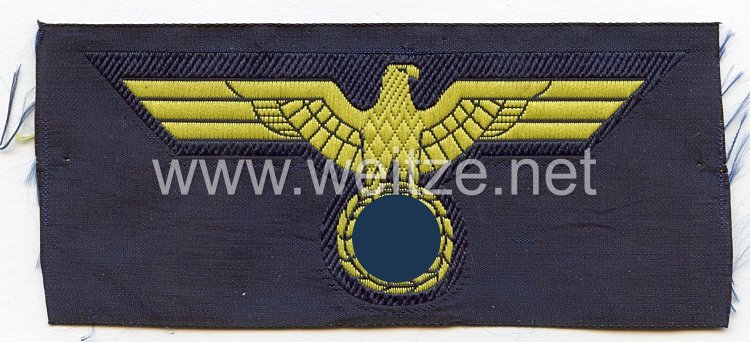
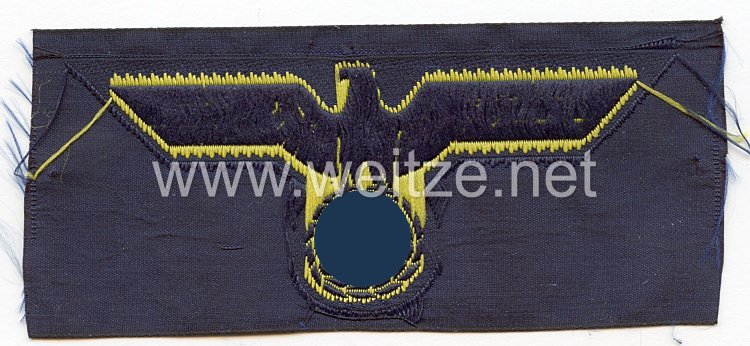
Kriegsmarine Breast Eagle for Enlisted Personnel
The Kriegsmarine Breast Eagle for Enlisted Personnel represents a characteristic uniform insignia of the German Navy during the Second World War. This particular specimen in Bevo-woven execution was intended for attachment to the blue tunic of enlisted ranks and represents the strict hierarchy and uniform regulations of the German Kriegsmarine of that era.
The uniform regulations of the Kriegsmarine, which built upon traditions of the Imperial Navy, were systematically reorganized after 1935. With the official reintroduction of conscription and the buildup of the Wehrmacht, each branch of service received its own uniform specifications. The Kriegsmarine introduced the national emblem in the form of a stylized eagle with outstretched wings, clutching a swastika in its talons.
The Bevo weaving technique referred to a special jacquard weaving process developed by the Barmen ribbon weaving company Ewald Vorsteher - hence the abbreviation “Bevo”. This technique enabled the production of detailed, multicolored textile badges of high quality. The woven badges were considered more durable and elegant than embroidered variants and were preferred for higher-quality uniform pieces. The weaving technique allowed for precise representations with fine details and color gradations that were difficult to achieve with traditional embroidery.
For the blue tunic of enlisted personnel, specific insignia were designated that differed in material and execution from those of non-commissioned officers and officers. The blue uniform formed the basic equipment for enlisted ranks and was worn both aboard ship and on shore. The breast eagle was attached to the right breast side of the tunic and identified the wearer as a member of the German Wehrmacht.
The hierarchical differentiation in the Kriegsmarine was reflected in all aspects of uniforming. While enlisted personnel wore woven eagles on a dark blue background, officers often used more elaborately crafted variants, sometimes interwoven with metal threads. These distinctions were not merely aesthetic in nature but served the immediate recognition of rank structures aboard ship and in shore installations.
The production of uniform insignia during the war was subject to strict quality controls and was carried out by authorized manufacturers. Various companies received contracts for the manufacture of these badges, with the Bevo technique considered particularly high-quality. Production followed exact specifications regarding size, color, and design to ensure a uniform appearance of the armed forces.
The unworn condition of such badges is today of particular significance for collectors and museums. Many uniform items were used intensively during the war and show corresponding signs of wear. Unworn specimens, possibly stored as depot stocks or reserves, today offer an unadulterated insight into the original quality and execution of these militaria.
After the end of the war in 1945, all uniforms and insignia bearing National Socialist symbols were withdrawn from circulation. The Allied occupation powers prohibited the wearing and display of such insignia. Today these objects are subject to strict legal regulations in Germany and may only be collected and presented for documentary, scientific, or similar purposes.
The historical significance of such uniform insignia lies in their function as period documents. They illustrate the organization, hierarchy, and visual representation of military structures of a specific historical epoch. For maritime military history, they offer important insights into uniform studies and the material culture of the Kriegsmarine. Museums and scientific institutions preserve such objects as part of the historical heritage to enable future generations to gain a comprehensive understanding of this period.