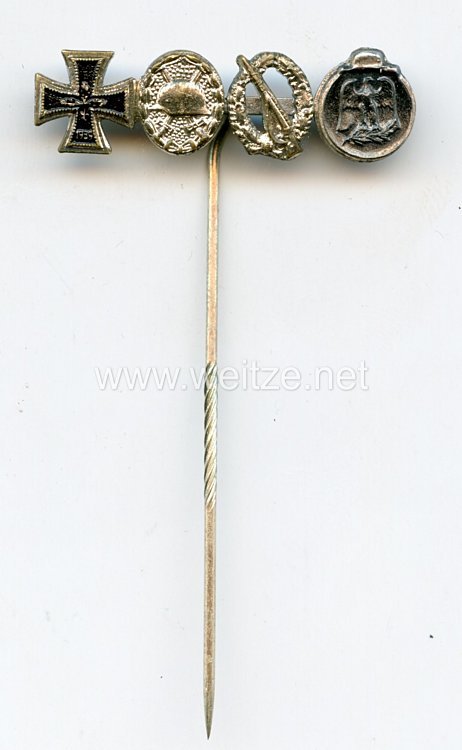
Miniature Medal Bar 1957 of a World War II Veteran - 4 Decorations

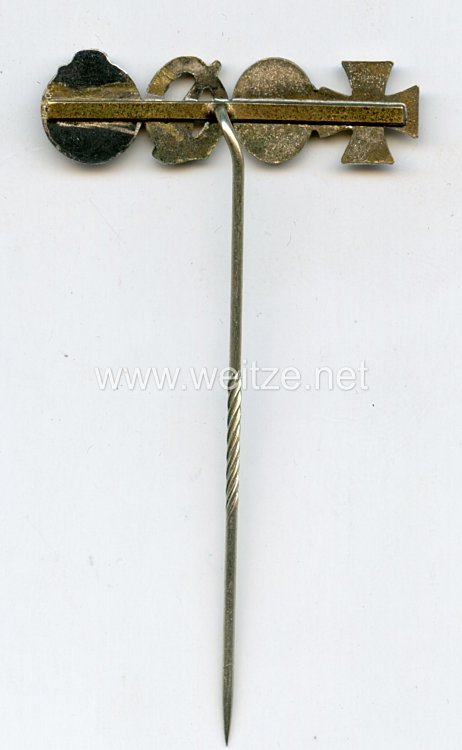
9 mm, Iron Cross 2nd Class, Wound Badge in Silver, Infantry Assault Badge in Silver, Eastern Front Medal; on long pin, condition 2.
434376
40,00

Miniature Medal Bar 1957 of a World War II Veteran - 4 Decorations

This miniature medal bar from 1957 represents the military career of a German Second World War veteran and documents his service through four significant decorations. With a width of 9 mm, it belongs to the typical miniature versions that were permitted to be worn in the Federal Republic of Germany after 1957, following the revision of legislation regarding the authorization to wear orders and decorations from the National Socialist era.

The bar carries four decorations arranged in order, which together provide a meaningful picture of the wearer's military service. The Iron Cross 2nd Class was renewed on September 1, 1939, by Adolf Hitler and was one of the most frequently awarded German decorations for bravery. It was awarded for valor in the face of the enemy or outstanding military merit. The decoration had its origins in the Wars of Liberation of 1813 and was reissued in every major German conflict.

The Wound Badge in Silver documents that the wearer was wounded three to four times or suffered a severe wound. This badge was also renewed on September 1, 1939, and was awarded in three grades: Black for one to two wounds, Silver for three to four wounds, and Gold for five or more wounds. The award was not automatic but had to be applied for and required appropriate documentation through hospital stays or medical certificates.

The Infantry Assault Badge in Silver was established on December 20, 1939, by Commander-in-Chief of the Army Field Marshal von Brauchitsch. It was awarded to infantrymen and assigned units who had participated in at least three infantry attacks on different days. Alternatively, it could be awarded for wounds received during an infantry attack or for special bravery. The badge symbolized the particularly dangerous role of infantry in combat and enjoyed high esteem among soldiers.

The Eastern Front Medal, colloquially also called “Frozen Meat Medal,” was established on May 26, 1942. It was awarded to all members of the Wehrmacht and its allies who were deployed on the Eastern Front for at least 14 days between November 15, 1941, and April 15, 1942, or were wounded there. This decoration commemorates the first catastrophic winter of the Russian campaign, during which German troops fought under extreme conditions at temperatures down to minus 40 degrees Celsius. Over three million of these medals were awarded.

After the end of World War II, wearing and displaying orders and decorations from the NS era were initially prohibited. The Law on Titles, Orders and Decorations of July 26, 1957 regulated the legal situation for the first time in the Federal Republic of Germany. According to this law, orders and decorations from before 1945 could only be worn in modified form with all NS symbols such as swastikas removed. These so-called “denazified” versions were legally worn from 1957 onwards.

The present miniature bar was specially manufactured for wearing on less formal occasions or on civilian clothing. Unlike regular medal bars worn on uniforms, miniatures were about one-third to half the original size. They were attached to a long pin, as described in this example, and could be worn on the lapel of a suit. The production of such miniatures was a specialized craft, and various companies such as Steinhauer & Lück in Lüdenscheid manufactured these pieces after 1957.

The combination of these four decorations tells the story of a soldier who actively participated in combat operations, was wounded multiple times, distinguished himself particularly in infantry combat, and survived the harsh winter of 1941/42 on the Eastern Front. Such medal bars are important contemporary historical documents that preserve individual fates in the context of the greatest military conflict in human history. The stated condition 2 indicates a well-preserved piece with minor signs of use, which is remarkable for an object over 60 years old.