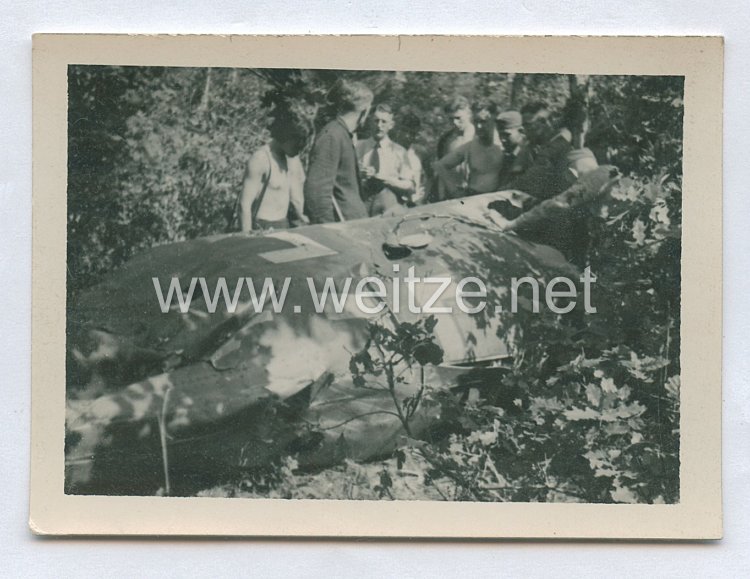
Luftwaffe Photograph, Part of a Crashed Aircraft
Historical Context: Luftwaffe Photographs of Crashed Aircraft in World War II
The photograph in question documents parts of a crashed aircraft and represents an authentic testimony to aerial warfare during the Second World War. Such images held considerable military and documentary significance within the German Luftwaffe between 1939 and 1945.
Photographic Documentation in the Luftwaffe
The systematic photographic recording of aircraft crashes served several important purposes within the military organizational structure. The Luftwaffe, established as an independent branch of the Wehrmacht in 1935, maintained specialized photographic units called Bildberichter (photo-reporters). These were tasked with documenting military operations, equipment, and losses.
Photographs of aircraft wreckage served technical intelligence and damage analysis purposes. Engineers and designers could identify structural weaknesses, analyze combat damage, and develop improvements for future models based on such images. The Reich Ministry of Aviation (Reichsluftfahrtministerium, RLM) systematically collected such documentation for technical evaluation.
Military and Intelligence Significance
When dealing with crashed enemy aircraft, such photographs were of invaluable importance to the Luftwaffe leadership and intelligence services. The identification of aircraft types, armament, armor, and technical innovations enabled the development of countermeasures and adaptation of tactics. The Abwehr and other intelligence agencies systematically evaluated such photographic material.
For losses of German aircraft, photographs served accident investigation and statistical recording purposes. The Luftwaffe maintained detailed loss records, and photographic documentation helped identify wreckage parts and reconstruct crash causes. This was particularly important for flight safety and the development of training programs.
Format and Technical Aspects
The stated format of approximately 9 x 6.5 cm corresponds to the commonly used small-format standard during World War II. The German photographic industry, particularly companies like Agfa and Leica, supplied high-quality cameras and film material for military purposes. Soldiers often used private or officially issued cameras such as the Leica II or III, as well as less expensive models.
The image quality and processing of such photographs varied considerably, depending on the circumstances of capture and available development facilities. Many photographs were developed under field conditions, which affected the quality and durability of the material.
Propaganda Use
Beyond technical and military use, such photographs also had a propaganda dimension. Images of shot-down enemy aircraft were frequently published in the Wochenschau (newsreel) or magazines such as “Die Wehrmacht” or “Der Adler” to demonstrate military success and strengthen morale on the home front. The Reich Ministry of Public Enlightenment and Propaganda under Joseph Goebbels strictly controlled which images were published.
The Air War and Its Losses
The air war exacted enormous losses on all sides. The Luftwaffe lost an estimated 70,000 aircraft during the war due to enemy action, accidents, and technical problems. The Battle of Britain (1940), the Russian campaign (from 1941), and increasing Allied bombing raids on Germany resulted in massive material and personnel losses.
Each wreck represented not only the loss of valuable resources but often also the death or injury of trained crew members whose training had taken months to years. Photographic documentation of these losses helped leadership assess the extent of casualties and make strategic decisions.
Collector Value and Historical Significance Today
Today, such photographs are important historical documents that provide insight into the reality of aerial warfare. They are valued by military historians, museums, and collectors as authentic visual testimonies of a defining era. The scholarly examination of such materials contributes to understanding the technical, tactical, and human aspects of World War II.
The preservation and contextualization of such photographic documents is crucial for historical research and memory culture. They serve as reminders of the devastating consequences of war and as sources for reconstructing historical events.