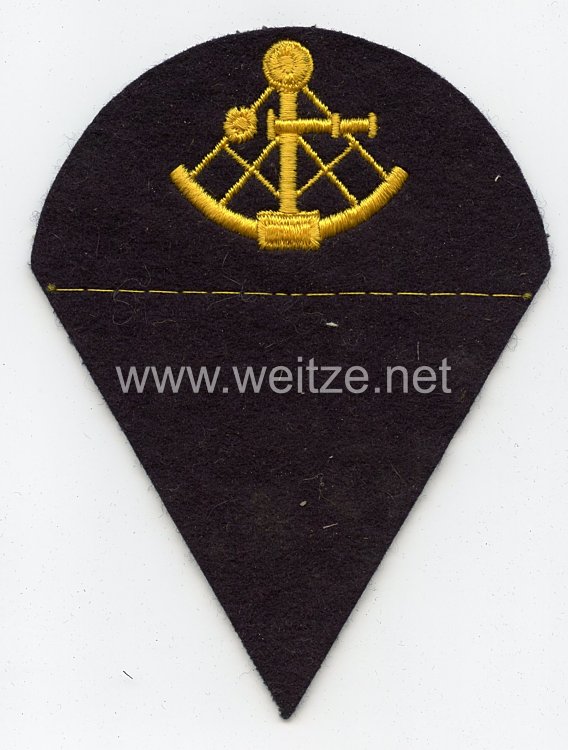
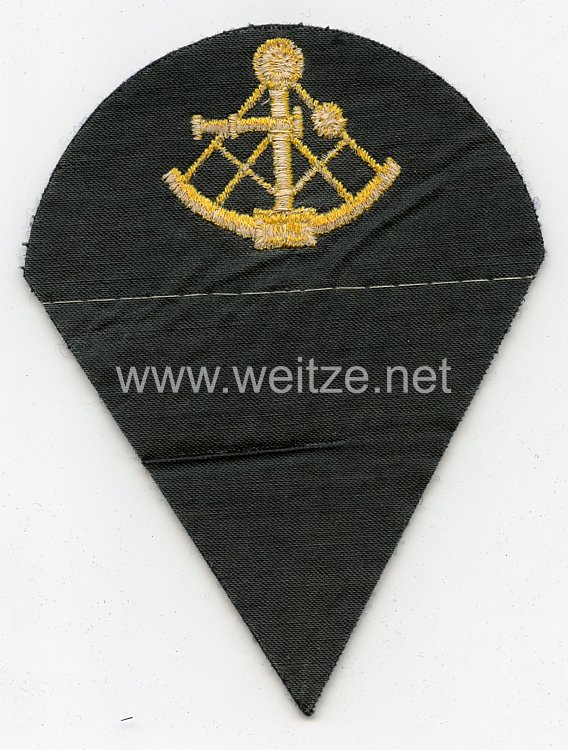
Kriegsmarine Enlisted Men's Sleeve Insignia Survey Career Branch
The Kriegsmarine enlisted personnel sleeve insignia for the surveying career path represents a remarkable example of the specialized career badges used during World War II in the German Navy. These insignia served to identify the professional specialization of enlisted ranks and were an essential component of the Kriegsmarine's complex uniform system.
The Vermessungslaufbahn (surveying career path) within the Kriegsmarine was responsible for nautical cartography, hydrographic surveys, and the creation and updating of nautical charts. This highly specialized activity required mathematical knowledge, precise work, and a deep understanding of oceanography. Survey officers and enlisted personnel played a crucial role in fleet navigation, particularly in poorly charted waters or during the planning of amphibious operations.
The sleeve insignia was worn on the left upper arm of the uniform according to Kriegsmarine uniform regulations, typically between the shoulder and elbow. The version for blue wool uniform cloth was embroidered on the traditional navy blue background and displayed the characteristic symbol of the surveying career path. The design typically consisted of crossed instruments or symbols representing surveying activities, with the exact design conforming to official Kriegsmarine regulations.
The production of such insignia was carried out by specialized insignia manufacturers that produced for the Navy. Quality varied depending on the manufacturer and production period. Early wartime productions generally showed higher craftsmanship quality with fine embroidery, while later versions were often simplified due to material shortages and accelerated production.
The career path insignia were regulated by various Kriegsmarine ordinances that specified their exact execution, manner of wearing, and authorization. Only members of the corresponding career path were permitted to wear the respective insignia after completing the required training. The award was thus also a sign of professional qualification and recognition within the military hierarchy.
In historical context, it must be emphasized that the Kriegsmarine's surveying work was not limited to military purposes but also expanded maritime knowledge. Many of the charts and survey data produced were confiscated by the Allies after the war and contributed to international hydrographic knowledge.
The preservation of such sleeve insignia is often problematic today. Textiles from the World War II era suffer from natural decay, light exposure, moisture, and pest damage. Foxing, as mentioned with this specimen, is a typical aging phenomenon caused by moisture and fungal infestation. It testifies to decades of storage and the challenges of conserving historical textiles.
For collectors and military historians, such insignia offer valuable insights into the organizational structure of the Kriegsmarine and the specialization of its personnel. They document the diversity of technical and scientific professions required for operating a modern naval fleet. The surveying career path was among the less well-known but indispensable services within the Navy.
Authenticating such insignia requires expertise in manufacturing techniques, materials, and historical variants. Modern reproductions exist on the market, making examination of stitching, thread types, aging characteristics, and construction details crucial. Original insignia typically show characteristic features of wartime production and conform to the documented standards of the period.
The study of these insignia contributes to our understanding of the Wehrmacht's complex organizational structure and the specialization that characterized modern 20th-century military forces. They serve as tangible evidence of the technical sophistication and professional differentiation within the German Navy during one of history's most significant conflicts.