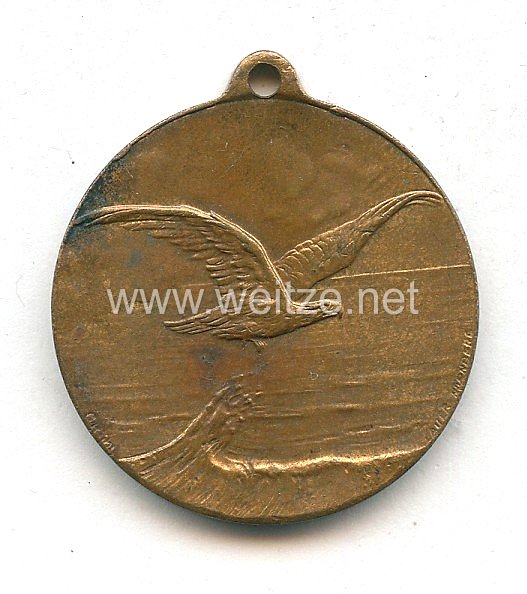
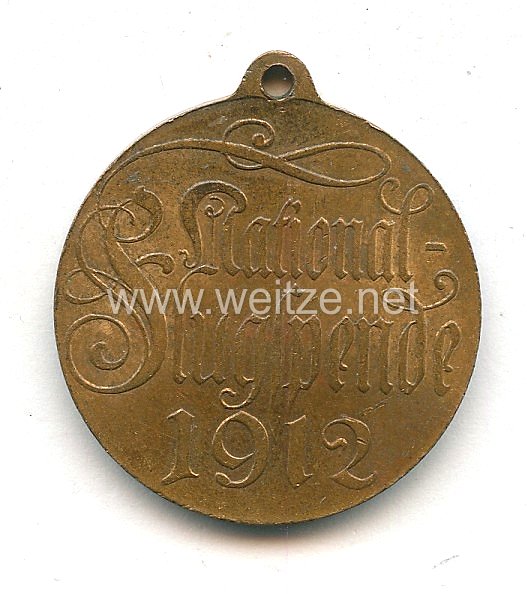
Wearable Donation Medal “National-Flugspende 1912”
The National-Flugspende was a national fundraising campaign initiated by Prince Heinrich of Prussia to advance the development of the German aviation industry.
The portable donation medal of the National-Flugspende 1912 represents a fascinating testimony to German aviation history and patriotic enthusiasm in the German Empire immediately before World War I. This bronze-toned medal was issued as part of one of the most significant national fundraising campaigns of the early 20th century and documents the intense public mobilization for the development of military aviation.
Prince Heinrich of Prussia, the younger brother of Kaiser Wilhelm II, initiated the National-Flugspende (National Aviation Fund) in 1912, a nationwide donation campaign to promote the German aircraft industry. The Prince, himself an enthusiastic supporter of modern technology and passionate sailor, recognized early on the strategic importance of aviation for the military and economic future of the German Reich. The campaign occurred at a time when Germany was competing with France, Great Britain, and the United States in the international race for supremacy in aviation technology.
The years immediately preceding World War I were characterized by rapid technological progress in aviation. Following the Wright Brothers' first successful powered flights in 1903, aviation developed at an astonishing pace. In Germany, pioneers such as Otto Lilienthal (posthumously), August Euler, and Hans Grade demonstrated impressive technical innovations. Nevertheless, the German Reich lagged behind its potential adversaries in the number of available military aircraft. This strategic weakness prompted the political and military leadership to seek ways to massively strengthen the domestic aircraft industry.
The National-Flugspende 1912 was orchestrated as a patriotic civic duty. Contemporary newspapers and posters appealed to German national sentiment and warned of the supposed threat from foreign air forces. The donation campaign was extraordinarily successful and collected considerable sums, which were used to finance aircraft procurement, the expansion of airfields, and pilot training. Donors received various badges of honor and medals in recognition, depending on the amount of their contribution.
The portable version of the medal, as described here, was executed in bronze and was originally equipped with a ring and ribbon for wearing. The medals typically displayed on the obverse a stylized eagle or aircraft, often combined with patriotic symbols such as the Prussian crown or the imperial eagle. The reverse usually contained inscriptions referring to the National-Flugspende and the year 1912. These medals were not only regarded as collectibles but were also worn publicly to demonstrate support for the national cause.
The historical significance of this medal extends beyond its material value. It represents the militarization of society in the German Empire and the growing acceptance of the notion of a future great war. The aviation fund was part of a broader movement of armament and national mobilization that gripped the German Reich in the years before 1914. Public enthusiasm for aviation combined technological optimism with military nationalism—a mixture characteristic of the Wilhelmine era.
The military-historical context is equally significant. German military planners recognized the potential of aerial reconnaissance for modern warfare. During World War I, these investments would pay off: German air forces played an important role in reconnaissance, aerial combat, and later also in tactical bombing. Famous aviators such as Manfred von Richthofen, the “Red Baron,” became national heroes and symbolized the technological modernity of warfare.
From a collector's perspective, medals of the National-Flugspende are today sought-after military-historical objects. They document not only a specific moment in German history but also the beginnings of military aviation. The condition varies greatly; specimens with original ribbon and ring are significantly rarer and more valuable than those lacking these elements, as in the present case.
The National-Flugspende of 1912 was not the only such campaign. It was followed in subsequent years by similar initiatives, each contributing to strengthening various aspects of military armament. These donation campaigns demonstrate how the German Empire involved the civilian population in military preparation, skillfully linking patriotic feelings with material incentives.
In summary, the portable donation medal of the National-Flugspende 1912 is a significant historical artifact that documents the intersection of technological progress, military armament, and public mobilization in the late German Empire. It recalls a time when aviation was still in its infancy but was already recognized as a decisive factor for national security and military superiority.