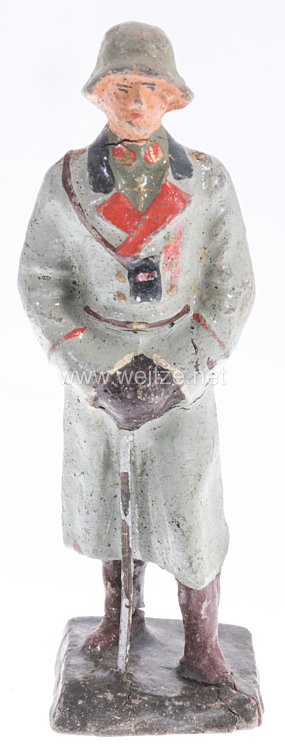
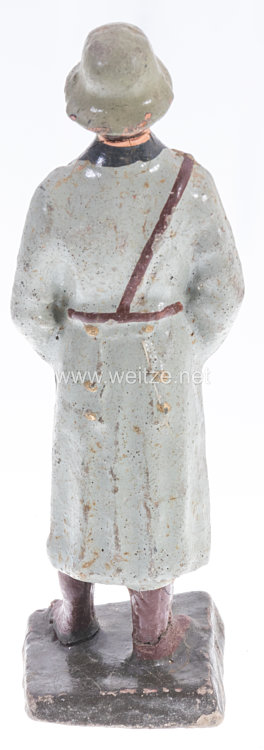
Schusso - Army General Staff Officer with Overcoat and Steel Helmet, Binoculars Suspended and Leaning on Saber

7.5 cm, Condition 2.
356575
30,00

Schusso - Army General Staff Officer with Overcoat and Steel Helmet, Binoculars Suspended and Leaning on Saber

The described Schusso figurine represents a General Staff Officer of the German Army in full uniform and belongs to a special category of military collectibles from the first half of the 20th century. Standing 7.5 cm tall, this miniature embodies the characteristic attributes of a senior staff officer: the typical overcoat, the steel helmet, a slung binocular, and a saber on which the figure is leaning.

Schusso was a well-known German manufacturer of military miniature figures, particularly active in the 1930s and early 1940s. The name stood for high-quality tin figures and composition figures depicting various branches and ranks of the Wehrmacht. These figures served both as toys for children and as collectibles for adults, fulfilling a propaganda function through the idealization of military hierarchies.

The representation of a General Staff Officer is of particular significance. General Staff officers formed the intellectual elite of the German armed forces and underwent extraordinarily demanding training at the War Academy (Kriegsakademie). They were recognizable by special insignia: crimson-red stripes on the uniform trousers (Lampassen) and special crimson collar patches. The saber depicted on the figure was not merely a ceremonial weapon but also a traditional status symbol of the officer corps, with roots extending back to the Prussian Army of the 19th century.

The steel helmet shown on the figure was introduced in its characteristic form in 1916 and represented a revolutionary development in head protection. The Model M1916 and its successors M1935, M1940, and M1942 became iconic symbols of the German armed forces. The steel helmet offered significantly better protection than earlier Pickelhaube models and substantially reduced head injuries from shell fragments.

The binoculars were an indispensable piece of equipment for officers, especially for General Staff officers responsible for terrain reconnaissance and tactical planning. German optical companies such as Carl Zeiss and Leitz produced high-quality military binoculars that were world-renowned for their precision. The typical officer's binoculars had 6x or 8x magnification.

The overcoat on the figure likely represents the Greatcoat (Model M1936), which was worn as part of the service uniform. This long, double-breasted coat made of field-gray cloth provided protection in cold weather and featured appropriate rank insignia on the shoulder straps.

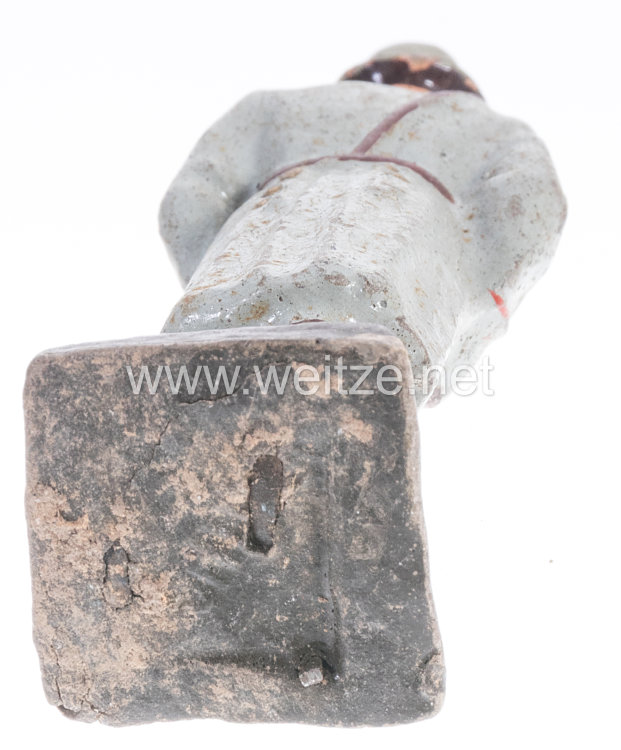
The manufacture of such figures followed a specific process. Schusso figures were predominantly made from a mass composition, a mixture of sawdust, glue, and other binding agents that was pressed into molds and then hand-painted. This technique enabled relatively inexpensive mass production while maintaining detailed design. The painting usually followed correct uniform colors according to official Army clothing regulations.

The collector value of such figures today is determined by several factors: the condition (here stated as Condition 2, indicating good to very good condition), the rarity of the depicted rank or branch of service, the quality of painting, and historical authenticity. Figures of senior officers such as General Staff officers are generally rarer than representations of common soldiers.

From a historical perspective, such objects document the material culture and propaganda aesthetics of the period. They conveyed to the civilian population, especially to youth, an idealized image of the military and its hierarchies. Today they are important study objects for uniform researchers and military historians who use such miniatures to trace the development of uniforms, equipment, and military iconography.

The collection and trade of such military-historical objects today are subject to special ethical and legal considerations. They are viewed as testimonies of a historical era and serve the scientific and educational examination of history without glorifying the associated ideology.

r