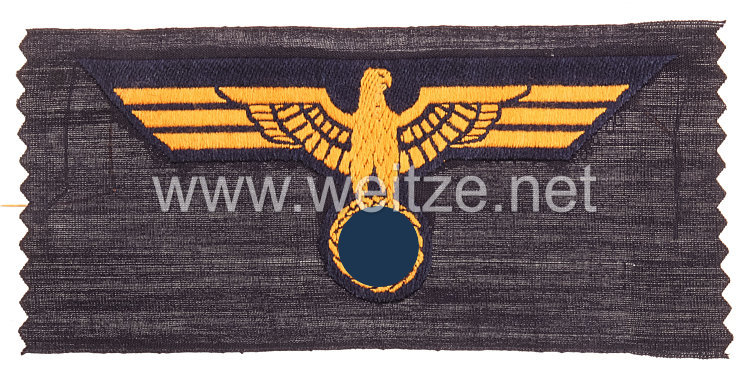
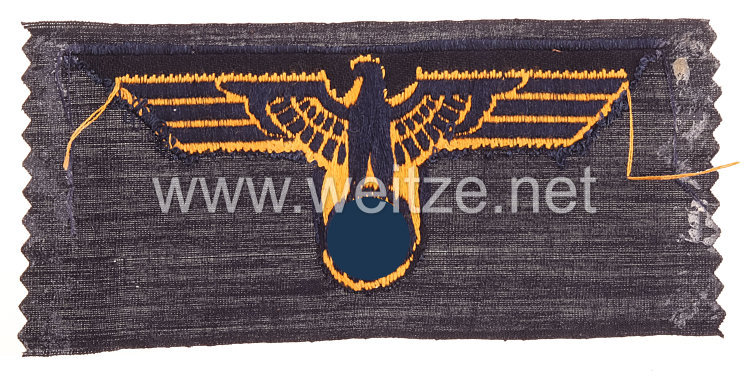
Kriegsmarine Breast Eagle for Enlisted Personnel
The Kriegsmarine Breast Eagle for Enlisted Personnel represents a significant example of military uniform insignia from the Third Reich. This particular specimen was manufactured using the Bevo weaving technique and was intended to be worn on the blue working blouse of enlisted ranks in the German Kriegsmarine.
The Bevo weaving technique was an innovative manufacturing process developed by Barmer Bandweberei Vohwinkel, whose abbreviation “BeVo” gave the process its name. This technique enabled the machine production of detailed textile insignia with high precision. Bevo-woven badges were characterized by their durability, clean detail processing, and cost-effective mass production. Unlike hand-embroidered variants, these insignia could be produced in large quantities, which was of great importance given the enormous personnel strength of the Kriegsmarine.
The blue blouse for which this insignia was intended was part of the working and shipboard uniform for enlisted personnel. It was worn during daily duty aboard ships as well as during practical work. The service regulations of the Kriegsmarine precisely prescribed the wearing of the breast eagle on this uniform. The eagle was worn centered on the chest, usually above the right breast pocket.
The national emblem in the form of an eagle with spread wings clutching a swastika in its talons became a mandatory component of all Wehrmacht uniforms from 1935. Specific versions were developed for the Kriegsmarine that differed in material, color, and execution from those of the Heer (Army) and Luftwaffe (Air Force). The eagle for Kriegsmarine enlisted personnel was typically woven in yellow or light brown on a dark blue background, creating a distinct contrast with the blue uniform.
The enlisted ranks of the Kriegsmarine included various grades from Matrosenanwärter (naval recruit) to Oberbootsmann (chief petty officer). All these ranks wore the same version of the breast eagle, in contrast to officers who wore more elaborately crafted, often hand-embroidered or metal insignia. This distinction reflected the strict hierarchical structure of the Kriegsmarine.
The Kriegsmarine itself was officially founded on June 1, 1935, when the Reichsmarine was renamed as part of the rearmament program. With the Anglo-German Naval Agreement of June 18, 1935, Germany received permission to significantly expand its navy. In the following years, the personnel strength of the Kriegsmarine grew rapidly. By the beginning of World War II in 1939, over 50,000 men were already in service, and this number increased to over 700,000 members by 1945.
The uniform regulations of the Kriegsmarine were detailed in the Anzugsordnung für die Kriegsmarine (Dress Regulations for the Navy). These regulations precisely specified when which uniform was to be worn, how insignia were to be attached, and what quality standards were to be maintained. Insignia had to be properly sewn on, with exact distances and positions prescribed.
The unworn condition of this specimen makes it a valuable historical witness. Many uniform parts and insignia were used intensively during the war and show corresponding signs of wear. Unworn pieces are significantly rarer and were either in depot storage or were requisitioned at the end of the war before they could be issued.
After the war ended in 1945, the Kriegsmarine was dissolved, and all its symbols and insignia were banned by the Allies. Many uniform parts were destroyed or taken as souvenirs by soldiers. This makes preserved original pieces important military-historical objects today that provide insight into the material culture and organization of the Kriegsmarine.
From today's perspective, such objects are important sources for military-historical research. They document not only the technical aspects of uniform production but also the organizational structure, mass production of militaria, and the significance of symbolism in totalitarian systems. For museums and research institutions, well-preserved specimens are of invaluable worth for documenting this historical era.