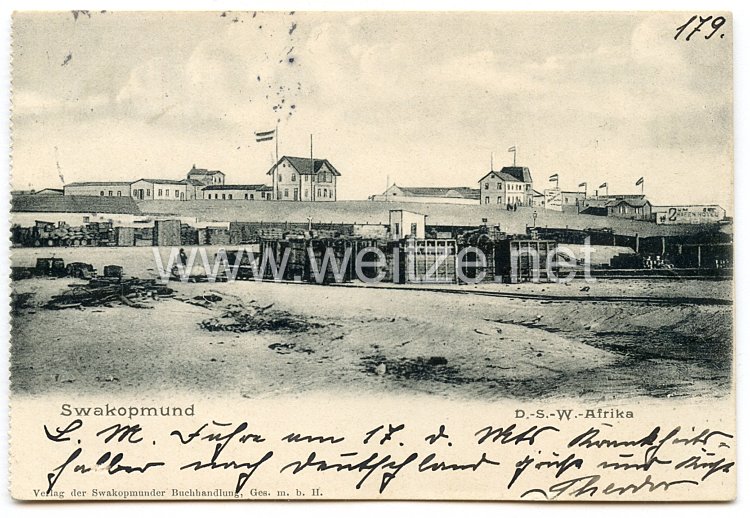
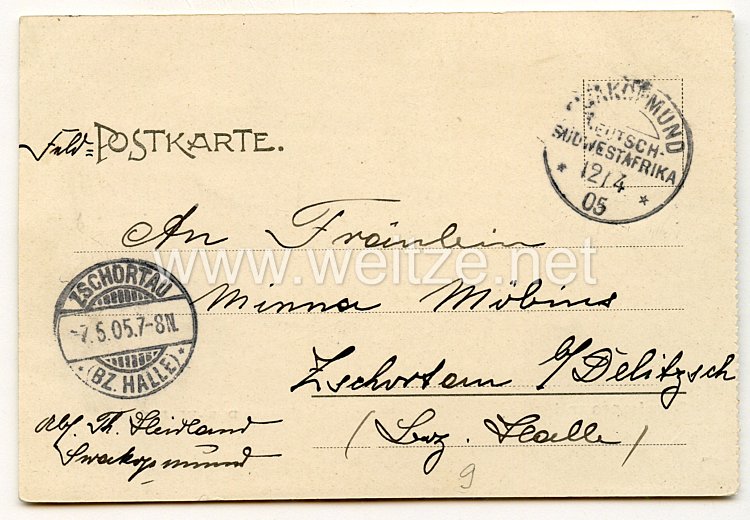
Imperial German Schutztruppe German South-West Africa Photo Postcard
This field postcard from German South West Africa dated 1905 documents a significant period of German colonial history and is set within the context of the Herero Uprising (1904-1908), one of the darkest chapters of the German colonial era.
Swakopmund, mentioned on this card, was founded in 1892 as the colony's most important port and served as a central supply point for German troops. The town quickly developed into a strategic hub for military operations in the colony.
The Imperial Schutztruppe for German South West Africa was established in 1889 and was the principal military formation in the colony. It consisted of German officers and non-commissioned officers, as well as indigenous auxiliary troops. Its original mission was to secure German interests and maintain colonial order. The strength of the force fluctuated considerably: in peacetime it comprised about 2,000 men, while during the Herero Uprising it was reinforced to over 14,000 soldiers.
The year 1905, when this card was sent, marks an intensive phase of the colonial war. Following the Battle of Waterberg in August 1904 and the devastating pursuit of the Herero into the Omaheke Desert, the military situation intensified. General Lothar von Trotha, who assumed command in June 1904, pursued a policy of systematic extermination that culminated in his infamous “Extermination Order” of October 1904.
The field post system played a central role in maintaining troop morale in the German colonies. It enabled soldiers to maintain contact with home and simultaneously served propaganda purposes. Field postcards like this one were exempt from postal charges and were frequently used by soldiers. They often featured photographs of garrisons, landscapes, or military scenes, conveying to the German population an often idealized image of colonial reality.
The photographic representations on such postcards were produced by various photographers and studios that followed the Schutztruppe or were based in colonial towns. They document not only the military presence but also colonial infrastructure, indigenous populations, and the South West African landscape. These images served an important propaganda function and were intended to legitimize colonial rule as a civilizing mission.
The condition rating of 2 for this card (on a scale of 1-6, where 1 is excellent) indicates a well-preserved postcard with slight signs of use, which is remarkable for a document over 115 years old. The fact that the card was actually posted significantly increases its historical value, as it was authentically used rather than merely produced as a collector's item.
The historical significance of such documents is ambivalent today. On one hand, they are important sources for researching German colonial history, military history, and the everyday life of colonial soldiers. On the other hand, they exist within the context of a colonial war now recognized as genocide. It is estimated that approximately 65,000 to 80,000 Herero (about 80% of their population) and at least 10,000 Nama died during the conflict through direct combat, systematic extermination, expulsion into the desert, and internment in concentration camps.
For collectors and historians, such field postcards are valuable period documents. They provide insights into communication between the front and home, the propaganda of the German Empire, and the material culture of the colonial period. At the same time, they require responsible and critical engagement with this difficult historical legacy.
The German government officially recognized in 2015 that the events in German South West Africa should be designated as genocide, and in 2021 an official apology was issued. This underscores the necessity of understanding historical objects like this field postcard in their complete historical context and preserving them as reminders for the future.