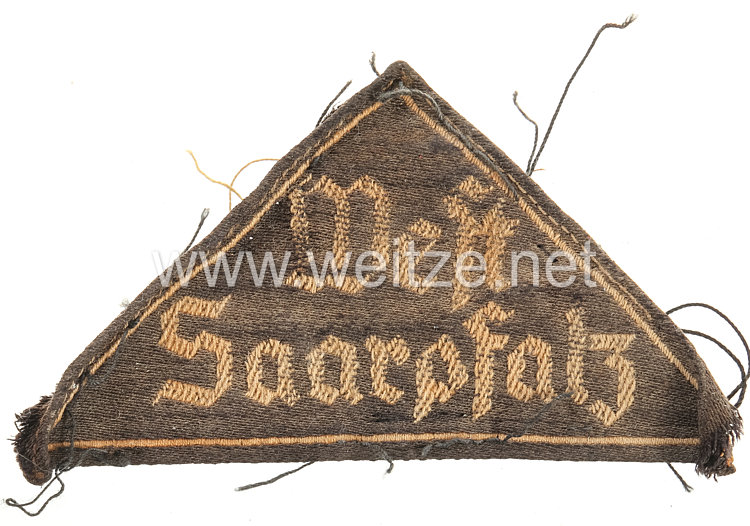
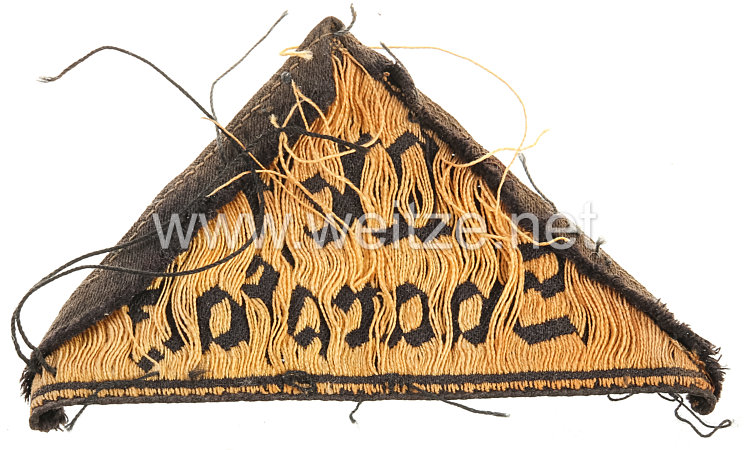
HJ Gebietstreieck “West Saarpfalz”

Heavily worn, condition 3.
368475
135,00

HJ Gebietstreieck “West Saarpfalz”

The HJ Area Triangle "West Saarpfalz" represents a significant piece of the organizational history of the Hitler Youth (Hitler-Jugend, HJ) during the National Socialist regime in Germany. These textile insignia served as important identification markers within the strictly hierarchical youth organization of the NS regime.

The Hitler Youth was founded in 1926 and developed into a state organization after the seizure of power in 1933. With the Law Concerning the Hitler Youth of December 1, 1936, it was declared the sole youth organization of the German Reich. The organizational structure of the HJ was based on the territorial administrative structure and military structures of the NSDAP. The highest regional organizational level was formed by the Gebiete (areas), which roughly corresponded to the Gaue of the NSDAP.

The Gebiet West (West Area) was one of these territorial administrative districts and geographically encompassed the region of the Saarpfalz (Saar-Palatinate), an area of particular historical significance. After World War I, the Saar region was under League of Nations administration and was only reintegrated into the German Reich after the plebiscite on January 13, 1935. This reintegration was an important success for NS propaganda. The integration of Saarland youth into HJ structures occurred immediately after the reunification.

The Gebietsdreiecke (area triangles) were triangular cloth badges worn on the uniforms of HJ members. They were typically attached to the left upper arm and served for quick identification of a member's regional affiliation. The triangles were usually in black and white colors, with the area designation embroidered or printed on them. These badges were part of a complex system of uniform insignia, rank badges, and awards that visualized the hierarchical structure and territorial organization of the HJ.

The production of these badges was carried out by various licensed manufacturers throughout the Reich. Quality varied considerably depending on the time of production and manufacturer. Early examples from the 1930s often showed higher-quality workmanship with careful embroidery, while later wartime productions were often more simply executed due to material shortages.

The stated condition 3 and the description "heavily worn" indicate a specimen that was actually used in service. Such worn pieces are historically particularly interesting as they represent authentic testimonies of that era. Signs of wear such as fading, fabric wear, or repair marks document real use and distinguish these objects from unworn warehouse stocks.

HJ membership was effectively mandatory from 1936, and with the Second Implementation Ordinance to the Law Concerning the Hitler Youth of March 25, 1939, youth service duty was formally introduced. This meant that virtually all German youth between the ages of 10 and 18 had to be members of the HJ or the League of German Girls (Bund Deutscher Mädel, BDM). The organization reached a membership of approximately 8.7 million young people in 1939.

The Gebiet West Saarpfalz, like all HJ areas, was subdivided into Banne (districts), which in turn consisted of Stämme (regiments), Gefolgschaften (units), Scharen (troops), and Kameradschaften (comradeships). This military-style structuring served the ideological education and pre-military training of youth in accordance with NS regime principles.

Today, such area triangles are historical documents of a dark epoch in German history. They are preserved by museums, collections, and research institutions as educational material and serve historical education and enlightenment. The scientific and museum-based handling of such objects is important for the documentation and critical examination of the NS era.

The preservation of such artifacts in different conditions enables historians to draw conclusions about production methods, material usage, and actual wearing practices. Heavily worn specimens like the described area triangle are testimonies to everyday reality in the HJ and document the comprehensive capture of youth by the NS regime in all regions of the former German Reich, including areas reintegrated after 1935 such as the Saarpfalz.