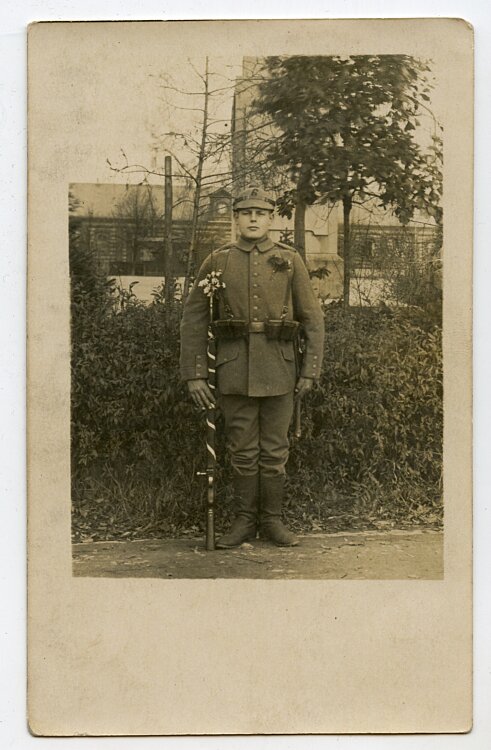
World War I Photograph, Member of the German Army 6.Regiment
This historical photograph in postcard format depicts a member of the 6th Regiment of the German Army during the First World War (1914-1918). Such photographs were widespread during the Great War and served both as personal mementos and as means of communication between soldiers at the front and their families at home.
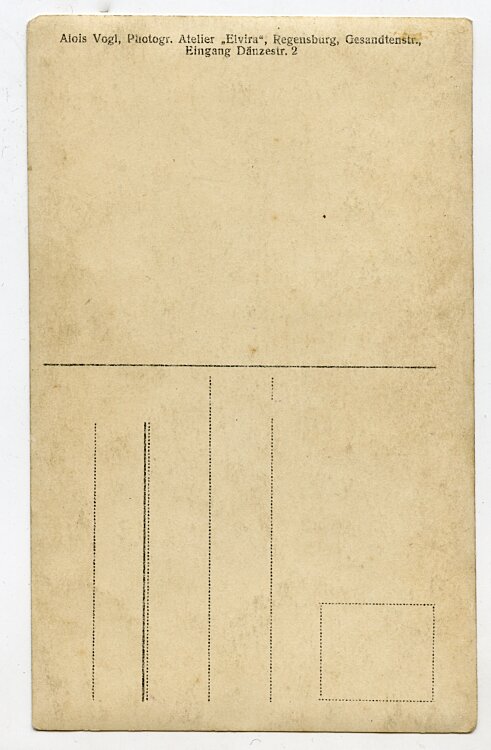
The postcard format was extremely popular and practical during this period. The standard size allowed soldiers to easily send photographs or keep them among their personal belongings. Many soldiers had their portraits taken in professional photo studios in garrison towns or near the front to send images of themselves in uniform to their relatives. This practice fulfilled several important functions: it strengthened connections to home, documented military service, and often served as a proud display of membership in the Imperial Army.
The designation “6th Regiment” could refer to various units of the German Army, as the Prussian and later Imperial Army maintained several regiments with this number across different branches of service. It could be an infantry regiment, a cavalry regiment, or another type of unit. Each of these regiments had its own history, traditions, and specific uniforms that are often recognizable in photographs.
The German Army in World War I was one of the largest and best-organized military forces of its time. At the outbreak of war in 1914, it comprised approximately 800,000 active soldiers, which quickly grew to several million through mobilization. The regimental structure formed the backbone of this army, with each regiment having its own identity, traditions, and often strong regional connections.
Photographs like this were typically taken in field grey uniforms, which had replaced the colorful uniforms of the 19th century from 1907/1910 onwards. The field grey uniform was designed to provide better camouflage on the modern battlefield and became an iconic symbol of the German soldier in World War I. Such photographs often show details like shoulder straps, buttons, collar patches, and badges that allow conclusions about the regiment, rank, and function of the depicted person.
The photographic culture of World War I experienced a remarkable flourishing. Despite wartime conditions, professional photographers operated both in rear areas and near the front. Many soldiers also used emerging amateur cameras, although military regulations often restricted photography at the front for security reasons. Official military photographers documented the war for propaganda and historical purposes.
The indicated condition grade 2 suggests a good to very good state of preservation according to common collector standards, which is remarkable for a document over one hundred years old. Such photographs were often preserved in family albums, contributing to their survival. Today they are important historical sources providing personal insights into the lives and appearance of World War I soldiers.
The military-historical significance of such photographs lies not only in their documentary quality but also in their cultural-historical value. They show the self-representation of soldiers, their uniforms, and often details of military equipment. For historians and collectors, they are indispensable testimonies of an era that fundamentally changed the world.
This photograph stands representative of millions of similar images created during World War I. It reminds us of the individual fates behind great historical events and makes tangible the personal dimension of this global conflict. For descendants and collectors, such documents are of immeasurable value as material connections to this formative period of German and European history.