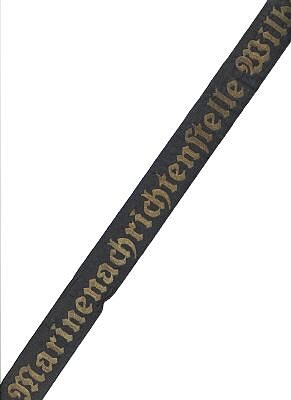
Cap Tally "Marinenachrichtenstelle Wilhelmshaven"
Cap Tally of the Marine Intelligence Station Wilhelmshaven
This cap tally from the Marinenachrichtenstelle Wilhelmshaven (Marine Intelligence Station Wilhelmshaven) represents a significant piece of German naval history from the first half of the 20th century. This headgear insignia, manufactured using metal thread weaving technique, embodies the technological and organizational development of the German Navy in the field of military communications.
Historical Background
The Imperial German Navy recognized the strategic importance of communications and signals intelligence even before World War I. Wilhelmshaven, as one of the most important naval bases of the German Reich on the North Sea coast, played a central role in this development. The city had been home to the Prussian and later German war navy since 1869 and evolved into one of Germany's most important military centers.
The Marine Intelligence Station was responsible for coordinating and analyzing intelligence information, radio monitoring, and the encryption and decryption of military communications. During World War I, this facility gained enormous importance as signals intelligence and radio defense became decisive factors in naval warfare.
Technical Execution and Manufacturing
The cap tally was manufactured using the characteristic metal thread weaving technique typical for naval cap tallies. This manufacturing method used gilded or silvered metal threads interwoven with cotton or silk threads. The length of 149 centimeters corresponds to the standardized measurements for cap tallies of the Imperial Navy and later the Reichsmarine and Kriegsmarine.
The lettering was created through the weaving process itself, with the golden or silver letters standing out clearly against the dark blue or black base fabric. This elaborate manufacturing method guaranteed durability and representative appearance, while also complying with the strict regulations governing naval uniforms.
Significance and Use
Cap tallies in the German Navy served not only as decorative elements but as important identification markers. They indicated membership in a specific ship, coastal station, or, as in this case, a specialized service unit. Wearing the correct cap tally was mandatory and strictly controlled.
For naval personnel of the Intelligence Station, the cap tally meant more than just a uniform item – it was an expression of belonging to an elite unit entrusted with highly sensitive and war-decisive tasks. Communications specialists enjoyed high prestige within the Navy, as their work required technical understanding, language skills, and absolute discretion.
Wilhelmshaven as a Naval Base
The location of Wilhelmshaven underscores the significance of this cap tally. The city housed not only large portions of the High Seas Fleet but also important command posts, shipyards, and technical service stations. The strategic location at the mouth of the Jade River made Wilhelmshaven an ideal location for intelligence services tasked with monitoring radio traffic in the North Sea.
During World War I and throughout the interwar period, Wilhelmshaven remained a center of the German Navy. The Intelligence Station played an essential role in coordinating fleet operations and monitoring enemy communications.
Condition and Collector Value
The described slightly faded condition is quite typical for metal thread cap tallies. The metal threads were susceptible to oxidation, and the colors of the base fabric could fade through exposure to light and moisture. Nevertheless, such originals represent important contemporary historical documents that establish a direct connection to German naval history.
For collectors and military historians, cap tallies from specialized service units are particularly valuable as they are rarer than those from large ships. The Marine Intelligence Station was a comparatively small facility, which limited the number of cap tallies issued.
Historical Classification
This cap tally is an authentic testimony to German naval history and documents the development of military intelligence services. It recalls a time when technological development revolutionized warfare and specialized units like the Marine Intelligence Station became indispensable components of the armed forces.
As a collectible object, it combines maritime tradition with the history of communications technology and offers insight into the organization and structure of the German Navy in the early 20th century.