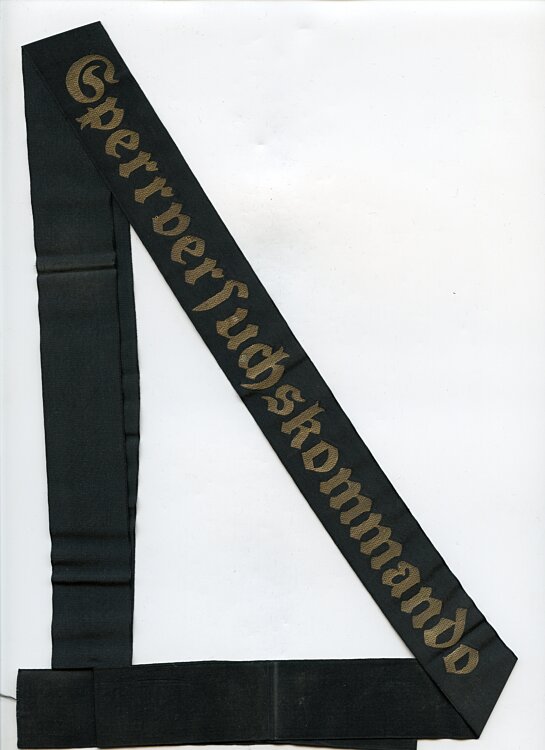
Kriegsmarine Cap Tally "Sperrversuchskommando"
The cap tally of the Sperrversuchskommando (Barrier Testing Command) of the Kriegsmarine represents an extremely rare and historically significant piece of equipment from the German Navy during World War II. With a length of 124 cm, it corresponds to the standardized dimensions for Kriegsmarine cap tallies and shows authentic signs of wear from the period through its lightly worn condition.
The Sperrversuchskommando (SVK) was a highly specialized and secret unit of the Kriegsmarine dedicated to the development, testing, and improvement of barrier devices. These included naval mines, mine barriers, underwater obstacles, and other maritime defense systems. The work of these commands was of paramount strategic importance for naval warfare, as mine barriers served both offensive and defensive functions and could render entire sea areas impassable to enemy vessels.
The organization and structure of such experimental commands were strictly classified. Personnel consisted of highly qualified naval personnel, engineers, technicians, and scientists. Deployment typically occurred at specially secured naval bases and testing facilities on the Baltic Sea and North Sea coasts. Known locations for mine testing and barrier development included Kiel, Wilhelmshaven, and various Baltic Sea islands.
The cap tally itself followed the Kriegsmarine dress regulations, which were detailed in various ordinances and service regulations. The standard design of Kriegsmarine cap tallies consisted of black ribbon with golden-yellow lettering in German script. The text was typically machine-woven or embroidered. Attachment was made to the enlisted men's and petty officers' cap (Schirmmütze), with the band placed around the cap and tied with a bow at the back of the head.
The issuance of unit cap tallies with specific designations was strictly regulated in the Kriegsmarine. While regular ship crews wore the name of their vessel, shore units, schools, special commands, and experimental units received corresponding designations. The use of the term “Sperrversuchskommando” indicates the official authorization of this unit to carry its own cap tally—a privilege that underscores the importance and special status of this formation.
In the context of German naval history, barrier devices played a central role. Already in World War I, the German Reich had laid extensive mine barriers in the North Sea and Baltic Sea. These experiences directly influenced development work during the interwar period and World War II. The Torpedo Testing Institute (TVA) in Eckernförde and other research facilities worked continuously on improving mine technology, fuses, anchor systems, and tactical deployment procedures.
The work of the Sperrversuchskommando likely encompassed the following areas: testing new mine types under real conditions, developing laying techniques, testing detonation mechanisms and sensors, examining effectiveness against various ship types, and training mine personnel. The knowledge gained was crucial to the war effort, as Germany attempted to compensate for Allied naval superiority through technological innovation.
The rarity of this cap tally is explained by several factors: the unit was numerically small, the work was subject to the highest secrecy, and many documents and equipment items were destroyed at the end of the war. Surviving cap tallies from special units are therefore extraordinarily rare and of high collecting and documentary value.
The lightly worn condition of this specimen confirms its authenticity and actual use by a member of the Sperrversuchskommando. Such personal equipment items provide a direct connection to the people who served in these secret units and to a highly specialized aspect of naval warfare that is often overlooked.
For military historians and collectors, this cap tally represents tangible evidence of Germany's sophisticated approach to naval mine warfare and the dedicated units responsible for advancing this critical technology during one of history's most devastating conflicts.