Third Reich - Reichsnährstand Exhibition 1936 Frankfurt am Main
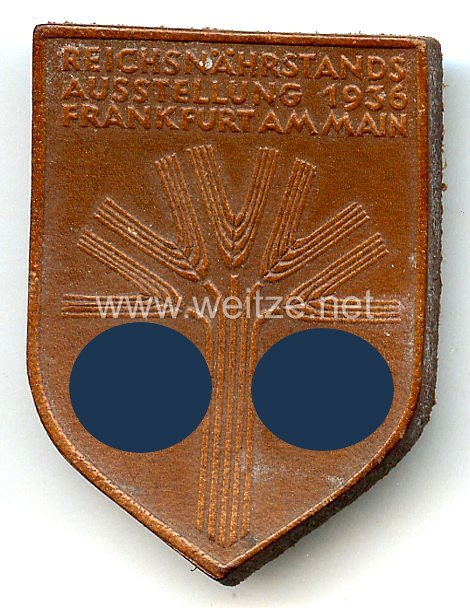
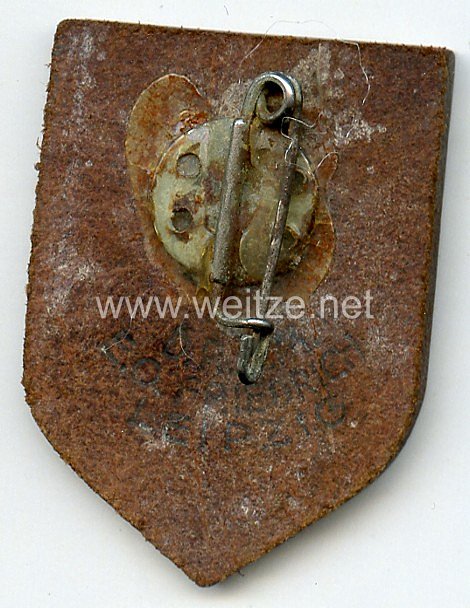
The Reichsnährstand badge from the 1936 exhibition in Frankfurt am Main represents a significant chapter in National Socialist agricultural policy and propaganda history. This leather badge, manufactured by E.O. Friedrich of Leipzig and marked with D.R.G.M. (Deutsches Reichsgebrauchsmuster - German Reich Registered Design), documents the comprehensive efforts of the Nazi regime to control and ideologically penetrate German agriculture.
The Reichsnährstand (Reich Food Estate) was established on September 13, 1933, through the Reichsnährstand Act under the leadership of Richard Walther Darré, who served as Reich Peasant Leader and Reich Minister of Food and Agriculture. This organization was not a voluntary association but a compulsory corporate body to which all those working in agriculture and the food industry had to belong. The Reichsnährstand encompassed an estimated 17 million people and controlled every aspect of agricultural production and marketing in the German Reich.
The Reichsnährstand Exhibition 1936 in Frankfurt am Main was part of a series of major events through which the Nazi regime showcased its agricultural policy achievements and ideologies. Frankfurt was deliberately chosen as the venue because the city represented an important economic center and possessed the necessary infrastructure for such large-scale events. The year 1936 was of particular significance for the Nazi regime: the Olympic Games in Berlin were to present Germany to the world, while simultaneously the regime intensified its efforts toward autarky and economic independence.
The exhibition demonstrated the Blood and Soil ideology that was central to Darré's agricultural policy. This ideology glorified the peasantry as the supposed original source of the German people and combined racist concepts with agricultural production. The exhibition presented modern agricultural techniques, harvest yield increases, and the organization of the Reichsnährstand as a success story of National Socialist policy.
The leather badge described here served as an exhibition badge for participants, exhibitors, or visitors to the event. Such badges were widespread in the Third Reich and fulfilled several functions: they served as access credentials, as collectibles, and above all as propaganda instruments. The material leather was more unusual for such badges than metal, but suggests a certain value and possibly a connection to the theme of agriculture and craftsmanship.
The manufacturer E.O. Friedrich of Leipzig was one of many producers who manufactured badges, medals, and decorations in the Third Reich. The marking D.R.G.M. (Deutsches Reichsgebrauchsmuster) was a legal protection for utility models used from 1891 to 1945. This marking shows that the design was legally protected and that the manufacturer valued documentation of his authorship.
The activities of the Reichsnährstand extended far beyond mere exhibitions. The organization controlled prices, production quantities, and marketing channels. The Reich Hereditary Farm Law of 1933 regulated the inheritance of agricultural enterprises and was intended to create a racially “pure” peasantry. Farmers had to prove their “Aryan” descent to be recognized as Reich hereditary farm owners.
In the context of the Four-Year Plan, proclaimed in 1936 under the leadership of Hermann Göring, the work of the Reichsnährstand gained additional significance. Germany's agricultural self-sufficiency was to be maximized to prepare the country for a coming war. The 1936 exhibition thus also served to demonstrate progress toward this autarky.
After World War II, the Reichsnährstand and all its sub-organizations were dissolved by the Allies. The organization was considered an integral part of the Nazi system. Objects such as the described badge became historical witnesses to an era in which even agriculture was completely placed in the service of a totalitarian ideology.
Today, such badges are important sources for historical research. They document the penetration of all areas of life by National Socialist propaganda and the regime's attempts to construct and consolidate a people's community through mass events and symbolic objects.