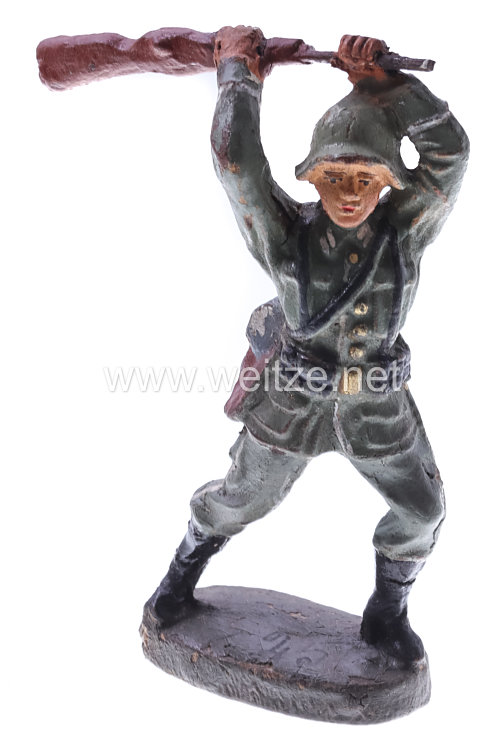
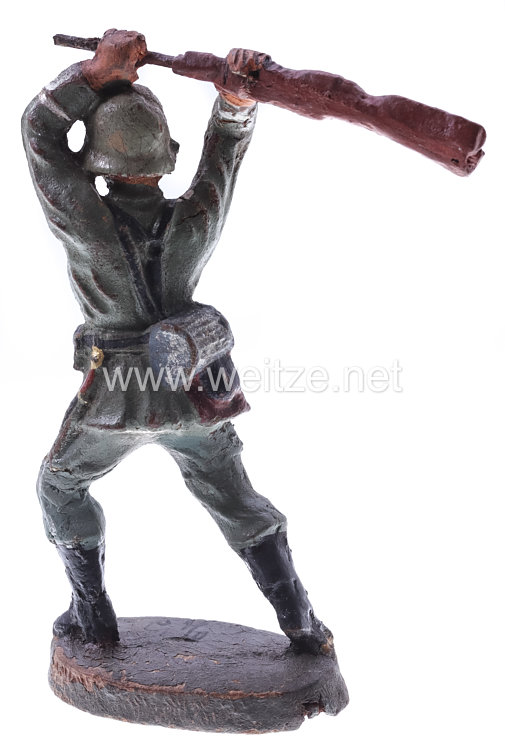
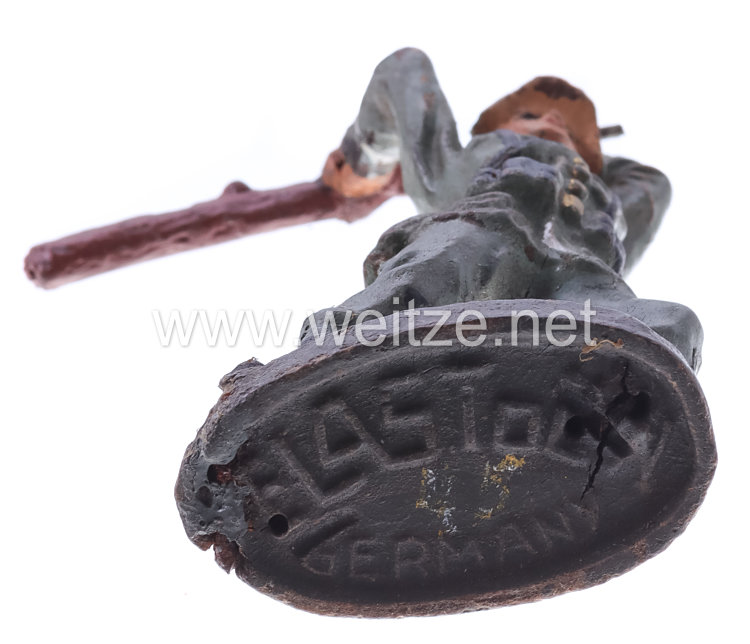
Elastolin - Army Soldier Striking with Rifle “Butt Striker”

7.5 cm, condition 2-.
385574
20,00

Elastolin - Army Soldier Striking with Rifle “Butt Striker”

The Elastolin figure of an army soldier with a striking rifle, also known as a “Kolbenschläger” (buttstock striker), represents a fascinating aspect of German toy and military history of the 20th century. This 7.5 cm figure belongs to the characteristic products of the company O. & M. Hausser from Ludwigsburg, which manufactured military toy figures from the 1920s through the post-war period.

The Hausser company developed the material Elastolin in the 1920s as an alternative to traditional lead or tin. This innovative composite consisted of casein, glue, chalk, and other components applied to a wire armature. The material proved to be durable, relatively break-resistant, and more cost-effective to produce than metal figures. Elastolin figures became very popular in Germany and internationally, establishing Hausser as one of the leading manufacturers of toy soldiers.

The depicted combat action of the buttstock strike was a real close-combat technique taught in military training. During World War I, especially in trench warfare, close combat developed into an important form of fighting. The Gewehr 98 and later the Karabiner 98k were not only firearms but were also used as close-combat weapons. Military training included special techniques of bayonet fighting and the use of the rifle butt as a striking weapon.

German army service regulations detailed close combat extensively. The H.Dv. 130/2a (Army Service Regulation) covered close-combat training and described various techniques, including the buttstock strike. This combat technique was particularly relevant in situations where there was no time to reload or when the enemy was already too close for effective use of the firearm.

Elastolin figures of the Wehrmacht and army were produced in large quantities between 1933 and 1945. They served not only as toys but also fulfilled a propagandistic function in the militarization of youth. The figures were manufactured in various poses: marching, shooting, attacking, wounded, and indeed in close combat like this buttstock striker.

The painting of the figures was done by hand and typically showed the field-gray uniform of the Wehrmacht with characteristic details such as the M35 or M42 steel helmet, puttees or boots, ammunition pouches, and other equipment items. The quality of painting varied depending on the production period, with earlier figures often being painted in more detail than later wartime productions.

After World War II, Hausser's production was initially controlled under French military administration. From the 1950s onward, the company resumed production but increasingly also manufactured civilian figures and later modern Bundeswehr soldiers. Wehrmacht figures from the pre-war and war periods became sought-after collector's items.

The condition 2- of this figure indicates a very good state of preservation with only minimal signs of wear. In the collector's field, condition is evaluated on a scale from 1 (mint) to 6 (heavily damaged). A condition of 2- means that the figure is almost completely preserved with intact paint and possibly only slight signs of aging.

Today, Elastolin figures are important testimonies of German toy and cultural history. They document not only the craftsmanship quality of German toy manufacturing but also the social and political conditions of their time of origin. For collectors of military-historical miniatures and experts in toy history, they represent significant objects of study that provide insights into uniforms, armaments, and tactical representations.

The particular pose of the buttstock striker reflects the reality of combat in the first half of the 20th century, when close-quarters fighting remained a crucial element of infantry combat despite increasingly modern weaponry. These figures thus preserve a piece of military-historical knowledge in miniature form.