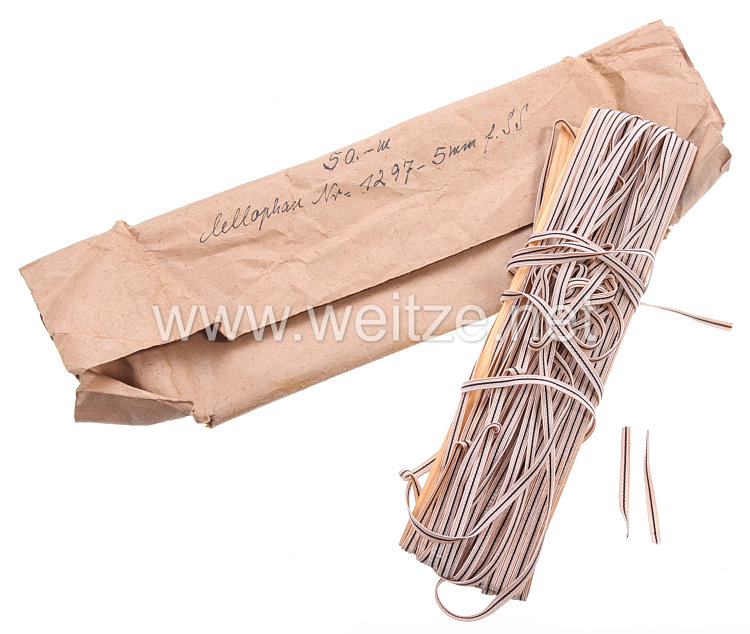
Waffen-SS/Allgemeine-SS Rank Braid for Collar Tabs of Enlisted Men and NCOs
We were able to acquire a small remaining stock from a tailor shop, still in the original packaging labeled “50 M Cellophan Nr. 1297 - 5 mm f. SS”.
This rank braid (also called Tresse or Litze) represents an authentic example of the standardized uniform equipment of the Waffen-SS and Allgemeine SS during World War II. This particular version made from cellophane was used for the collar patches of enlisted men and non-commissioned officers and originates from remaining stock of a contemporary tailor's workshop.
The uniform design of the SS was subject to strict regulations detailed in the SS Clothing Regulations (Bekleidungsvorschriften der SS). Rank braids served for immediate identification of rank and were an essential component of collar patch design. While higher ranks wore elaborate metal embroidery or silver braids, simpler versions were used for enlisted men and non-commissioned officers.
The use of cellophane as a material is characteristic of wartime production, particularly from 1942/1943 onwards, when traditional materials such as aluminum and high-quality metal threads became increasingly scarce. Cellophane, a regenerated cellulose material, offered a cost-effective and technically simple alternative to originally used materials. Industrial production of such braids was carried out in specialized textile companies and tailor shops that executed orders for the Wehrmacht and SS agencies.
The originally preserved packaging with the inscription “50 M Cellophan Nr. 1297 - 5 mm f. SS” documents the standardized production method and inventory management of these uniform components. The width of 5 mm corresponded to the precise regulations for rank braids of lower grades. Such detailed product designations enabled tailor shops to order and process the required materials with precision.
The collar patches (Kragenspiegel) of the SS had been a characteristic feature of SS uniforms since the early 1930s. They consisted of black fabric with various symbols and rank braids, designed differently on both collar patches. While one side bore the unit designation or runes, the other side showed rank insignia in the form of braids and later also stars or oak leaves.
The unworn condition of this braid and its origin from a tailor shop's remaining stock make it an important historical document. Many such production stocks were destroyed or lost after the war ended in 1945. Surviving materials from workshops and warehouses today offer valuable insights into production methods, material usage, and the logistics of uniform manufacturing during the war.
From a historical perspective, such objects document not only military organization but also the economic constraints and material shortages of Nazi Germany. The transition from high-quality materials to substitutes like cellophane reflects the increasing resource scarcity under which the German war economy suffered from the middle of the war onwards.
For collectors and historians, originally packaged, unworn pieces are of particular value as they document the original production and delivery condition and have not been altered through use. The preservation of such materials today serves exclusively for historical research and documentation of a dark period in German history.