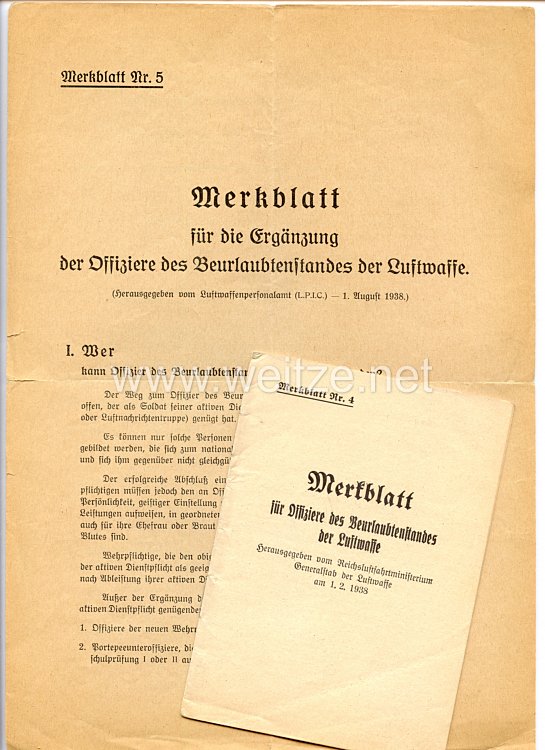
Memorandum No. 4 and 5 for Officers of the Furloughed Status of the Luftwaffe
The Merkblätter (Information Sheets) for Officers of the Furloughed Status of the Luftwaffe represent a fascinating testament to the organizational structure and mobilization planning of the German Air Force during World War II. These documents, of which numbers 4 and 5 are present here, belonged to a series of instructional materials specifically developed for officers who were in the so-called Beurlaubtenstand (furloughed status).
The term Beurlaubtenstand designated a special status of reserve officers within the military context of the German Reich. These officers were not on active duty but remained fundamentally liable for service and could be called up when needed or in case of mobilization. The system of furloughed status was an essential component of the military constitution and enabled the Wehrmacht, and particularly the Luftwaffe, to quickly access a large pool of trained leadership personnel in case of emergency.
The Luftwaffe, as the youngest branch of the Wehrmacht, was officially founded in 1935 after the German Reich publicly rejected the restrictions of the Treaty of Versailles. Under the leadership of Hermann Göring as Commander-in-Chief, the Luftwaffe rapidly developed into one of the most modern air forces of its time. This rapid expansion required a sophisticated system for managing and mobilizing personnel, especially officers.
The present information sheets served several important purposes: they informed furloughed officers about their duties and rights, about procedures in case of call-up, about current developments in military organization and tactics, as well as about administrative requirements. The format as a small booklet and DIN A double sheet was practically chosen to enable wide distribution and to provide officers with handy reference works.
During the course of the war, the furloughed status gained increasing importance. With the progression of the war and rising casualties, the Wehrmacht had to repeatedly draw upon reserves. The systematic registration and preparation of furloughed officers was therefore of strategic significance. The information sheets ensured that these officers remained current with military regulations and procedures even outside of active service.
The numbering of the information sheets (here numbers 4 and 5) suggests a systematic series covering various subject areas. Typical contents of such information sheets included details about pay and pension entitlements, reporting obligations, conduct in case of mobilization, uniform regulations for reserve officers, as well as changes in army organization and tactical principles.
The used condition of these documents underscores their actual use by an officer. These information sheets were not mere administrative files that disappeared unread into drawers, but practical working tools. Signs of use testify to their importance in the daily life of a furloughed officer who had to maintain his connection to the Luftwaffe.
In the broader context of military history, such information sheets document the bureaucratic penetration and organizational complexity of the Wehrmacht. The meticulous documentation and systematization of all aspects of military service was characteristic of the German military tradition. At the same time, they show how totalitarian regimes attempted to maintain control over their officers even outside of active service and keep them in constant readiness.
Today, such information sheets are important sources for military historians researching the personnel structure, mobilization planning, and administrative practice of the Luftwaffe. They complement official service regulations and offer insights into the practical implementation of military organization. For collectors of military-historical documents, they represent authentic testimonies of a specific era that help understand the functioning of the Wehrmacht as an institution.