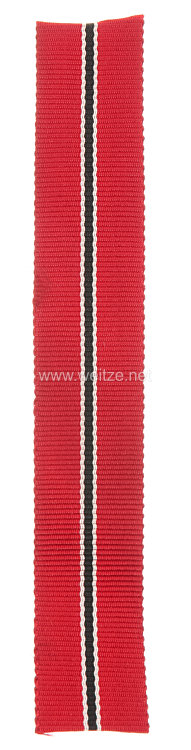
Eastern Front Medal - Ribbon for Miniature

Width 16 mm, length 100 mm, unworn.
Shipping as letter 1€ postage possible.
362173
5,00

Eastern Front Medal - Ribbon for Miniature

Medal Ribbon of the Eastern Front Winter Campaign – Historical Context

The object described is a miniature ribbon for the “Eastern Front Medal 1941/42” (Medaille Winterschlacht im Osten), one of the most significant German military decorations of World War II. This medal, colloquially known as the “Frozen Meat Order” (Gefrierfleischorden), was instituted on May 26, 1942, by Adolf Hitler.

The medal recognized the extraordinary hardships and suffering endured by German soldiers during the first catastrophic winter on the Eastern Front from November 1941 to April 1942. The German attack on the Soviet Union, Operation Barbarossa, began on June 22, 1941, with expectations of a swift victory. However, the Wehrmacht was unprepared for a winter campaign, and when temperatures dropped to minus 40 degrees Celsius, German troops were caught off guard by the severity of the Russian winter.

The medal ribbon displays characteristic colors: a white center stripe flanked by black and red stripes at the edges. The white color symbolizes snow and winter, while black and red represent German national colors and blood shed. This color scheme makes the decoration instantly recognizable and distinguishes it from other German orders and decorations of this era.

Award Criteria and Significance

The awarding of the medal followed strict criteria established in the decree of May 26, 1942. Eligible recipients included all members of the Wehrmacht and Waffen-SS, as well as civilians who served at the Eastern Front for at least 14 days between November 15, 1941, and April 15, 1942, or 60 days through April 26, 1942. Wounds, frostbite, or illness caused by extreme conditions could reduce the required service time.

Approximately 3 million examples of this medal were awarded during the war, making it one of the most frequently awarded German decorations. This underscores the extent of German losses and suffering during that first Eastern Front winter, which marked a turning point in the war.

Miniature Versions and Wearing Protocol

The described miniature with a width of 16 mm and length of 100 mm corresponds to official specifications for miniature ribbons. Such miniatures were worn with civilian clothing, formal dress, or during certain uniform occasions where the full medal was not appropriate. They were typically attached to the left lapel.

The ribbon could be worn with or without the actual medal. With full uniform, the complete medal was normally worn, while at less formal occasions or when space was limited due to multiple decorations, only the ribbon was displayed. Wearing protocols were precisely regulated in the Wehrmacht dress regulations.

Production and Materials

Medal ribbons were produced by various manufacturers, both state-owned and private enterprises. Quality varied depending on production period and manufacturer. Early war productions often showed higher quality with firmer weaves and more intense colors, while later productions sometimes exhibited inferior quality due to material shortages.

The present specimen is described as “unworn,” meaning it was never attached to a uniform. Such unworn pieces are rarer today, as most ribbons were actually used and show corresponding signs of wear.

Collector Value and Historical Significance

Today, these medal ribbons are sought-after military historical collectibles. They document a significant chapter of military history and commemorate the extreme conditions under which millions of soldiers had to fight. For collectors of military antiques, unworn and well-preserved examples are of particular interest.

The Winter Battle in the East marked a turning point in World War II. The myth of Wehrmacht invincibility was shattered, and strategic initiative began shifting in favor of the Soviet Union. The medal itself is thus not only a military decoration but also a historical testament to these dramatic events.

When handling such historical objects, scientific objectivity is essential. They serve historical documentation and research, helping us understand the past and learn from it.

r