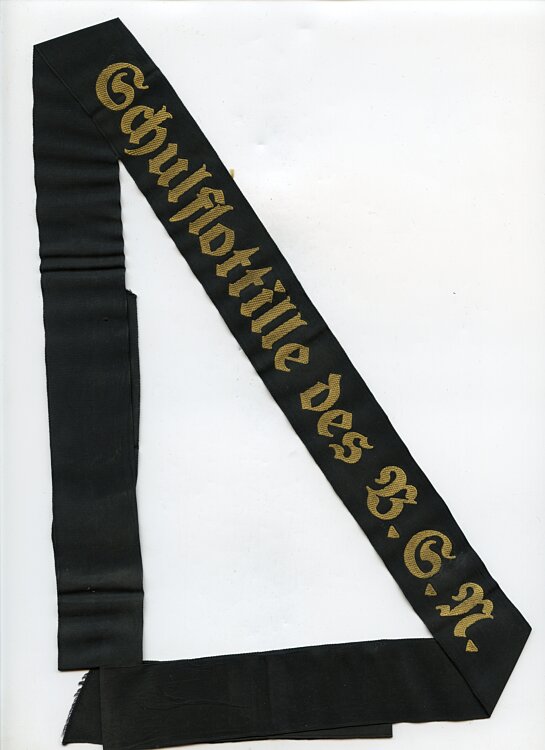
Kriegsmarine Cap Tally "Schulflottille des B.S.N."

lightly worn, 116 cm long. Condition 2+ (B.S.N. = Befehlshaber der Schulschiffe der Nordsee - Commander of Training Ships of the North Sea).
107773
100,00

Kriegsmarine Cap Tally "Schulflottille des B.S.N."

The Kriegsmarine cap tally bearing the inscription "Schulflottille des B.S.N." represents a fascinating artifact of German naval training during World War II. The abbreviation B.S.N. stands for Befehlshaber der Schulschiffe der Nordsee (Commander of Training Ships of the North Sea), an important command structure within the Kriegsmarine responsible for training naval recruits.

The Kriegsmarine, which existed from 1935 to 1945, was the navy of the German Reich during the National Socialist era. After the Treaty of Versailles in 1919, Germany was permitted only a severely limited navy, but with the seizure of power in 1933 and the gradual lifting of Versailles restrictions, the rebuilding of German naval forces began. The official renaming of the Reichsmarine to Kriegsmarine occurred on June 1, 1935.

The cap tally was an essential component of the naval uniform and served to identify a sailor's affiliation with a particular ship, unit, or facility. According to the Kriegsmarine dress regulations, the cap tally was worn on the Bordmütze (service cap), which was part of the daily service uniform. The tallies were typically made of black cloth with gold-yellow woven or embroidered lettering.

The training flotillas played a central role in the education of young sailors and officer candidates. The Commander of Training Ships of the North Sea was responsible for organizing and conducting practical sea training. His duties included coordinating several training ships on which theoretical instruction was supplemented by practical experience at sea. These training voyages were essential for preparing crews for service in the operational fleet.

The Kriegsmarine's training structure was complex and encompassed various stages. After basic training on land, recruits underwent voyages of several months on training ships, where they learned navigation, seamanship, weapons handling, and ship operations. The training ships were often older cruisers, sailing vessels, or units specially converted for training purposes. Well-known Kriegsmarine training ships included the sail training ships Gorch Fock and Horst Wessel, as well as various smaller units.

The location in the North Sea was of great strategic importance. The North Sea formed an important operational area for the Kriegsmarine and was simultaneously a suitable sea area for training voyages. The changing weather conditions and navigational challenges of the North Sea provided ideal conditions for training future crew members.

The length of 116 cm corresponds to the usual dimensions of Kriegsmarine cap tallies, which needed to be long enough to be wrapped around the cap and tied with a bow at the back of the head. The two loose ends would then hang down at the nape of the neck, which was part of the characteristic appearance of the German sailor.

The present specimen shows light signs of wear, indicating that it was actually worn. Such authentic pieces are today significant military-historical collectibles, as they establish direct connections to the men who served in the Kriegsmarine. Each cap tally tells the story of a training period that for many young men marked the beginning of an often brief and dangerous naval career.

After the war ended in 1945, the Kriegsmarine was dissolved, and its ships were confiscated by the Allies, sunk, or scrapped. Cap tallies often remained as the only personal mementos and are today important documents for researching German naval history. They enable historians and collectors to trace the organizational structure, various units, and training pathways within the Kriegsmarine.

For collectors and historians, such cap tallies from training units are particularly interesting, as they are rarer than tallies from operational ships. They document an important but often overlooked aspect of the Kriegsmarine: the comprehensive training infrastructure necessary to supply the rapidly growing fleet with qualified personnel.