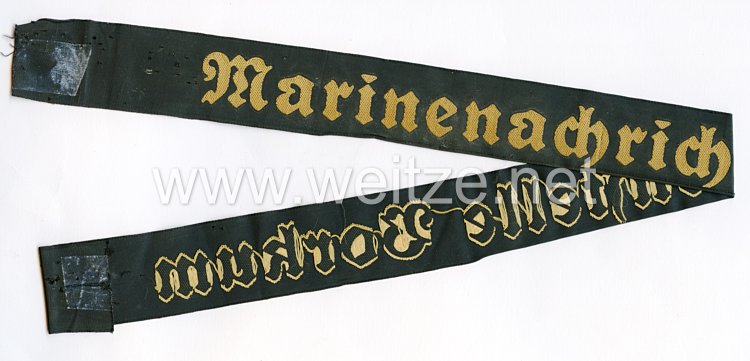
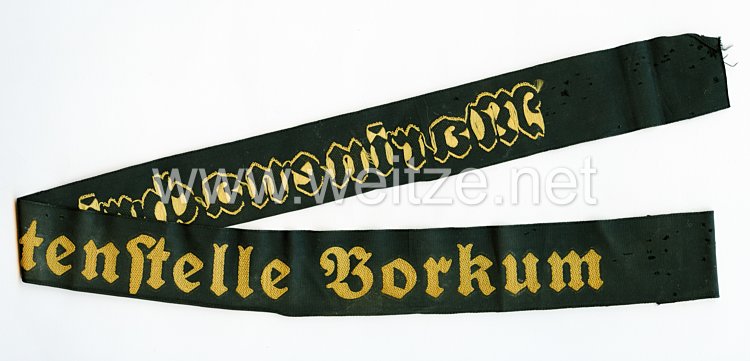
Kriegsmarine Cap Tally "Marinenachrichtenstelle Borkum"
The Kriegsmarine cap tally bearing the inscription “Marinenachrichtenstelle Borkum” represents a significant piece of equipment from the German Navy during World War II. These cap tallies, attached to sailors' caps, served not only to identify unit affiliation but also as an important means of identification within the Navy.
The Marinenachrichtenstelle Borkum (Naval Communications Station Borkum) was one of several radio intelligence and communications stations that the Kriegsmarine established along the German coast. The island of Borkum, the westernmost of the East Frisian Islands, held special military significance due to its strategic location in the German Bight. Already utilized militarily during World War I, during World War II the island became an important component of coastal defense and naval communications.
The Naval Communications Stations (Marinenachrichtenstellen) were specialized facilities responsible for radio reconnaissance, message transmission, and processing. They played a crucial role in naval warfare, intercepting enemy radio messages, assisting in decoding, and transmitting encrypted messages. The station on Borkum was part of a comprehensive network of such facilities that monitored the entire German coast and secured communications between various naval offices.
The present cap tally is made in cotton construction, which was typical for wartime production. Unlike early cap tallies, which were often made from higher-quality materials, the Kriegsmarine had to increasingly resort to simpler and more cost-effective materials from approximately 1941/42 onward. The cotton version was more robust and practical for daily service than the more expensive variants with silk threads.
The inscriptions on cap tallies followed strict regulations of the Naval Service Regulations (Marinedienstvorschrift - MDv). Standardly, the letters were embroidered or printed in gold color on a black background. For communications stations and other shore establishments, the complete name of the service location was given on the band, as opposed to ship crews who wore the ship's name.
The tally is described as “heavily shortened” with a length of only 55 centimeters. Regular cap tallies originally had a standard length of approximately 120-140 centimeters to be wrapped completely around the cap band and end with ribbons at the back. The shortening indicates that the band may have been subsequently adjusted or cut for a smaller cap. Such modifications were quite common in practice when equipment was passed on or reused.
The island of Borkum itself was heavily fortified during the war. The Wehrmacht erected numerous bunker installations, anti-aircraft positions, and radar stations as part of the Atlantic Wall. The Naval Communications Station was integrated into this defense system and worked closely with other military facilities, including the Luftwaffe and coastal artillery.
The personnel of these communications stations consisted of specialized radio operators, cipher clerks, and communications officers who had undergone intensive training. The work was demanding and required technical understanding as well as absolute secrecy. Many of the naval personnel stationed on Borkum came from various parts of Germany and wore their cap tallies with pride as a sign of their affiliation with this important facility.
After World War II, the military installations on Borkum were dismantled or destroyed by Allied forces. The island was demilitarized and gradually developed into a tourist destination. Today, only scattered bunker ruins and military relics remain as reminders of the island's military past.
Cap tallies such as this are today sought-after military historical collectibles that represent important testimonies to German naval history. They document the organizational structure of the Kriegsmarine and the multitude of different service locations and ships. Cap tallies from smaller or less well-known units such as communications stations are rarer than those from major warships and therefore of particular historical interest.