Deutschnationale Kranken- und Begräbniskasse Hamburg - Membership Book
The Deutschnationaler Handlungsgehilfen-Verband (DHV) was a völkisch-antisemitic employees' union that existed from 1893 to 1933.
This membership book of the German National Sickness and Burial Fund Hamburg from 1904 is a remarkable testament to German social history at the beginning of the 20th century. It documents not only the development of the social insurance system but also the political-ideological orientation of certain trade union associations during the Imperial period and the Weimar Republic.
The German National Sickness and Burial Fund was a social institution of the Deutschnationaler Handlungsgehilfen-Verband (DHV), or German National Union of Commercial Employees, founded in Hamburg in 1893. The DHV developed into the largest white-collar union in the German Empire, reaching over 400,000 members in the 1920s. Unlike the socialist-oriented workers' unions, the DHV understood itself as a professional organization for commercial employees and explicitly represented a völkisch-nationalist and antisemitic ideology.
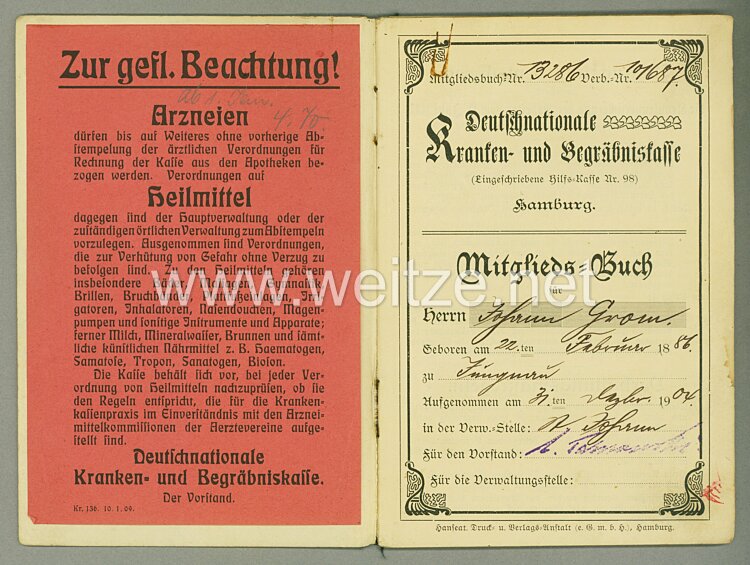
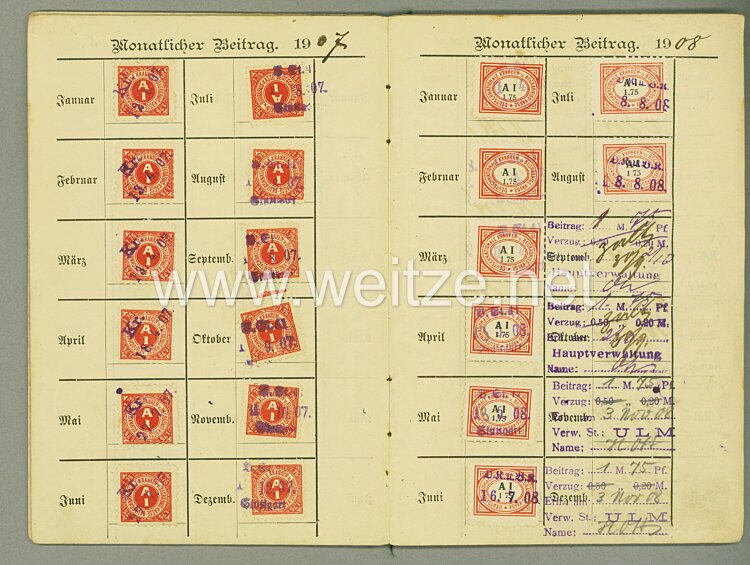
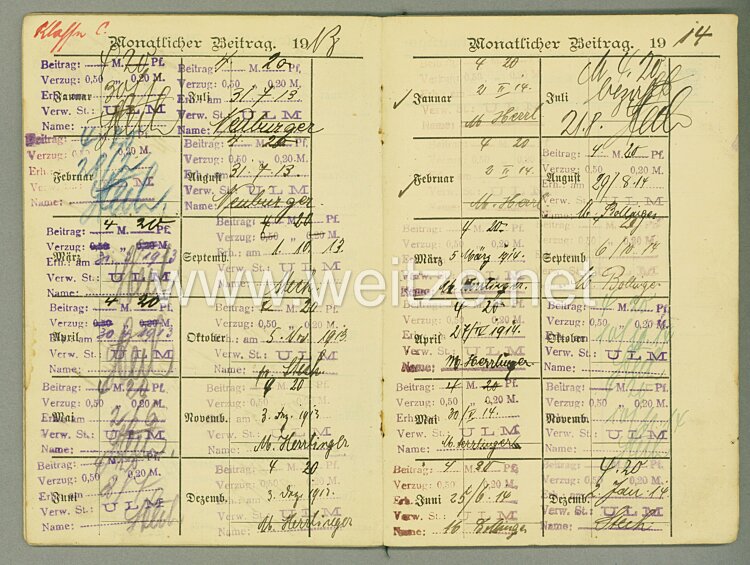
The membership book was issued on December 31, 1904, for a man born in 1886, who was therefore 18 years old at the time of joining. This was a typical age for young commercial employees to enter the association, often joining directly after completing their training. The numerous contribution stamps in the book document continuous membership and regular payment of dues over many years. These stamps were affixed similarly to postage stamps and served as proof of payment and thus entitlement to benefits.
The sickness and burial funds fulfilled an important social function at a time when state social insurance did not yet cover all contingencies. Although Bismarck had already established important foundations in the 1880s with his social legislation (health insurance 1883, accident insurance 1884), many employees still depended on additional coverage. The burial fund guaranteed a dignified burial in case of death and provided financial relief to survivors – an important aspect in a society where pauper's burials were considered a great disgrace.
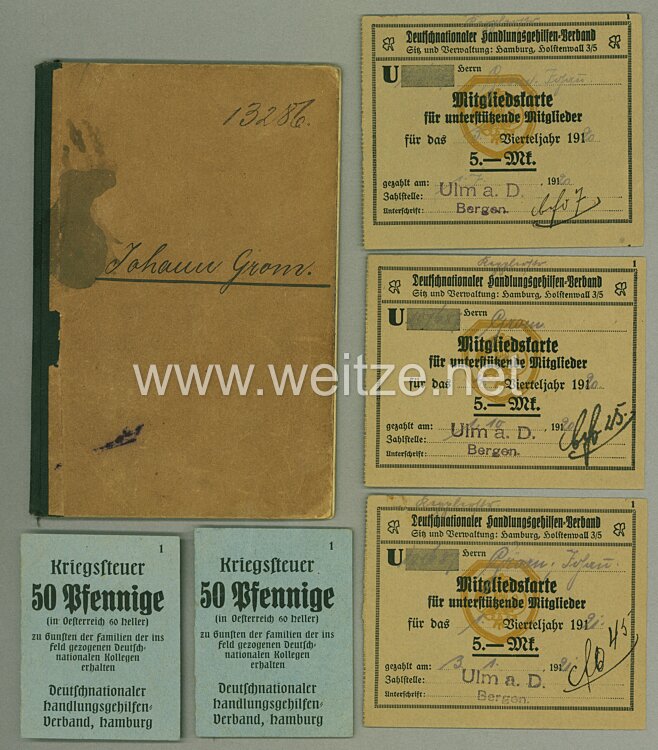
The enclosed membership cards for 1920-1921 document the continuity of membership beyond World War I. This period was one of great expansion for the DHV, as the number of employees in Germany increased significantly and many war veterans entered commercial professions. The two receipts for the war tax of 50 Pfennigs are interesting contemporary historical documents. These levies were imposed to finance the costs of war consequences and affected trade unions and their members as well.
The political character of the DHV fundamentally distinguished it from other trade unions. While the social democratic and Christian unions focused on class struggle or Christian social teaching, the DHV propagated the “Volksgemeinschaft” (people's community) and sharply demarcated itself against “Marxism” and “Judaism.” The statutes explicitly excluded Jewish members. This ideology made the DHV an important precursor to National Socialist thought among white-collar workers after 1918.
Leading DHV functionaries such as Wilhelm Schack and Hans Bechly disseminated antisemitic propaganda and demanded the exclusion of Jews from commerce. The association published its own periodicals, including the “Deutsche Handels-Warte” (German Commercial Watch), which regularly published antisemitic articles. This ideological orientation meant that the DHV could be seamlessly integrated into the Deutsche Arbeitsfront (DAF), the German Labor Front, in 1933.
Nevertheless, the practical benefits of the sickness and burial fund were the main reason many members joined. The fund paid sickness benefits, covered medical costs, and ensured burial expenses in case of death. For employees who often had only limited financial reserves, these benefits were existentially important. The membership book served as legitimation to doctors and pharmacies and had to be presented whenever benefits were claimed.
From today's perspective, such documents are important sources for social and mentality history. They show how social security and political ideology were intertwined in the first half of the 20th century. The membership book documents the life of an ordinary employee over at least a decade and a half and provides insights into the everyday history of a social group that stood between the working class and the bourgeoisie, whose political orientation was of considerable significance for the rise of National Socialism.