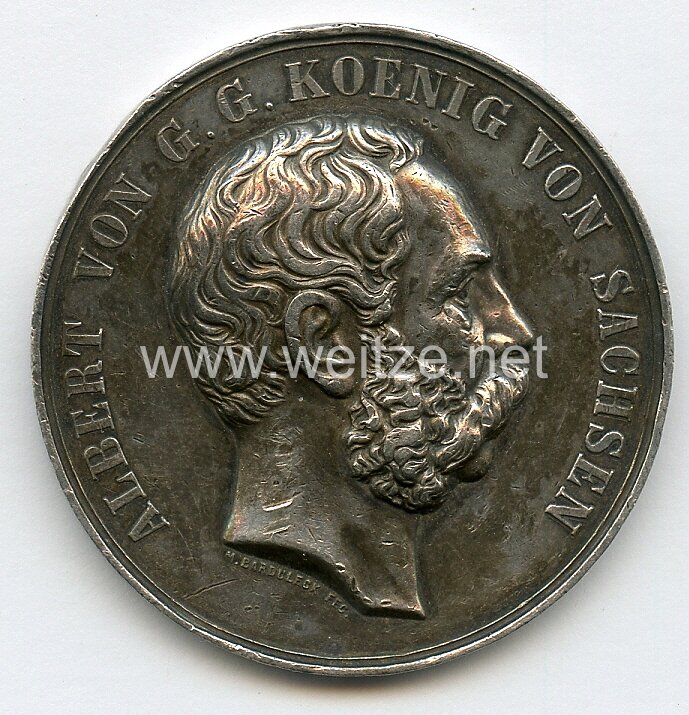
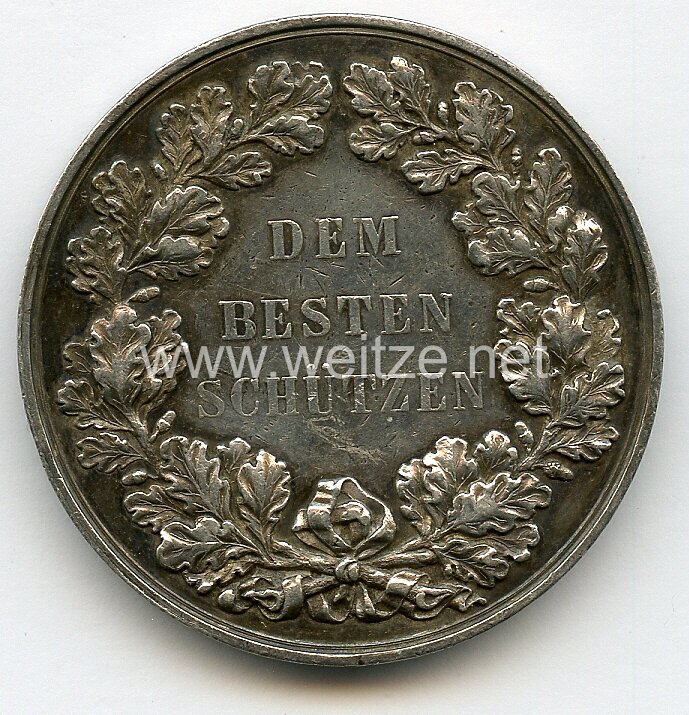
Saxony Kingdom Non-Portable Medal "To the Best Marksman"
The Saxon shooting medal “To the Best Marksman” from the reign of King Albert of Saxony (1873-1902) represents a significant tradition of military awards in the Kingdom of Saxony. This non-wearable medal in silver with a diameter of approximately 42 millimeters was crafted by the renowned die engraver M. Barduleck and embodies the high esteem for military marksmanship in the German Empire.
Historical Context of the Kingdom of Saxony
The Kingdom of Saxony formed one of the most important German states from 1806 to 1918. After the foundation of the German Empire in 1871, Saxony retained its independent military administration and decoration system, as did other German kingdoms and principalities. King Albert, who ruled from 1873 to 1902, was known as a military reformer and placed great emphasis on the training and effectiveness of the Saxon army. His reign was characterized by the modernization of military affairs and the promotion of military virtues.
Importance of Marksmanship Training
In the late 19th century, marksmanship training gained increasing importance in all European armies. The introduction of breech-loading rifles and later repeating rifles such as the Gewehr 88 revolutionized infantry tactics. Precise shooting became the decisive military skill. The Saxon army organized regular shooting competitions at regimental, brigade, and divisional levels to promote and reward soldiers' accuracy.
Non-Wearable Medals
The designation “non-wearable” distinguishes this award from regular order decorations. While wearable medals were attached to uniforms, non-wearable medals were designed as commemorative pieces and display objects. They were typically presented in representative cases and kept in private settings. Their larger format allowed for more detailed artistic design and made them valued collector's items. Such medals documented outstanding achievements and served to honor as well as motivate other soldiers.
The Die Engraver M. Barduleck
M. Barduleck belonged to the skilled medalists and die engravers who worked for German princely courts in the 19th century. The craft of die engraving required the highest technical precision and artistic skill. Die engravers carved the striking dies in steel, which were then used to mint the medals. The die engraver's signature on a medal testifies to the appreciation of this craftsmanship and today enables the attribution and dating of historical awards.
Material Choice and Production
The execution in silver emphasizes the value of the award. In the hierarchical system of military honors in the German Empire, silver marked an elevated rank. The medal was manufactured using the striking process, whereby a silver blank was struck between two engraved steel dies under high pressure. This process produced sharp, detailed reliefs on both sides of the medal. The diameter of 42 millimeters corresponds to the standards of the time for non-wearable awards and provided sufficient surface area for meaningful representations and inscriptions.
Shooting Competitions in the Saxon Army
The Saxon military administration organized annual shooting competitions according to precise regulations. These included various disciplines such as single shots at different distances, rapid fire, and combat shooting. Evaluation was based on point systems that considered shot placement and grouping. The title of “best marksman” of a unit represented a significant honor and was often associated with material benefits such as special leave or promotion opportunities. The ceremonial presentation of medals usually took place during battalion or regimental formations.
Collector Value and Historical Significance
Today, such Saxon shooting medals are sought-after collector's items that provide insights into the military culture of the German Empire. They document not only military achievements but also the self-conception and values of that era. The stated condition grade 2 (according to numismatic classification) indicates very good preservation with minimal signs of wear, which underscores the value and historical significance of the object. Such awards enable historians to research the recognition culture and motivational strategies in historical military organizations.