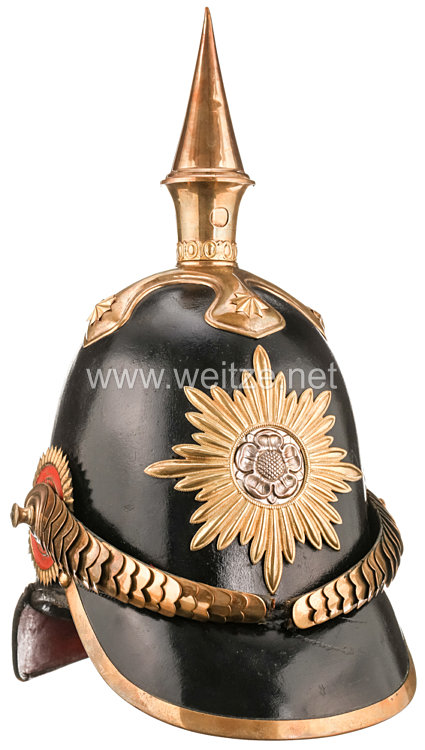
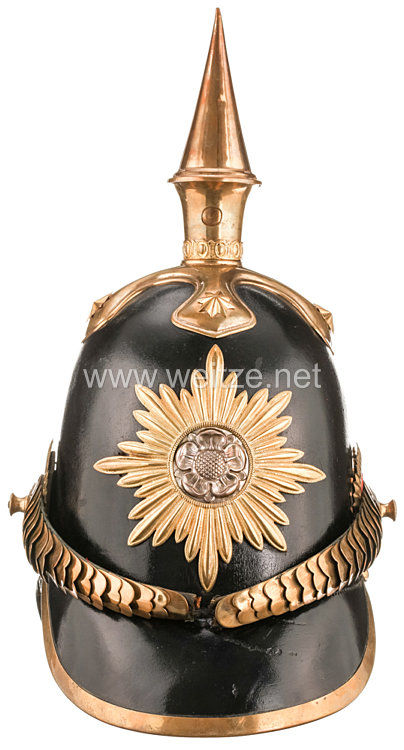
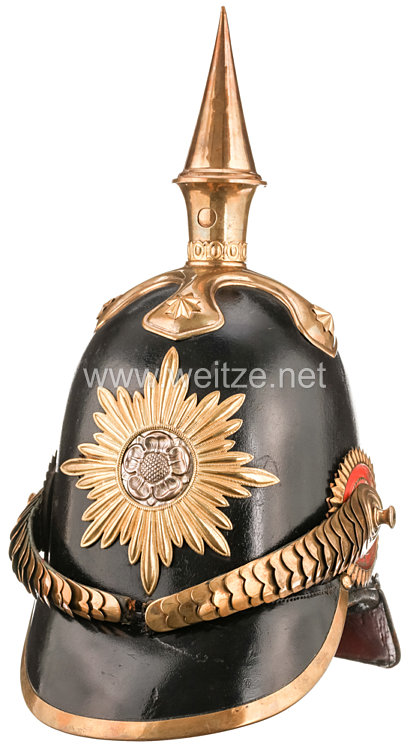
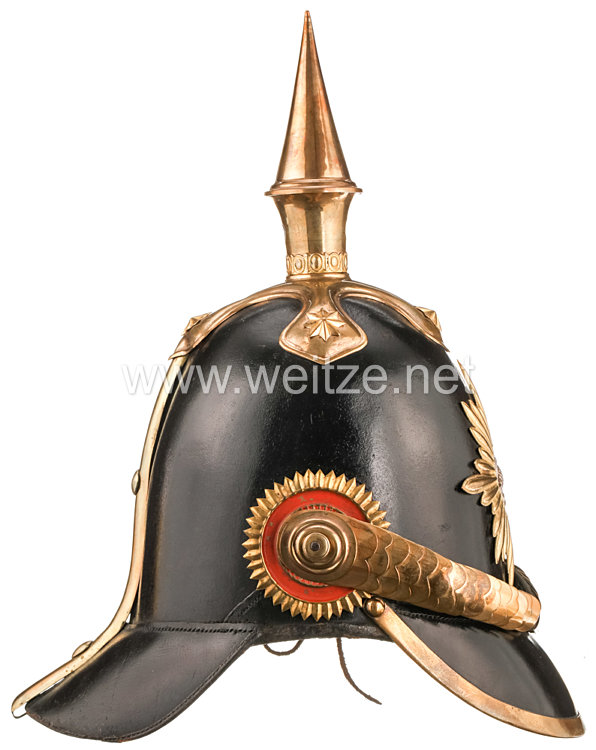
Lippe-Detmold Pickelhaube for Officers of the Infantry Battalion of the Principality from the Personal Property of Prince Friedrich

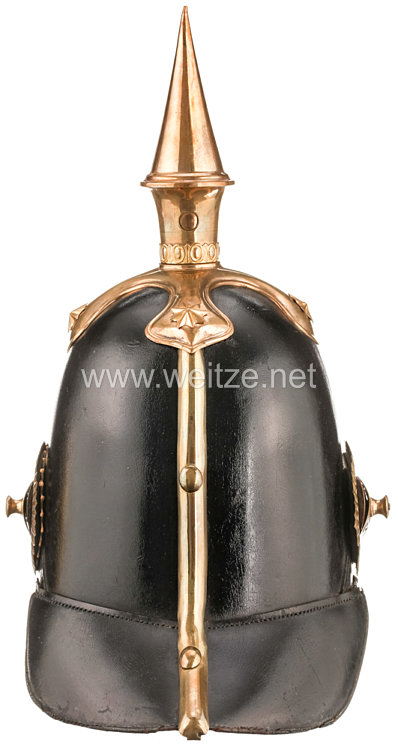
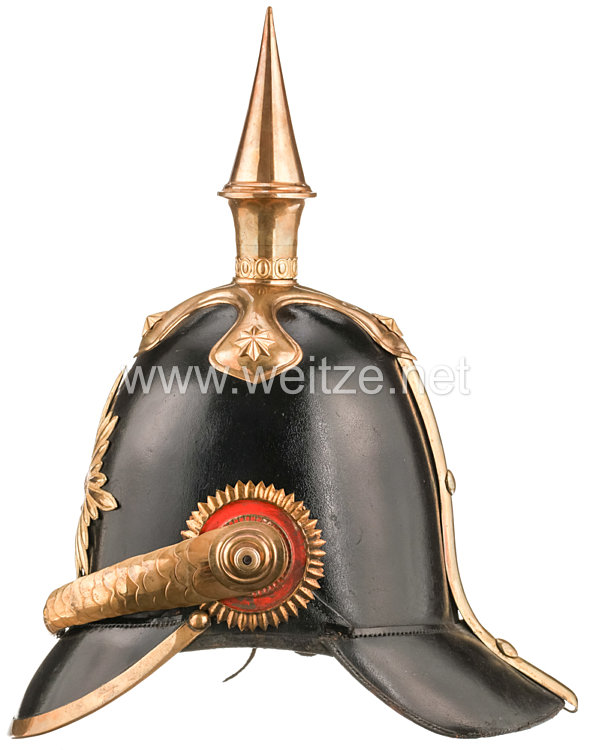
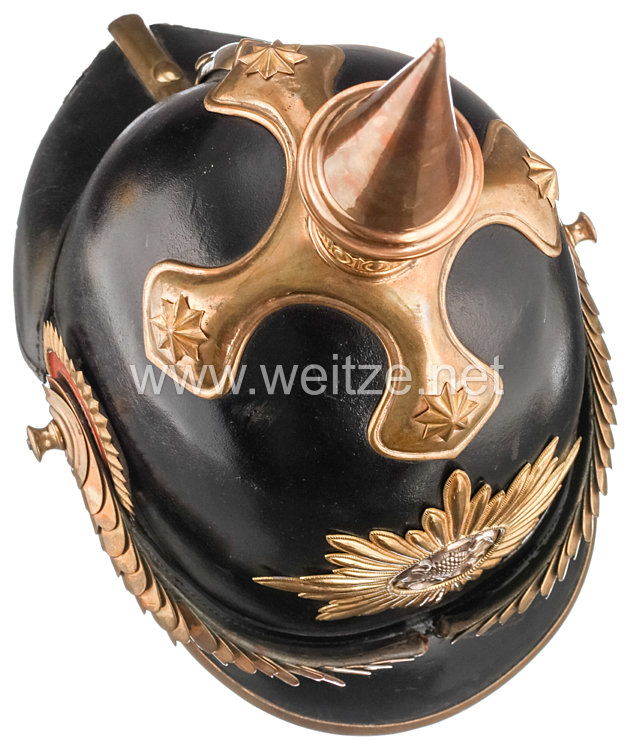
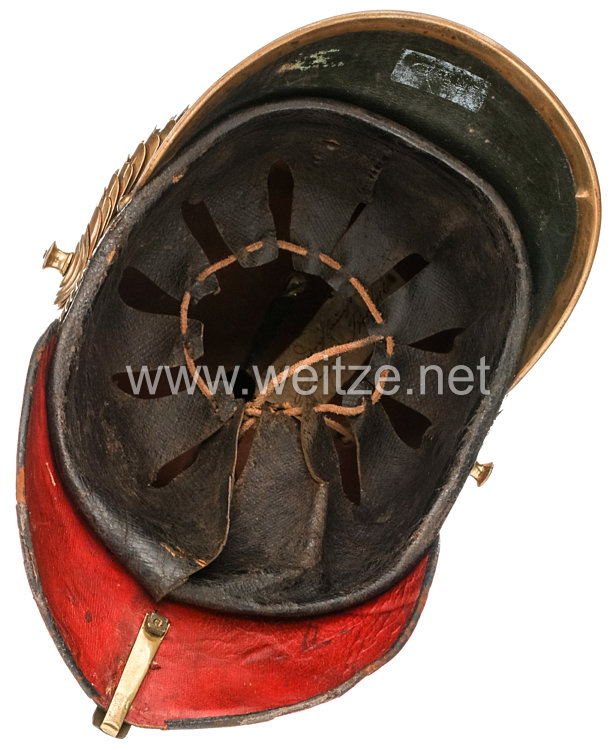
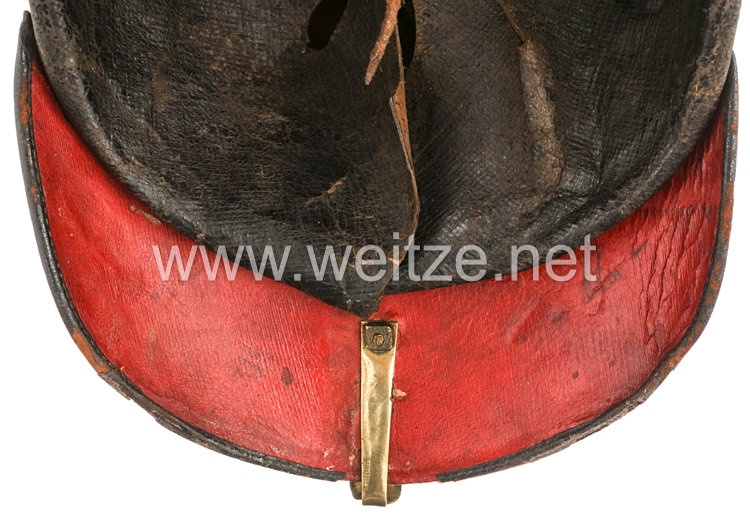
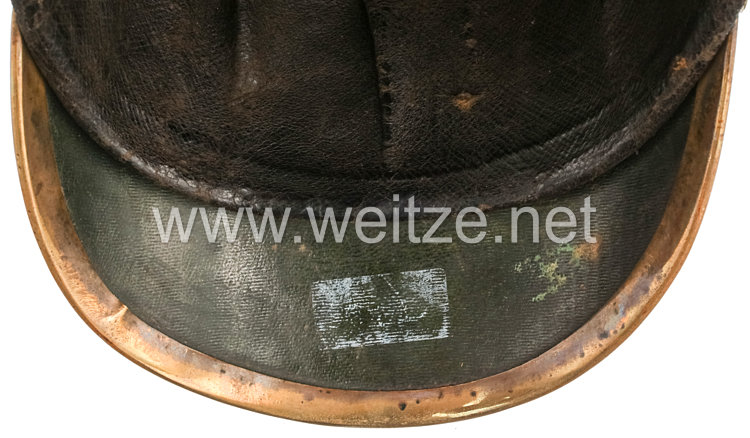
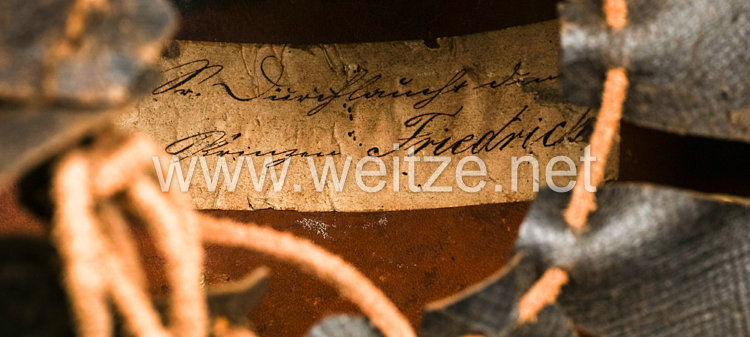
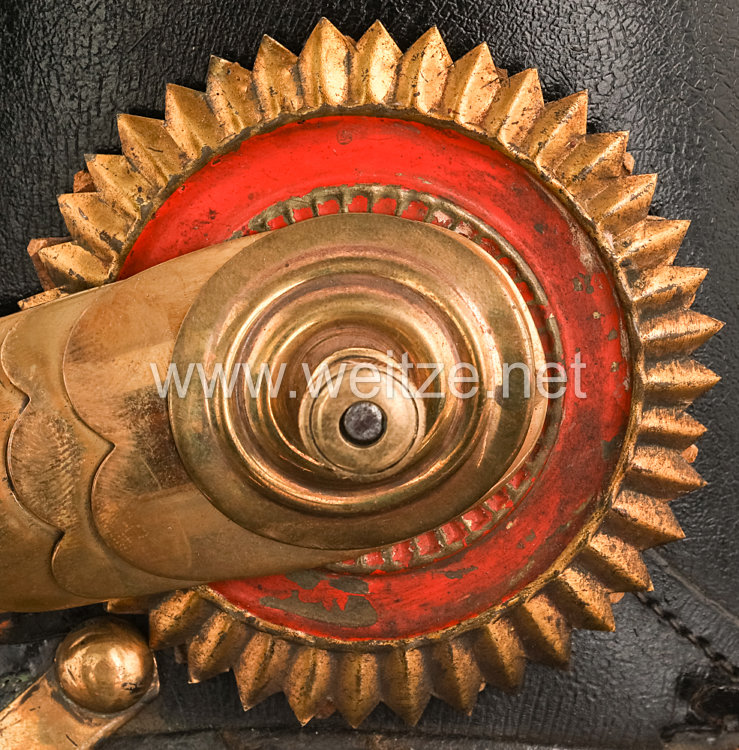
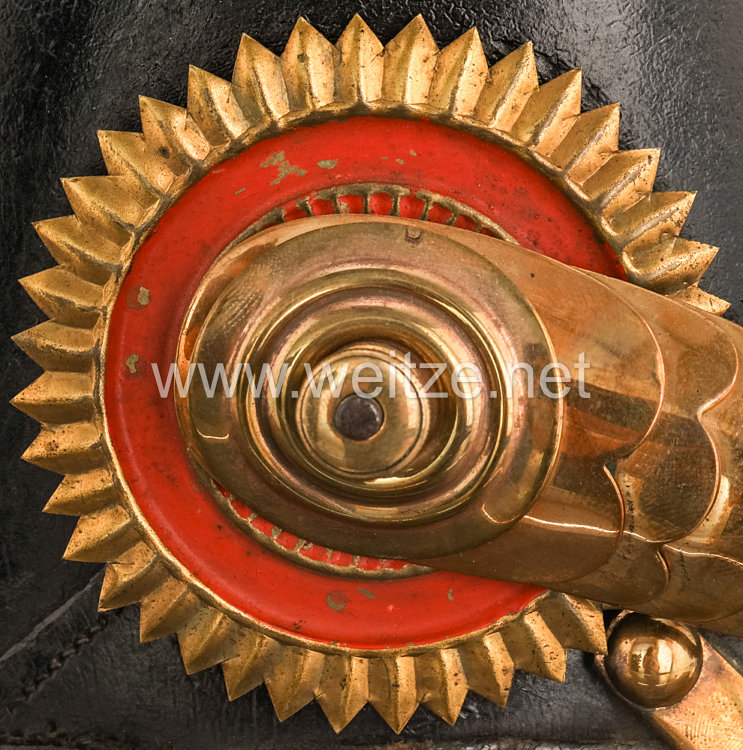
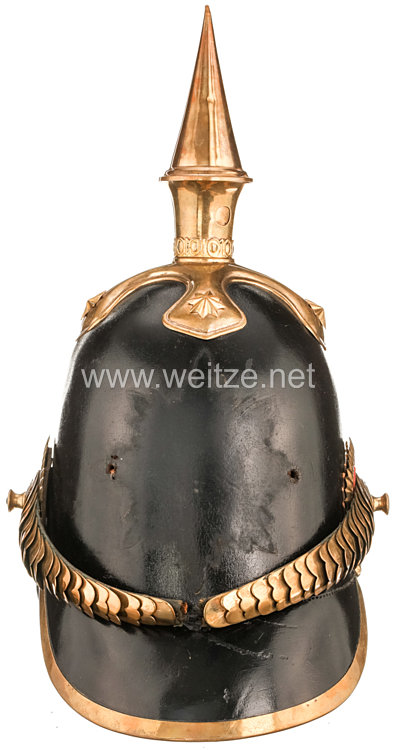
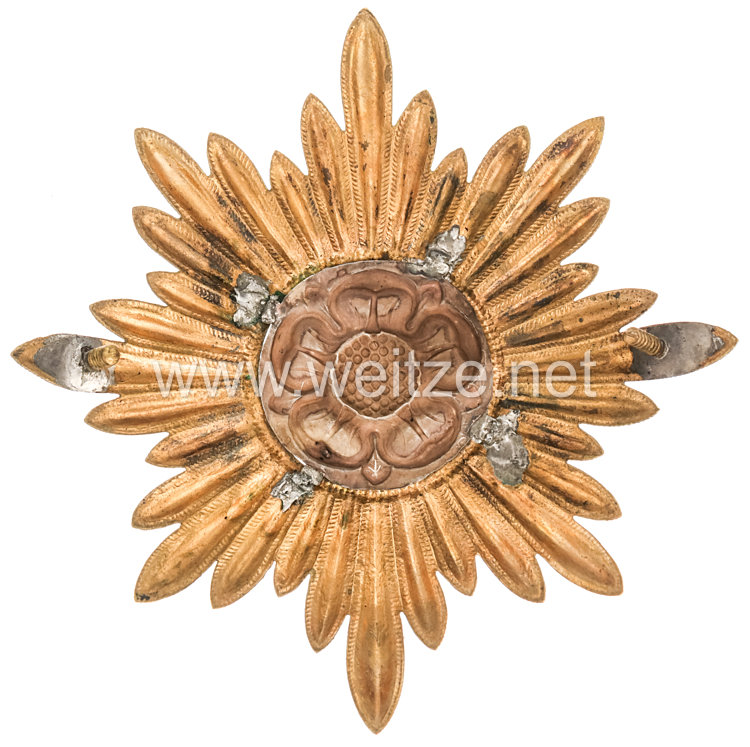
Circa 1845. Elegant tall leather helmet with rounded front visor, complete with all fittings in gilt finish. Front helmet plate featuring the gilt helmet star, with the silvered Lippe Rose mounted at center. The cross-shaped base with tall spike, non-removable. Domed scale chin chains on knurled screws, large Lippe officer's cockades on both sides. Interior with stitched leather lining, front visor lined in green, neck guard lined in red. Inside the bell, the original handwritten label “Seiner Durchlaucht dem Prinzen Friedrich” (His Serene Highness Prince Friedrich). Only lightly worn, the clasps of the scale chains are missing, otherwise very well preserved. Condition 2.

Very rare.

After the Wars of Liberation, the Principality raised an infantry battalion for the Federal Army. Beginning in the 1840s, the Pickelhaube was introduced in the regiment but was replaced in 1861 by a shako in the style of the Prussian Jäger. Prince Friedrich, as a younger prince, stood second in the line of succession to the throne of the Principality of Lippe and pursued an officer's career in the K.u.K. Army. He died only one year after the death of his older brother and reigning Prince Leopold II in 1852 in Lemgo.


345272

The Pickelhaube of the Principality of Lippe-Detmold for Officers of the Infantry Battalion – From the Personal Possession of Prince Friedrich zur Lippe

Among the rarest artifacts of nineteenth-century German military history, this officer’s Pickelhaube from the Principality of Lippe-Detmold, dating to approximately 1845, stands as an extraordinary testament to the military traditions of one of Germany’s smallest sovereign states. Its significance is amplified immeasurably by its provenance: an original handwritten label inside the helmet bell reading “Seiner Durchlaucht dem Prinzen Friedrich” (“His Serene Highness Prince Friedrich”), confirming it as the personal property of a member of the ruling House of Lippe.

Historical Context: The Principality of Lippe and Its Military Contribution

The Principality of Lippe, with a population of approximately 150,000, was one of the smallest sovereign states within the German Confederation (Deutscher Bund). Following the Wars of Liberation (Befreiungskriege) against Napoleon, the principality contributed a single infantry battalion to the Bundesheer, the federal army of the German Confederation. This solitary battalion represented the entirety of Lippe’s military commitment — a reflection of both its sovereign ambitions and its limited resources.

The Pickelhaube, the iconic spiked leather helmet, was introduced by Prussia on October 23, 1842, by order of King Frederick William IV. The new headgear spread rapidly across the German states during the 1840s, and Lippe adopted it for its infantry battalion during this same decade, following the Prussian model. The Pickelhaube served as the standard headgear for Lippe’s officers and soldiers until 1861, when it was replaced by a Tschako (shako) patterned after the Prussian Jäger style.

Physical Description and Heraldic Elements

This helmet exemplifies the high-form design characteristic of the early Pickelhaube era. Its body is constructed of hardened leather with a round front visor and rear neck guard, fitted throughout with gilded metal fittings — the hallmark of an officer’s model, as enlisted personnel would have received markedly less ornate trim. The front bears a gilded helmet star (Helmstern), at the center of which is set the silvered Lippische Rose (Lippe Rose).

The Lippische Rose, a five-petaled red rose, served as the foundational heraldic device of the House of Lippe and appeared on all state insignia. Its placement as the central emblem identifies this helmet unmistakably within the Lippe military tradition. The helmet features a non-removable crosspiece (Kreuzblatt) with a high spike, curved chin scales (Schuppenketten) mounted on knurled screws, and large Lippe officer’s cockades on both sides. The interior is fitted with a laced leather lining, with the front visor lined in green and the rear neck guard in red.

The Owner: Prince Friedrich zur Lippe (1797–1854)

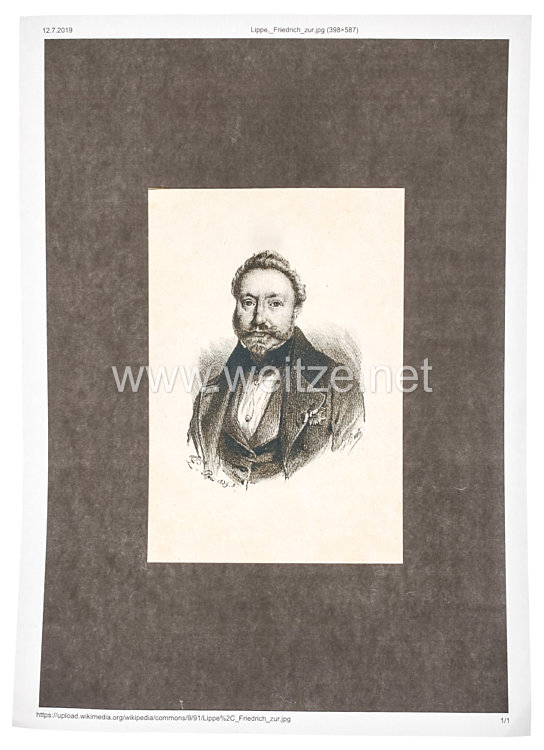
Prince Friedrich zur Lippe was born on December 8, 1797, in Detmold, the younger son of Prince Leopold I and Princess Pauline of Lippe. As a younger son, Friedrich stood second in the line of succession, a position that characteristically led members of minor German ruling families toward military careers in the service of larger states. Friedrich followed precisely this path: in 1816, he served with the Hanoverian Garde-Husaren, and he later pursued an officer’s career in the Austrian Imperial (K.u.K.) Army.

His elder brother, Leopold II, reigned as Prince of Lippe from 1820 until his death on January 1, 1851. Prince Friedrich himself died on October 20, 1854, in Lemgo. That a personal Pickelhaube from the Lippe infantry battalion was inscribed to Friedrich — despite his primary service being in foreign armies — speaks to the intimate connection between minor German dynasties and their small territorial forces. As a prince of the blood, Friedrich remained symbolically bound to his homeland’s military establishment.

The End of Lippe’s Military Independence

The trajectory from an independent Lippe infantry battalion to absorption into the Prussian military apparatus unfolded over the following decades. The replacement of the Pickelhaube with the Tschako in 1861 signaled Lippe’s continued alignment with Prussian military trends. The decisive moment came in 1867, when Lippe concluded a military convention with Prussia. Under this agreement, Lippe’s soldiers were integrated into the Prussian 6th Westphalian Infantry Regiment Nr. 55, with the regiment’s staff and 3rd Battalion stationed in Detmold. This effectively ended Lippe’s centuries-old tradition of maintaining an independent military force.

The Pickelhaube itself continued in Prussian and later German service for decades, eventually being replaced by the Stahlhelm (steel helmet) beginning in 1916 during the First World War. However, a Pickelhaube from a tiny German principality, dating from the earliest phase of the helmet’s adoption, occupies an entirely different historical category from the mass-produced Prussian examples of later decades.

Significance for the Collector

The extreme rarity of this helmet derives from the convergence of several factors: the very limited production for a single battalion of one of Germany’s smallest states, the relatively brief period of use spanning only about fifteen years, and the princely provenance confirmed by the original handwritten label. This Pickelhaube bridges the history of German military uniform, the dynastic history of the House of Lippe, and the political architecture of the German Confederation — a single object that illuminates an entire world of nineteenth-century German statehood and military tradition.

r