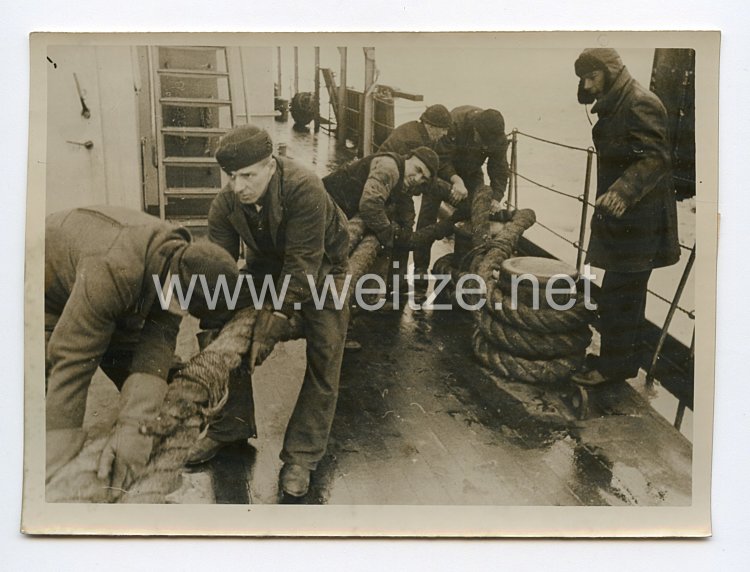
Kriegsmarine Press Photo: Heavy Duty Service of Icebreaker Crews 16.4.1944
Kriegsmarine Press Photo: The Icebreaker Crews' Heavy Duty in World War II
This Kriegsmarine press photograph dated April 16, 1944, documents the arduous service of icebreaker crews during World War II. Such images were part of the Third Reich's extensive propaganda machinery and were systematically distributed to German and neutral press organizations to document the achievements of German armed forces and raise public awareness of specialized military duties.
Icebreakers played a strategically significant role for the Kriegsmarine, particularly in the northern waters of the Baltic Sea, Norway, and Arctic routes. In April 1944, when this photograph was taken, Germany was already in a defensive phase of the war. However, control over sea routes in icy waters remained crucial for supplying troops stationed in Norway and Finland, as well as for transporting war-essential raw materials, especially nickel ore from the northern Finnish region of Petsamo.
Service aboard icebreakers was among the hardest duties within the Kriegsmarine. Crews were exposed to extreme weather conditions, with temperatures of minus 30 degrees Celsius and below being common. The heavy steel vessels had to fight through ice layers several meters thick, placing enormous mechanical stress on the engines and hull. Men worked in constant cold, with frostbite and other cold-related injuries being frequent occurrences.
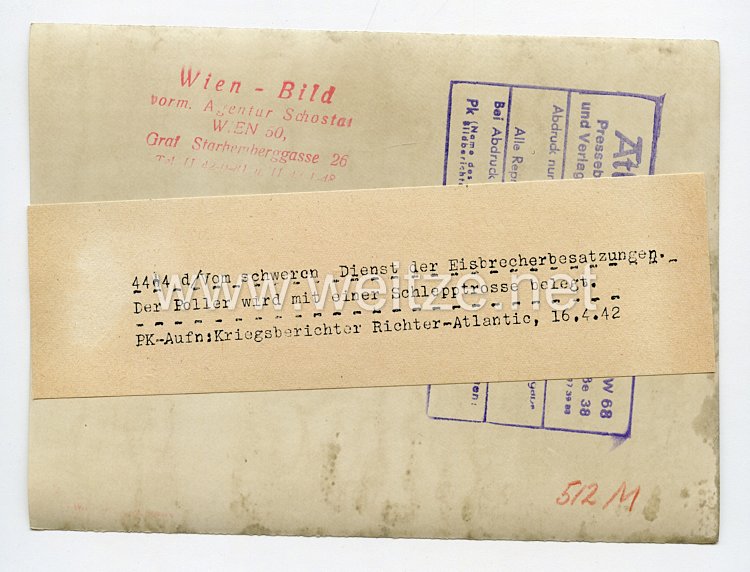
The Wehrmacht's Propaganda Companies (PK - Propagandakompanien) were responsible for creating such press photographs. These specially trained war correspondents accompanied troops to all operational areas and documented daily military life. Photographs were centrally distributed through the High Command of the Wehrmacht (OKW) and the Reich Ministry of Public Enlightenment and Propaganda under Joseph Goebbels. Each photo received a caption on the reverse with the date, description, and often usage instructions for the press.
By spring 1944, the situation for Germany had become critical. The Eastern Front had shifted significantly westward following the devastating defeat at Stalingrad and the failed Operation Citadel at Kursk. The Baltic Sea and Norwegian waters gained importance as the last relatively safe training areas for U-boat crews and as a retreat zone for the Kriegsmarine's surface units. Icebreakers secured harbor approaches and enabled year-round operation of important naval bases.
German icebreakers of this period were mostly civilian vessels requisitioned for military purposes, along with some specially built auxiliary ships. Well-known icebreakers in Kriegsmarine service included the “Stettin,” “Castor,” and “Pollux.” These vessels featured reinforced bow and hull construction and powerful engines that enabled them to break through pack ice and free stranded ships.
The propaganda portrayal of “heavy duty” served multiple purposes. On one hand, it was meant to inform the home front about the diverse and often unknown tasks of the Wehrmacht. On the other, such images were intended to foster perseverance and willingness to sacrifice by showing that German soldiers performed their duties under the harshest conditions. Emphasizing difficulties and hardships was simultaneously meant to highlight the troops' achievements.
Press photographs like this one are important historical sources today. They document not only military operations but also soldiers' daily lives, technical equipment, and how the regime presented its warfare to the public. The reverse caption often provides additional information about context, location, and intended use of the image.
After the war, many of these icebreakers went to the victorious powers as reparations, particularly to the Soviet Union, which itself had great need for such vessels in its northern and Siberian waters. Surviving press photographs are now housed in various archives and collections and serve as important documents for maritime historical research and the study of Nazi propaganda.