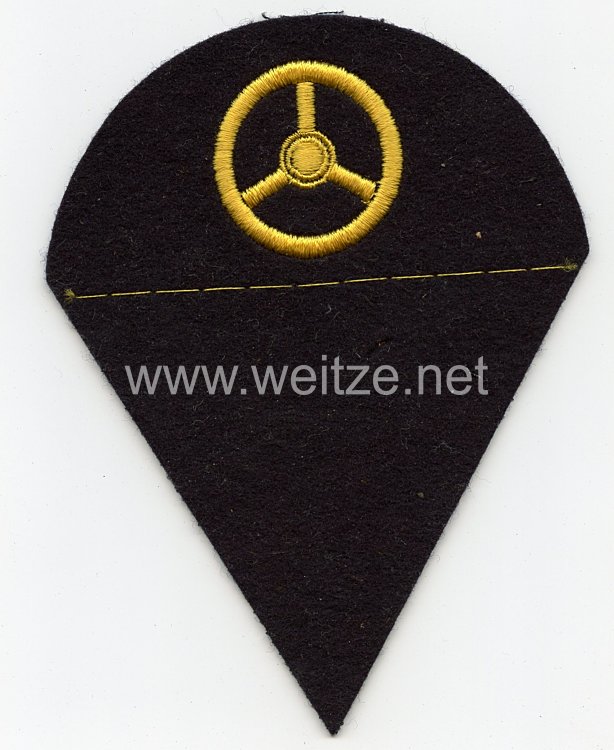
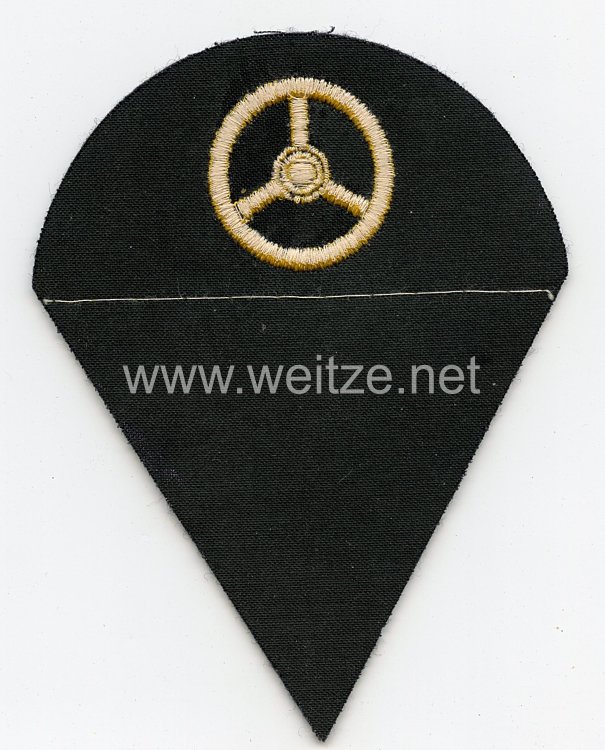
Kriegsmarine Enlisted Ranks Sleeve Insignia Motor Vehicle Driver Career Path

Version for blue collar uniform, condition 2-.
378072
15,00

Kriegsmarine Enlisted Ranks Sleeve Insignia Motor Vehicle Driver Career Path

The Kriegsmarine sleeve badge for enlisted men of the motor transport career path represents an interesting artifact of German naval uniforms from World War II. These specialized career insignia were introduced to visually identify the various technical and professional specializations within the Kriegsmarine and to make the hierarchy and qualifications of enlisted ranks visible.

The Kriegsmarine, as the official designation of the German Navy from 1935 to 1945, developed a complex system of uniforms and insignia that built upon the traditions of the Imperial Navy while simultaneously reflecting the modernization and technical specialization of armed forces in the 20th century. Following Germany's rearmament under the National Socialist regime and the official repudiation of the Treaty of Versailles in 1935, the Reichsmarine was renamed Kriegsmarine.

The motor transport career path (Kraftfahrerlaufbahn) was one of numerous specialized career tracks within the Kriegsmarine. With the increasing motorization of the armed forces and the necessity to operate and maintain complex land vehicles, transport equipment, and motorized gear, qualified personnel were essential. Motor transport personnel were responsible for operating trucks, passenger vehicles, motorcycles, and other land vehicles that were indispensable for the logistical support of the Navy ashore.

The sleeve badge was typically worn on the left forearm of the uniform and consisted of an embroidered or woven emblem on a dark, navy-blue base fabric. The version for the Kollani (abbreviation for Kollektor-Anzug, or colloquially for the dark blue work uniform) was particularly practically oriented. The Kollani was the everyday work uniform of enlisted men, worn during shipboard work, technical duties, and daily service.

The sleeve badges of the motor transport career path typically displayed a winged wheel as the main motif, sometimes with additional elements such as oak leaves or other maritime symbols. This symbolism connected mobility and speed (represented by the wings) with mechanical function (the wheel). The design followed the uniform regulations of the Kriegsmarine, which precisely specified which insignia were to be worn by which ranks and career paths.

The production of such badges was carried out by various textile manufacturers and specialized producers of military effects throughout the German Reich. Quality could vary depending on the manufacturer and the time of production. Early war years often showed higher-quality workmanship with fine embroidery, while later productions were sometimes simplified due to material shortages.

For enlisted men, these career badges were not only functional identifiers but also expressions of professional competence and vocational pride. Assignment to a specialized career path occurred after training and aptitude testing and often offered better promotion opportunities within the military hierarchy. Motor transport personnel completed special training courses in which they learned not only driving but also the maintenance and repair of vehicles.

The wearing of these badges was precisely regulated. They were worn on both sleeves, with the position and number of additional badges indicating rank and additional qualifications. The Naval Service Regulation (M.Dv.) contained detailed instructions for the correct attachment and care of uniform parts.

From a collector's and historical perspective, these sleeve badges are today important testimonies of military history. They document the organizational structure of the Kriegsmarine, the importance of technical specializations, and the material culture of World War II. Preservation conditions vary greatly, with badges in good condition becoming increasingly rare.

The present example in the version for the Kollani represents the practical, work-oriented side of naval service, far removed from the representative character of the dress uniform. It recalls the thousands of young men who served in various technical functions and whose work was indispensable for the operation of the Navy, even if they received less public attention than the seafaring crews of warships.

These insignia also reflect the broader professionalization and specialization of military forces in the modern era, where technical expertise became as crucial as traditional martial skills. The motor transport branch, though land-based, was integral to naval operations, ensuring the movement of supplies, personnel, and equipment between ports, bases, and operational areas.

r