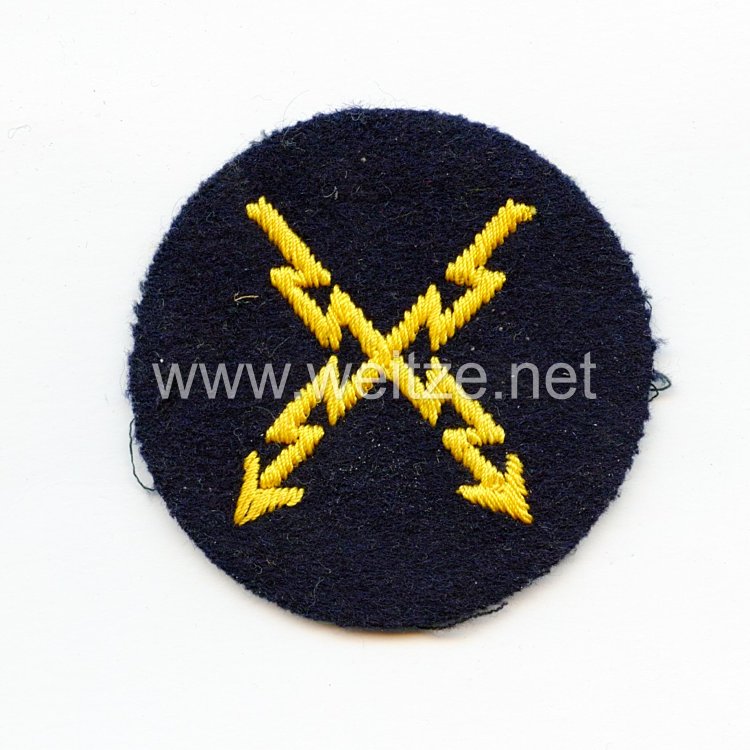
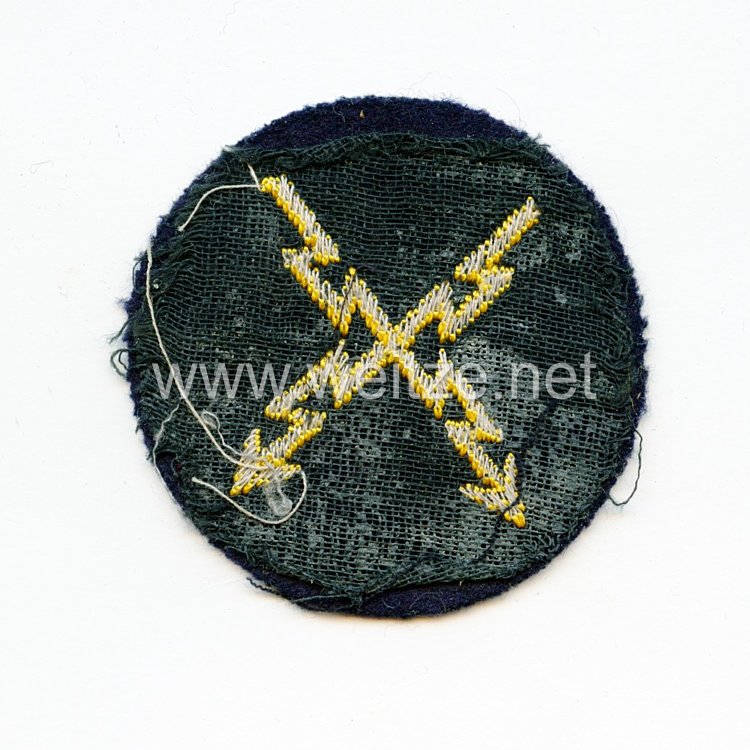
Kriegsmarine Enlisted Rank Sleeve Insignia for Teleprinter Operator
The Kriegsmarine sleeve badge for teletype operators (Fernschreiber) represents a fascinating testament to military specialization and career identification in the German Navy during World War II. This machine-embroidered version for the blue work blouse of enlisted ranks embodies the sophisticated hierarchy and complex system of career badges established in the Kriegsmarine between 1935 and 1945.
The Kriegsmarine, officially founded on June 1, 1935, adopted and expanded the traditional career badge system of the Imperial German Navy. With the increasing mechanization of naval warfare, new specialized roles emerged that required corresponding identification. The Fernschreiber (teletype operator) belonged to the communications branch and played a central role in military communications.
Teletype technology had developed rapidly during the 1920s and 1930s and was adapted for military purposes. Teletypes enabled fast and relatively secure transmission of messages over long distances, both from ship to ship and between ships and shore stations. Operating these complex devices required specially trained personnel who possessed both technical understanding and knowledge of encryption and message protocols.
The sleeve badge was worn on the left upper arm of the blue uniform blouse, typically about 10-12 cm below the shoulder seam. The machine-embroidered version was the standard variant for enlisted ranks and was usually manufactured on dark blue cloth backing. The design of the teletype operator's badge typically showed stylized elements symbolizing the activity – often a representation associated with communications technology or signaling.
The production of such badges was carried out by specialized companies authorized by the Kriegsmarine. Machine embroidery enabled cost-effective mass production with consistent quality, which was essential for the large number of badges required. In contrast, hand-embroidered variants also existed but were rarer and mostly worn by officers or on tropical uniforms.
Training as a teletype operator took place in special naval training facilities, where recruits learned not only how to operate the equipment but were also instructed in Morse code, radio procedures, and military communications discipline. After successfully completing training, sailors received their career badge, which identified them as qualified teletype operators.
In the context of Kriegsmarine uniforms, different types of uniforms were distinguished. The blue blouse (also referred to as working dress) was the everyday service clothing aboard ship and in coastal facilities. It differed from parade uniforms and the white summer uniform. Sleeve badges had to be worn on all uniform variants accordingly, with badges on white backing often used for white uniforms.
The importance of teletype operators cannot be overestimated. They were an integral part of the communications chain essential for coordinating fleet operations, submarine warfare, and coastal defense. Every major Kriegsmarine unit, from capital ships to naval bases, had trained teletype operators.
The career badge system was regulated in detail by the Kriegsmarine dress regulations (Anzugordnung). These regulations precisely specified which badges were to be worn by which ranks on which uniform parts. Violations of uniform regulations could be disciplined, underscoring the importance of correct wearing.
After the war ended in 1945, the Kriegsmarine was dissolved, and its uniforms and badges became historical artifacts. Today, such sleeve badges are sought-after collectibles that provide important information about the military organization, hierarchy, and technical specialization of the German Navy. They serve historians and museums as primary sources for researching the naval history of World War II.
The condition and wear patterns of surviving examples provide insights into their actual use. Worn badges like this example show that they were actively used during service, bearing witness to the daily life and duties of German naval personnel during one of history's most tumultuous periods. These artifacts connect us directly to the individuals who served and the technological evolution that characterized mid-20th century naval warfare.