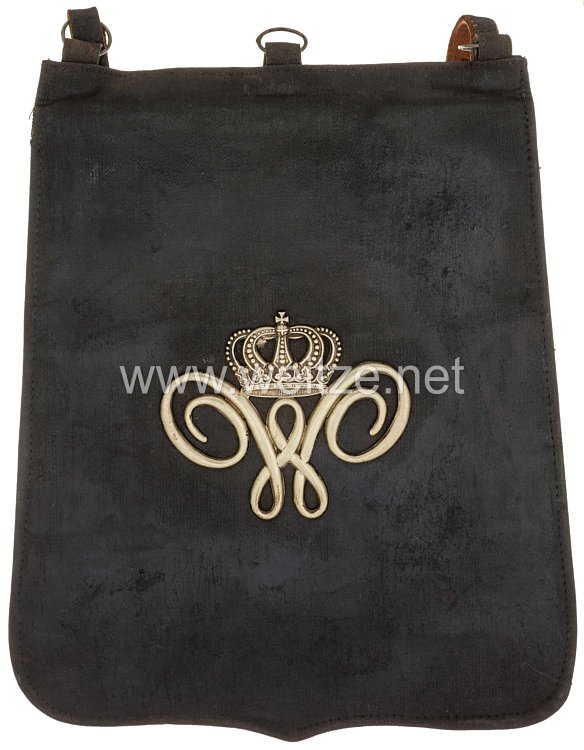
Prussian Saber Pouch for a Sergeant of the Royal Schutzmannschaft in the Mediatized Cities
.
This saber pouch represents a significant piece of Prussian police history from around 1900. It belonged to the equipment of a sergeant of the Royal Schutzmannschaft in the so-called Mediatized Cities, those Prussian cities that held a special administrative status.
The Royal Schutzmannschaft (Protection Corps) was fundamentally reformed in Prussia after the failed revolutionary attempt of 1848. With the Law on the Establishment of the Schutzmannschaft of January 1, 1850, the Prussian state created a modern, barracked police force modeled on military lines. These protection corps were to maintain public order and were directly subordinate to the Ministry of the Interior.
Mediatization referred to the process in the Holy Roman Empire and later in the German Confederation by which immediate imperial territories lost their sovereignty and were subordinated to other rulers. The Mediatized Cities in Prussia, however, retained certain administrative peculiarities and privileges, which was also reflected in the organization of their police forces.
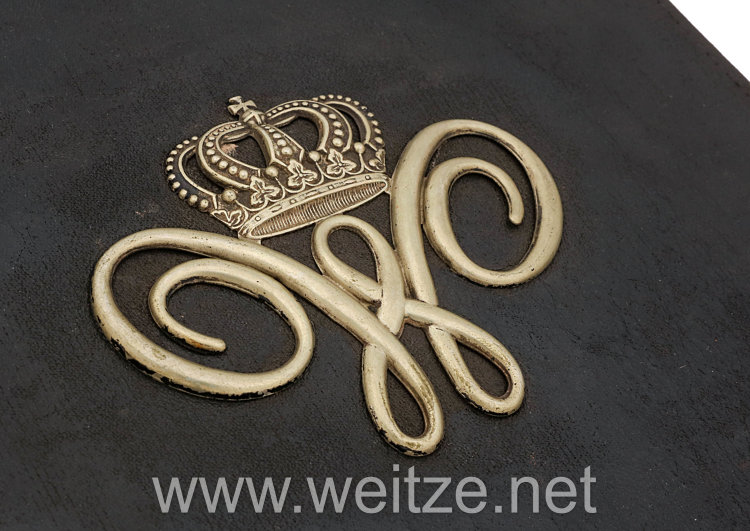
The saber pouch itself is made of black lacquered stiff fabric, which corresponded to the Prussian standard for police equipment. The black color was characteristic of the Prussian police and distinguished it from the more colorful uniforms of the army. The emblem with the crown and “W” mounted on the front refers to Kaiser Wilhelm II, who reigned from 1888 to 1918. This monogram was a clear sign of loyalty to the Prussian crown and the German Empire.
The rank insignia and uniform parts of the Schutzmannschaft were strictly standardized according to Prussian police regulations. A sergeant (also called Wachtmeister) was a non-commissioned officer who led a group of police constables and represented an important link between the rank and file and the officers. This middle leadership level was responsible for daily training, discipline, and operational command.
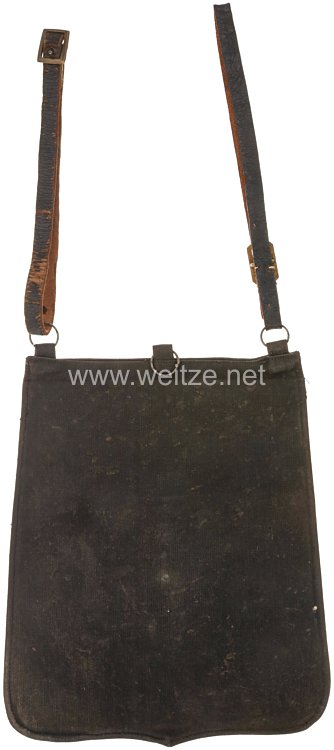
The saber pouch served to store personal items during duty and was part of the parade uniform. With three buckles and originally two carrying straps, it was attached to the belt. The robust construction ensured durability in daily service, while the lacquered surface was easy to clean and made a representative impression at parades.
The period around 1900 was a phase of professionalization and modernization for the Prussian police. Increasing industrialization, urban growth, and social issues posed new challenges to police work. The Schutzmannschaften not only had to ensure peace and order but also intervene in strikes, demonstrations, and social unrest.
The equipment of the Schutzmannschaft was carefully designed and combined military elements with police-specific requirements. In addition to the saber pouch, saber, pickelhaube helmet, uniform coat, and other equipment items belonged to the full outfit. The similarity to military equipment was intentional and was meant to demonstrate authority and state power.
After the end of World War I and the fall of the monarchy in 1918, monarchist symbols such as the Crown-W emblem were removed from police equipment. The Weimar Republic fundamentally reformed the police organization, and many pieces of equipment from the Imperial era were decommissioned or revised.
Today, such saber pouches are important testimonies of Prussian police history and are highly sought after by collectors of military-historical objects. They document not only the material culture of the Wilhelmine era but also the development of state security forces and the importance of symbolic representation in the German Empire.