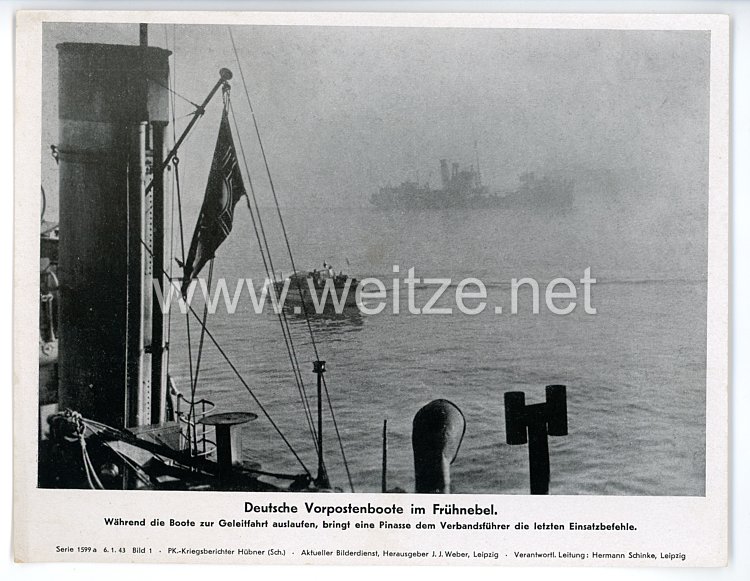
Third Reich - Printed Press Photo “German Vorpostenboote in Early Morning Fog” January 6, 1943

Publisher: Aktueller Bilderdienst, blank reverse, 23.5 x 18.5 cm, Condition 2.
331370
10,00

Third Reich - Printed Press Photo “German Vorpostenboote in Early Morning Fog” January 6, 1943

This press photograph from the Third Reich, dated January 6, 1943, depicts German patrol boats (Vorpostenboote) in early morning fog and represents a significant historical document of maritime warfare during World War II. Published by Aktueller Bilderdienst, one of the most important propaganda organs of the Nazi regime, this image documents a specific aspect of German naval warfare during a critical phase of the conflict.

The Vorpostenboote (patrol boats) formed an essential component of the German Kriegsmarine. These mostly converted fishing vessels, coastal motor ships, and smaller naval craft performed diverse duties along the coasts and in occupied territories. Their primary tasks included securing sea routes, mine detection and clearance, convoy escort duties, coastal surveillance, and defense against enemy submarines. The Vorpostenflottillen (patrol boat flotillas) were stationed along the entire German-controlled coastline from Norway to the Mediterranean.

The Aktueller Bilderdienst (Current Picture Service) functioned as the central agency for distributing press photographs in National Socialist Germany. Under the control of the Reich Ministry of Public Enlightenment and Propaganda led by Joseph Goebbels, this service produced and distributed carefully selected and censored photographic materials to German and international press outlets. The photographs were intended to convey a specific narrative and portray the German Reich's war efforts in a favorable light.

By early 1943, Germany found itself in an increasingly difficult strategic position. The catastrophic defeat at Stalingrad was unfolding, and in the Atlantic, the U-boat war was intensifying. The Battle of the Atlantic reached its peak during this period, with German submarines attempting to sever Allied supply lines. In this context, patrol boats played an important role in securing German coasts and occupied territories against Allied naval and air attacks.

The depiction of patrol boats in early morning fog held propagandistic significance. The atmospheric photograph conveyed impressions of vigilance, combat readiness, and the harsh conditions under which the German Kriegsmarine operated. Such evocative images were designed to strengthen the home front while documenting the tireless commitment of naval forces. The fog-shrouded scenery emphasized the dangers and uncertainties of naval warfare.

The technical characteristics of the photograph correspond to the standards of contemporary press photography. With dimensions of 23.5 x 18.5 cm, it matched the typical formats for press prints. The absence of printing on the reverse suggests this may have been an archival copy or an example not intended for immediate publication. Typically, press photographs bore stamps, captions, and censorship markings on the back.

The patrol boat service comprised several thousand boats of various types and sizes at the time of this photograph. Many of these vessels were requisitioned civilian ships equipped with light armament, usually 2-cm or 3.7-cm anti-aircraft guns and machine guns. The crews often consisted of older reservists and merchant marine sailors whose seafaring experience made them suitable for this duty.

January 1943 marked a turning point in naval warfare. While German U-boats still achieved considerable success, the Allies began to gain the upper hand with improved detection technologies such as radar and sonar, as well as the decryption of the Enigma code. Patrol boats along German coasts increasingly faced Allied air raids that intensified as the war progressed.

Such press photographs today serve as important historical sources for researching the propaganda machinery of the Third Reich and the daily reality of naval warfare. They document not only military aspects but also the ways in which the regime controlled public perception. The preservation of such documents in good condition enables historians and the public to understand and critically reflect upon the mechanisms of war propaganda.

The photograph represents a specific moment in the extensive visual propaganda campaign that accompanied Germany's war effort. As primary source material, it offers insights into how the Nazi regime sought to portray its military forces and maintain morale during an increasingly difficult phase of the war. The aesthetic choices—the atmospheric fog, the implied readiness of the vessels—were carefully calculated to produce specific emotional and psychological effects on viewers.

r