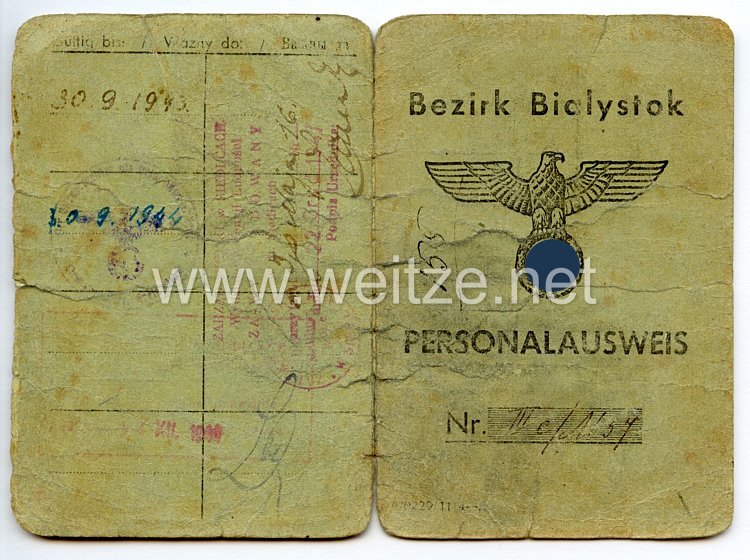
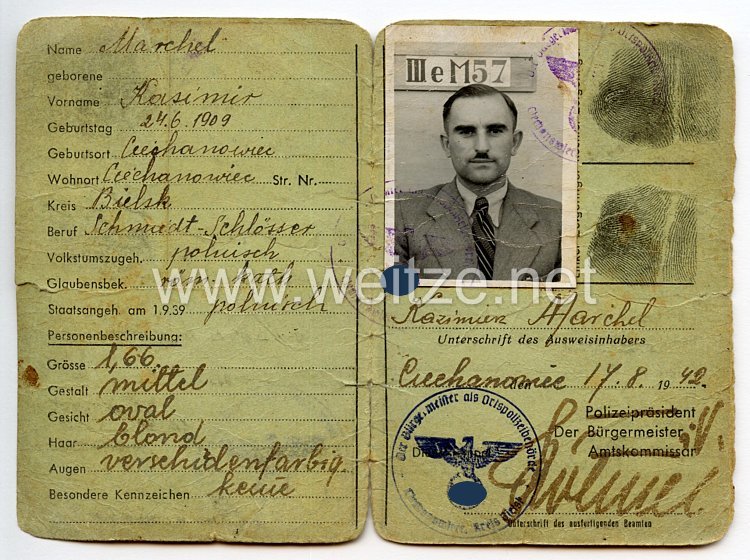
Third Reich / Occupied Eastern Territories - Bezirk Bialystok - Personal Identity Card for a Male Born in 1909

issued in Ciechanowice on August 17, 1942, with photograph and personal data, validity extended until September 30, 1944; used condition.
339370
160,00

Third Reich / Occupied Eastern Territories - Bezirk Bialystok - Personal Identity Card for a Male Born in 1909

Identity Cards in the Bialystok District during German Occupation 1941-1944

The identity card from 1942 represents a significant artifact from the German occupation administration in the occupied Eastern territories during World War II. Issued on August 17, 1942, in Ciechanowice in the Bialystok District, this document exemplifies the complex administrative structure that Nazi Germany established in the conquered Polish territories.

Following the invasion of the Soviet Union in June 1941 as part of Operation Barbarossa, the Wehrmacht occupied large parts of eastern Poland that had been under Soviet control since September 1939. The Bialystok District received a special administrative status. Unlike other occupied territories, it was neither incorporated into the General Government nor annexed to Reich territory, but was placed under the administration of East Prussia under Gauleiter Erich Koch on August 1, 1941.

This special administrative position reflected the long-term territorial ambitions of the Nazi leadership. The Bialystok District encompassed approximately 30,000 square kilometers with about 1.4 million inhabitants, predominantly Poles, but also significant Jewish, Belarusian, and Ukrainian minorities. The German administration established a comprehensive system for controlling and registering the population, with identity cards forming a central element of this surveillance structure.

The introduction and mandatory carrying of identity cards served multiple purposes. Primarily, they enabled the systematic registration and identification of all inhabitants. This was essential for implementing Nazi occupation policies, including the recruitment of forced laborers, control of movements, and identification of persons for deportations. The cards typically contained a photograph, personal data such as name, date of birth, place of birth, residence, and often information about religion or “ethnic affiliation.”

The fact that this card was issued to a man born in 1909 means that the holder was 33 years old at the time of issuance - thus of working age. This was particularly significant as the German occupation authorities systematically recruited forced laborers for the war economy. Men of this age were especially vulnerable to being drafted for work in the German Reich or for local German projects.

The extension of validity until September 30, 1944, is also historically significant. By this time, the German occupation was already in its final phase. The Red Army had liberated large parts of Belarus and eastern Poland following the successful Operation Bagration in summer 1944. Bialystok itself was captured by Soviet troops on July 27, 1944, causing the German administration to collapse.

Daily life under German occupation in the Bialystok District was characterized by extreme hardship. The region was the scene of severe crimes against the civilian population. The Jewish population, which constituted a substantial portion of the inhabitants, was systematically persecuted, concentrated in ghettos, and ultimately murdered in extermination camps. The Bialystok Ghetto was one of the largest in occupied Poland. The non-Jewish Polish population also suffered from repression, forced labor, confiscations, and arbitrary violence.

Identity cards like this one were essential for survival. Without valid identification documents, any movement outside one's residence was nearly impossible and life-threatening. Inspections by German police, Wehrmacht, SS, or local auxiliary police were routine. Missing or forged papers could lead to immediate arrest, deportation, or execution.

From a historical perspective, such documents are valuable sources for researching German occupation rule today. They document not only the administrative structure but also provide insights into individual fates. The used condition of this card - presumably with wear marks, stamps, and annotations - tells the story of its owner's daily life during one of the darkest periods in European history.

The preservation and study of such documents is of great importance for historical memory and educational work about World War II and the Holocaust.