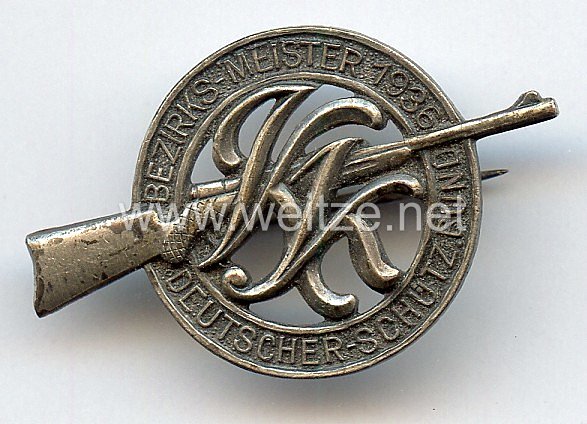
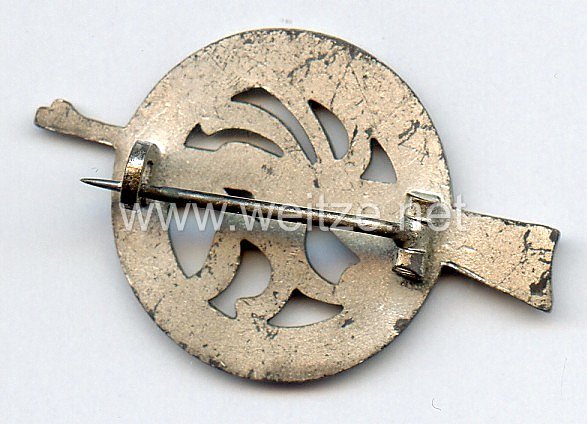
German Rifle Association (DSB) - Badge “District Champion 1936”

Silver-plated non-ferrous metal, on pin, condition 2.
319770
100,00

German Rifle Association (DSB) - Badge “District Champion 1936”

German Shooting Federation (DSB) - District Champion Badge 1936

The present badge of the German Shooting Federation (Deutscher Schützenbund - DSB) designated as “District Champion 1936” represents a significant epoch in German shooting sports history. This award badge, made of silver-plated base metal and equipped with a pin, documents sporting achievements in marksmanship during the mid-1930s.

The German Shooting Federation had a long tradition dating back to the 19th century. German shooting clubs had always been not only sporting institutions but also social and cultural organizations that played a central role in many communities. After the re-establishment of the DSB in the 1920s, organized shooting sports in Germany experienced considerable growth.

In 1936, the year this badge was created, Germany was in a period of significant political changes. This was also the year of the Summer Olympic Games in Berlin, where sport served as a means of international representation. Shooting sports held particular significance in this context, as they traditionally combined both military and civilian aspects.

The District Championships were important competitions in the hierarchical structure of German shooting sports. The organization was divided into various levels: local clubs, districts, regions (Gaue), and the national level. A District Champion title represented a significant achievement that went beyond the mere club level and signified regional recognition.

The production of such badges typically occurred through specialized manufacturers and metalware factories. The silver-plated base metal used was a common material for such awards, as it was cost-effective to produce while the silver plating gave it a dignified and representative character. The pin construction allowed wearing on civilian clothing or club uniforms.

The design of such badges usually followed traditional motifs of shooting sports. Typical elements included targets, crossed rifles, oak leaf wreaths, or eagles. The year 1936 was typically displayed prominently on the badge to document the specific performance period.

In the context of the time, it is important to understand that sports organizations in the 1930s were increasingly integrated into state structures. The German Reich League for Physical Exercise (DRL) became the umbrella organization for German sport. Nevertheless, many traditional shooting clubs maintained their local structures and traditions.

For the wearers of such badges, the award meant not only sporting recognition but also social prestige within their community. Shooting clubs were often closely connected with local traditions, folk festivals, and social events. Championship titles were accordingly honored and the badges worn with pride.

From a collector's and historical perspective, such badges are today important witnesses to German sports history. They document organizational structures, the craftsmanship quality of badge production, and the significance of shooting sports in German society during the interwar period. The condition of such pieces varies considerably, with the silver plating often affected by corrosion or wear.

The historical classification of such objects requires differentiated consideration. While shooting sports itself had a centuries-old tradition and was practiced in many countries, the specific time period of the 1930s in Germany is characterized by particular historical complexity. Collectors and historians are interested in these badges from both sports-historical and cultural-historical perspectives.

These badges serve as tangible connections to a sporting culture that emphasized competition, skill, and community involvement. The 1936 District Championship would have involved rigorous competition among skilled marksmen from various local clubs within a defined geographical area. Participants would have competed in various disciplines, possibly including rifle shooting at different distances and positions.