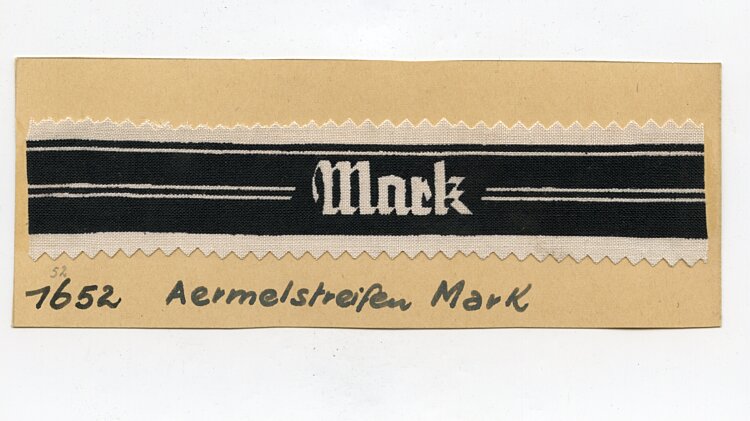
Armband of the Volkssturm Unit "Mark"

Printed cloth construction, manufactured circa 1945. Unissued condition on original index card from the original manufacturer, Condition 2+. A very rare variant.
131770
130,00

Armband of the Volkssturm Unit "Mark"

The armband of the Volkssturm-Abteilung “Mark” represents a fascinating yet dark chapter of German military history from the final months of World War II. This particular cloth insignia documents the desperate efforts of the Nazi regime to mobilize all available forces during the war's final phase.

The German Volkssturm was officially established on September 25, 1944, through a decree by Adolf Hitler, although preparatory planning had begun earlier. As the last military reserve of the German Reich, this formation was intended to encompass all able-bodied men between the ages of 16 and 60 who had not yet been conscripted for military service. The organization was directly subordinate to the NSDAP, with Martin Bormann as head of the Party Chancellery and Heinrich Himmler as Reichsführer-SS exercising administrative and military control.

The Volkssturm was structured according to territorial principles. Units were divided into battalions, companies, and platoons, with designations frequently reflecting local references. The armband “Mark” most likely refers to a geographical region—possibly the Mark Brandenburg or other areas historically designated as “Mark”. This local nomenclature corresponded to the principle of territorial defense, whereby Volkssturm units were primarily to be deployed in their home regions.

The uniforming and identification of the Volkssturm presented particular challenges. Due to the catastrophic supply situation in the war's final year, no standardized uniform existed. Members frequently wore civilian clothing supplemented with military equipment pieces, old uniform parts from various Wehrmacht branches, or improvised attire. The Volkssturm armband served as identification, worn on the left upper arm and intended to designate wearers as combatants under the Hague Conventions.

In addition to the standardized armband inscribed “Deutscher Volkssturm Wehrmacht”, various cuff titles existed to identify specific units. These were typically worn on the right forearm. The present specimen shows a printed cloth execution, characteristic of production from 1944/45 onwards. While earlier military cuff titles were often produced in elaborate hand embroidery or woven execution, war-related material shortages necessitated simplified production methods.

The fact that this armband was preserved on an old file card from the manufacturing company and never worn makes it a special historical document. It provides evidence of production processes and bureaucratic organization even during the chaotic final phase of the war. Many textile companies were requisitioned for the manufacture of military equipment items, with detailed records maintained regarding production and distribution.

The military value of the Volkssturm was extremely limited. Most members had no or only rudimentary military training, armament was completely inadequate and consisted of captured weapons, obsolete rifles, and improvised weapons such as the Panzerfaust. Tactical leadership was frequently provided by elderly or wounded officers. Despite propagandistic portrayal as the “last line of defense”, Volkssturm units were militarily hopelessly outmatched by Allied and Soviet forces.

Volkssturm deployments concentrated on the war's final months between autumn 1944 and May 1945. Particularly notorious was their deployment in the defense of Berlin in April 1945, where Hitler Youth and elderly men were sent into hopeless battle. Casualties were substantial, and many Volkssturm members became victims of the Nazi regime's senseless policy of continued resistance.

From today's historical perspective, armbands such as that of the “Mark” unit document the total mobilization of a society and the radicalization of warfare in its final phase. They are testimonies to a criminal system that, even on the brink of defeat, still forced civilians into hopeless combat. For military historians and collectors, such unworn specimens represent important research objects that provide insights into production, logistics, and organization.

The rarity of this specific variant is explained by several factors: the Volkssturm's short existence, the chaotic conditions of the war's final months, low production numbers for specific units, and the fact that many such insignia were destroyed after the war's end. Unworn specimens on original file cards are extraordinarily rare and offer authentic insight into the production processes of that time.