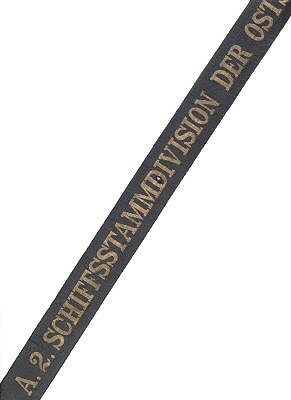
Reichsmarine Cap Tally "A.2. Schiffstammdivision der Ostsee. A.2."

Metal thread woven construction, length: 134 cm, condition 2
38769
20,00

Reichsmarine Cap Tally "A.2. Schiffstammdivision der Ostsee. A.2."

This Reichsmarine cap tally bearing the inscription “A.2. Schiffstammdivision der Ostsee. A.2.” represents a significant artifact of German naval history between 1919 and 1935. Manufactured using metal thread weaving technique with a length of 134 cm, it conforms to the standardized specifications for cap tallies of that period.

Following the end of World War I and the signing of the Treaty of Versailles in June 1919, the German Navy was drastically reduced. The new Reichsmarine emerged from the remnants of the Imperial Navy and was subject to severe restrictions regarding personnel, materiel, and organization. The treaty limited the German Navy to a maximum of 15,000 men, six battleships, six light cruisers, twelve destroyers, and twelve torpedo boats.

The Schiffstammdivisionen (Ship Crew Divisions) formed an essential component of the Reichsmarine's organizational structure. They served as training and administrative units for crews and were organized according to geographical regions. The Schiffstammdivision der Ostsee (Baltic Sea Ship Crew Division) was one of the main organizational units responsible for maritime operations and training in the Baltic region. The designation “A.2.” indicates a specific department or company within this division.

Cap tallies had been a traditional element of German naval uniforms since the Imperial era. They were worn on the Tellermütze (the characteristic sailor's cap) and served to identify membership in a particular ship or unit. The tradition of cap tallies dates back to the 19th century when the German Navy began outfitting its sailors with standardized headgear.

The metal thread weaving technique was a high-quality manufacturing method in which gold or silver metal threads were woven into the black base fabric. This elaborate technique produced durable and lustrous lettering that remained legible even under harsh maritime conditions. The standard length of approximately 134 cm allowed the band to be wrapped around the cap, with the ends typically tied together in a bow at the back of the head or left hanging.

The organization of the Reichsmarine in the 1920s was characterized by efforts to maintain a functioning navy despite the Versailles restrictions. The Naval Station Baltic Sea, headquartered in Kiel, coordinated the various Ship Crew Divisions and was responsible for training, maintenance, and operational readiness. The Baltic remained a strategically important sea area for Germany as it controlled access to the North Sea and the Atlantic.

In the Reichsmarine hierarchy, the Ship Crew Divisions were directly subordinate to their respective naval stations. They comprised various departments (often designated as “A,” “B,” “C,” etc.) that fulfilled different functions – from basic training to specialized technical instruction and administrative tasks. The numbering such as “A.2.” followed a systematic scheme for identification within the overall structure.

The year 1935 marked the end of the Reichsmarine when it was renamed the Kriegsmarine after the National Socialist regime publicly declared Germany's rearmament and concluded the Anglo-German Naval Agreement. With this transformation, many uniform regulations and organizational structures changed, making objects from the Reichsmarine era historical documents of a specific epoch.

For collectors and historians, Reichsmarine cap tallies are of particular interest as they represent authentic contemporary witnesses of a transitional period in German military history. They document not only the maritime tradition but also the organizational complexity of a navy that had to operate under difficult political and economic conditions. The quality of metal thread weaving and the state of preservation of such objects vary considerably, with well-preserved specimens like the present one being particularly valuable for understanding the material culture and uniform history of this era.

The Baltic Sea divisions played a crucial role in maintaining Germany's naval presence and training capabilities during the interwar period. Despite the limitations imposed by Versailles, the Reichsmarine maintained professional standards and preserved institutional knowledge that would later influence subsequent developments. Cap tallies from this period thus serve as tangible links to a navy navigating between tradition and constraint, pride and limitation.