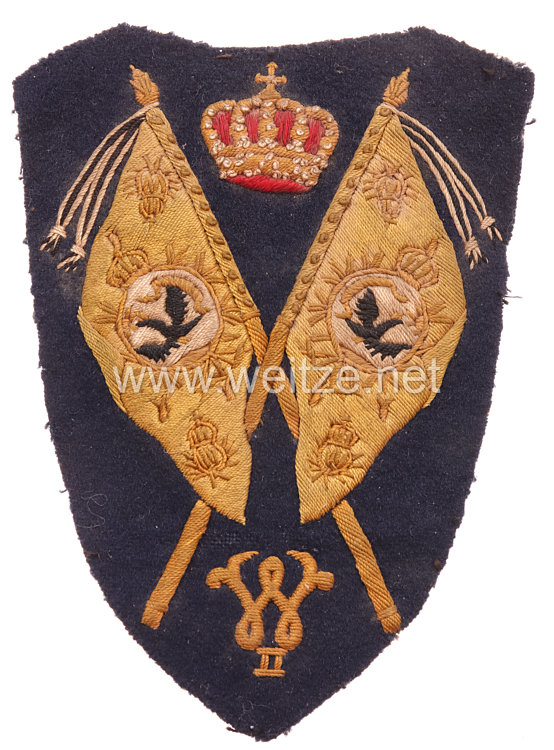
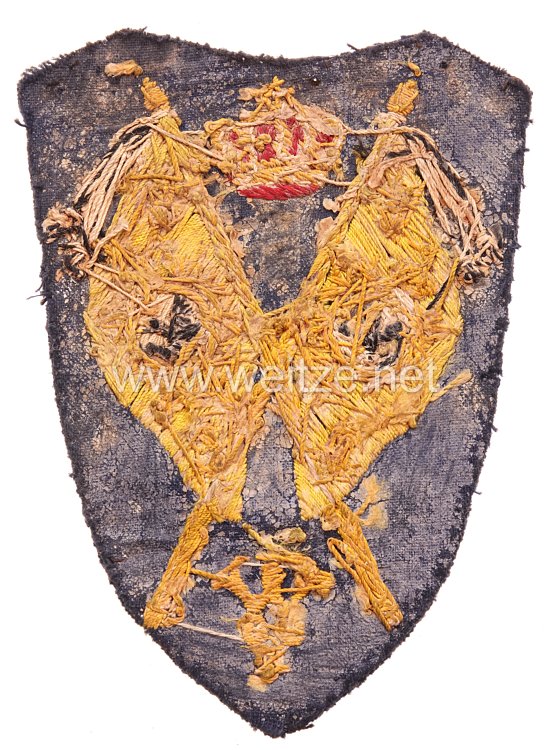
Prussia Sleeve Insignia for Infantry Color Bearer
Prussian Arm Badge for Infantry Standard Bearers
The Prussian arm badge for infantry standard bearers represents a significant element of the military distinction system of the Kingdom of Prussia that developed throughout the 19th and early 20th centuries. These hand-embroidered badges were crafted on dark blue cloth and served to immediately identify one of the most important and honorable positions within an infantry unit.
Historical Context and Significance
Standard bearers (Fahnenträger or Fahnenjunker) held an outstanding position in the Prussian army. The standard of a unit was not merely a practical orientation tool on the battlefield, but embodied the honor, tradition, and fighting spirit of the entire regiment. The loss of a standard was considered one of the gravest disgraces that could befall a military unit. Accordingly, standard bearers were selected from the most reliable and bravest soldiers.
The Prussian army organization, modernized after the reforms of Gerhard von Scharnhorst and August Neidhardt von Gneisenau between 1807 and 1814, placed great emphasis on clear hierarchical structures and their visible identification. The distinction system included, alongside shoulder boards, collar patches, and shoulder straps, special arm badges for particular function holders.
Technical Execution and Material
The arm badges for standard bearers were manufactured with careful handwork. The dark blue base cloth corresponded to the traditional Prussian branch color of the infantry, which had existed since the 18th century. The embroidery was typically executed with metal threads in silver or gold, depending on the regiment and time period. The craftsmanship quality of these badges varied considerably—from simple military workshop products to high-quality privately procured specimens.
The attachment was made to the left upper arm of the uniform, where the badge was clearly visible to both superiors and one's own troops. The position on the sleeve had been precisely defined since the Allerhöchste Kabinetts-Order (AKO—Supreme Cabinet Orders) of the 19th century and could not be arbitrarily altered.
Development and Period of Use
During the era of the German Empire (1871-1918), the Prussian distinction system reached its peak of complexity. The various branches of service, regiments, and functions were identified through an elaborate system of colors, shapes, and symbols. The infantry, as the largest branch, had particularly detailed regulations.
The arm badges for standard bearers were increasingly replaced in the field during World War I (1914-1918) by more practical field uniform regulations. The traditional colorful and richly decorated peacetime uniforms gave way to field-gray suits, in which decorative elements were greatly reduced. Nevertheless, many units retained their traditional badges for parades and special occasions.
Wearing Practice and Military Usage
The standard bearer wore his badge with pride, as it documented his special position of trust. As a rule, young officers or particularly distinguished non-commissioned officers were entrusted with this task. The position involved considerable risks, as standard bearers represented preferred targets in combat. At the same time, however, the function also offered opportunities for advancement and special recognition.
In garrison and at parades, the standard bearer marched in an exposed position, usually immediately behind the commanding officer. During military ceremonies, oath-takings, and standard consecrations, special symbolic significance was attached to the standard bearer and his badge.
Collector Value and Preservation
Today, authentic Prussian arm badges are sought-after collectibles that represent important testimonies of military history. Hand-embroidered specimens on dark blue cloth are sensitive due to their textile nature and often damaged by wear, moth damage, or improper storage. Well-preserved pieces with clear provenance are correspondingly valuable.
The scholarly study of these objects contributes to the understanding of Prussian-German military history and documents the social significance of military hierarchies and concepts of honor in the 19th and early 20th centuries.