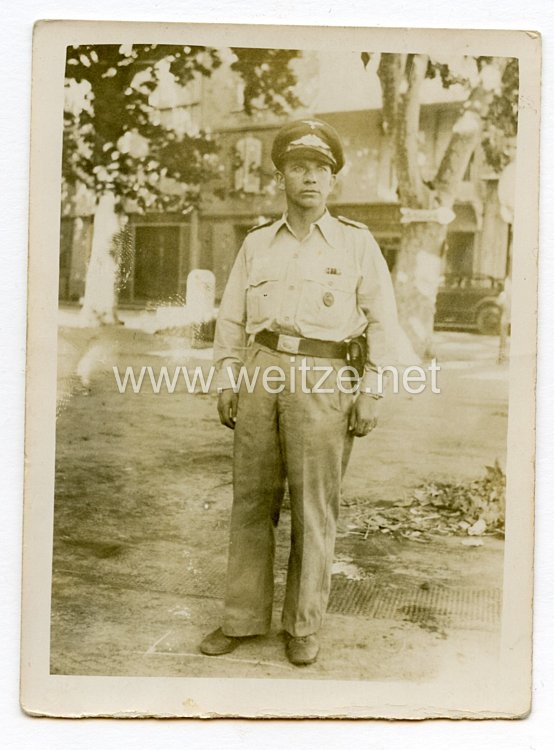
Luftwaffe Portrait Photograph, Feldwebel on the Southern Front
This portrait photograph of a Luftwaffe Feldwebel (sergeant) at the Southern Front represents an important aspect of military photography during World War II. Produced in postcard size, this image documents a non-commissioned officer of the German Air Force deployed at the southern front – a term that primarily encompassed the Mediterranean and North African theaters of war, as well as later Italy.
The Luftwaffe in the Mediterranean Region
The German Luftwaffe played a decisive role in the southern war zones from 1940 onwards. Following Italy's entry into the war in June 1940, the Wehrmacht dispatched various Luftwaffe units to support its Axis partner. The X. Fliegerkorps under Major General Hans Geisler was transferred to Sicily in December 1940 and operated over the Mediterranean. In North Africa, the German Afrika Korps under Field Marshal Erwin Rommel supported Italian forces from February 1941, with Luftwaffe units forming an essential component of these operations.
The Rank of Feldwebel
The Feldwebel was a middle-ranking non-commissioned officer position in the Wehrmacht and Luftwaffe. It stood hierarchically above the Unterfeldwebel and below the Oberfeldwebel. Feldwebel typically carried considerable responsibility for training and leading smaller units. In the Luftwaffe, Feldwebel could perform various functions: as pilots, radio operators, gunners, ground personnel, or in technical and administrative positions. Their experience and professional competence made them the backbone of military organization.
Military Portrait Photography
Portrait photographs in postcard size (typically 9 x 14 cm or 10 x 15 cm) were extraordinarily common during World War II. Soldiers had themselves photographed for various reasons: to send to family members, as mementos for comrades, or to document their military careers. Professional photographers, both military and civilian, operated in all garrisons and deployment areas. These photos were frequently mounted on cardboard and showed soldiers in their uniforms with visible rank insignia, decorations, and service branch emblems.
Uniforms and Insignia
Luftwaffe personnel wore characteristic blue-grey uniforms that distinguished them from the field-grey uniforms of the Army. A Feldwebel's uniform displayed specific rank insignia: shoulder straps with braided aluminum tress and typically sleeve chevrons. The Luftwaffe national emblem – a right-facing eagle with spread wings above a swastika in an oak wreath – was worn on the right breast. Feldwebel also frequently wore either the dress tunic (Fliegerbluse) or the more practical field blouse, depending on function and deployment area.
The Southern Front: Operational Conditions
Conditions at the Southern Front differed considerably from other theaters of war. In North Africa, troops fought under extreme heat, sandstorms, and water scarcity. The Luftwaffe had to adapt its tactics to the vast, open desert landscapes. In Italy from 1943 onwards, mountainous terrain and changing weather conditions presented the challenges. Luftwaffe units operated from improvised airfields and often had to manage with limited resources.
Photographic Documentation in War
The Wehrmacht recognized early the importance of photographic documentation for propaganda purposes and historical records. Propaganda Companies (Propagandakompanien or PK) were established, but private photography by soldiers was also widespread. The quality of such portrait photographs varied greatly – from professional studio shots in larger cities to simpler images in field studios near the front.
Historical Significance
Such portrait photographs possess significant historical and documentary value today. They convey not only information about uniforms, rank structure, and military organization but also offer personal insights into soldiers' lives. Each photograph tells the story of an individual fate within the context of a global conflict. For military historians and collectors, these documents serve as primary sources for researching military everyday culture, uniform studies, and social history of World War II.
The preservation of such photographic documents in good condition contributes to safeguarding historical memory and enables future generations to understand the human dimension of military history. These images remind us that behind every uniform and rank insignia stood a real person with their own story, experiences, and fate during one of history's most devastating conflicts.