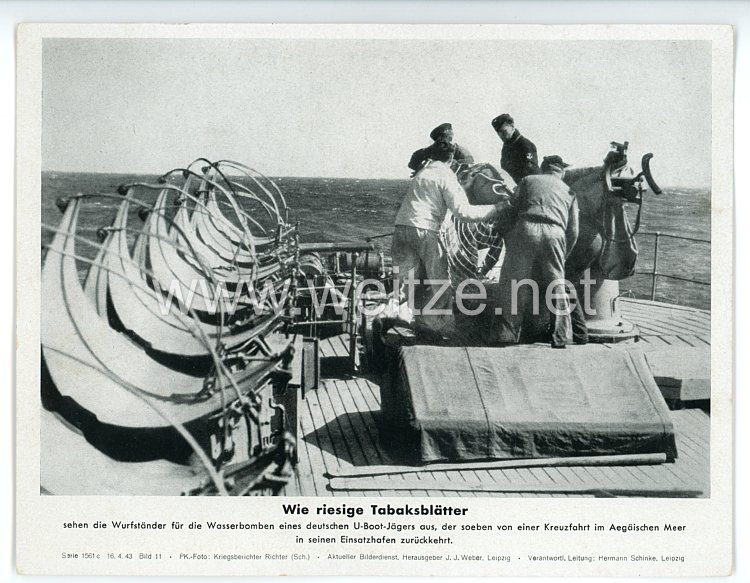
Third Reich - Printed Press Photo "Like Giant Tobacco Leaves" April 16, 1943
This object is a printed press photograph from the era of the Third Reich, published on April 16, 1943 by Aktueller Bilderdienst (Current Photo Service). Measuring 23.5 x 18.5 cm with an unprinted reverse side, it represents a typical example of National Socialist visual propaganda during World War II.
Aktueller Bilderdienst was one of several press photo services active during the Third Reich, serving the tightly organized propaganda machinery under Joseph Goebbels and the Reich Ministry for Public Enlightenment and Propaganda. These services provided newspapers, magazines, and other media with current photographic material that conformed to the regime's ideological requirements.
In April 1943, the German Reich was in a critical phase of the war. The catastrophic defeat at Stalingrad had occurred just a few months earlier - the 6th Army had capitulated in February 1943. The war on the Eastern Front had definitively turned, and the Nazi leadership had to adapt its propaganda strategy. Simultaneously, the Allies were intensifying their bombing raids on German cities, and in North Africa, the German Afrika Korps was on the verge of capitulation, which would occur in May 1943.
In this context, morale-sustaining propaganda became increasingly important. Press photographs played a central role in presenting the population with a controlled image of reality. Photo reporting increasingly focused on the home front, agricultural successes, technological achievements, and the allegedly unbroken fighting spirit of German troops.
The title “Like Giant Tobacco Leaves” suggests a motif from the realm of agriculture or raw material production. Such themes were of particular propaganda significance in 1943. Despite increasing supply shortages and the conversion to total war economy, the regime attempted to demonstrate normality and productivity. Tobacco was an important commodity for troop and civilian morale, and ensuring its supply had high priority.
The technical execution of the photograph - printed rather than as an original print - was characteristic of the mass distribution of propaganda material. Press photo services used various printing methods to cost-effectively produce large quantities of images. The unprinted reverse side might indicate that the photo was intended for direct use by editorial offices, which would then add their own captions and contextual information.
The format of 23.5 x 18.5 cm corresponded to a common standard for press photographs of that era, allowing flexible use in various publications. Newspapers and illustrated magazines such as “Berliner Illustrirte Zeitung,” “Das Reich,” or “Illustrierter Beobachter” were major recipients of such images.
The work of press photo services was subject to strict controls by the Propaganda Ministry. Every image had to conform to ideological specifications and could not contain information that might be interpreted as defeatist or subversive. The Reich Press Chamber, a sub-organization of the Reich Chamber of Culture, supervised all press activities in the Reich.
Today, such press photographs constitute important historical sources that provide insight into the propaganda methods of the Nazi regime. They document not only the depicted subjects but also the manner in which the regime attempted to control public perception. Historians and social scientists analyze these materials to understand the mechanisms of totalitarian media control and trace the development of visual propaganda in the 20th century.
The condition grade 2 (according to standard collector scales) indicates a well-preserved specimen showing only minor signs of use. This is noteworthy, as many press photographs from this period were damaged or lost due to their use in editorial offices or improper storage.
Press photographs from 1943 serve as tangible witnesses to a period when visual media were systematically exploited for political manipulation. They remind us of the importance of critical media literacy and the dangers of state-controlled information systems.