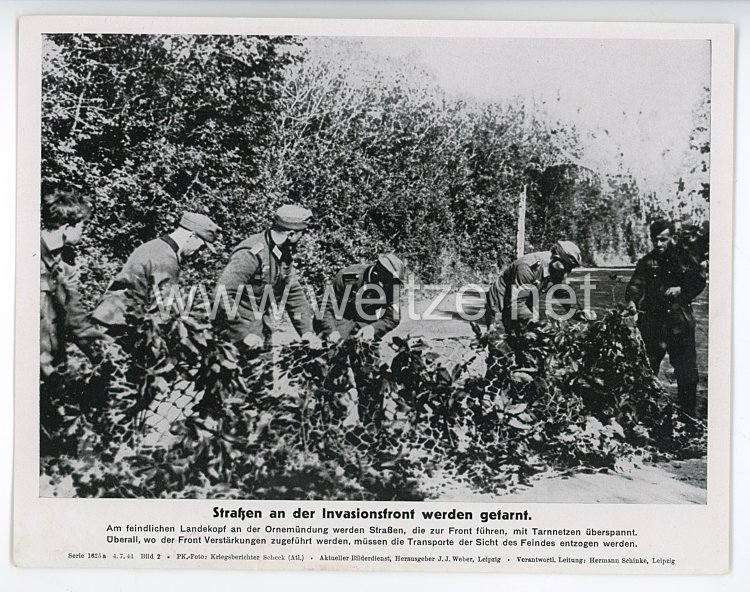
Third Reich - Printed Press Photo “Roads at the Invasion Front Being Camouflaged” July 4, 1944
Press Photography in the Third Reich: Propaganda Images from the Invasion Front 1944
This press photograph dated July 4, 1944, titled “Roads at the Invasion Front Being Camouflaged,” originates from the Aktueller Bilderdienst (Current Picture Service), one of the most important photo agencies in Nazi Germany. This document was created during a critical phase of World War II, less than a month after the Allied landing in Normandy on June 6, 1944.
The Aktueller Bilderdienst was closely connected to the Reich Ministry of Public Enlightenment and Propaganda under Joseph Goebbels. This organization produced and distributed photographic material to German newspapers and international press agencies to disseminate the Nazi interpretation of war events. Photographs were strictly controlled and censored to publish only those images that served the regime's propaganda objectives.
In the summer of 1944, the German Reich found itself in a desperate military situation. Following the successful Allied landing in Normandy, the Wehrmacht fought for every meter of ground in France. The invasion front stretched along the northern French coast, where German troops attempted to halt the Allied advance. Camouflage measures, as documented in this photograph, had become vital for survival, as the Allies possessed complete air superiority.
Military camouflage had assumed enormous importance in World War II. Faced with the increasing role of aerial reconnaissance and the devastating effects of Allied fighter-bombers, German troops had to conceal all transport routes, supply lines, and troop movements. Roads were covered with nets, concealed with foliage, or adapted to the surrounding landscape through artificial coloring. These measures were intended to deceive enemy pilots and prevent attacks on vital communication lines.
The format of 23.5 x 18.5 cm corresponds to the standard dimensions for press photographs of that era. The blank reverse side is noteworthy, as many press photos normally bore stamps, censorship marks, or captions on the back. This could indicate that it was an archive copy or an unused photograph.
Press photography in the Third Reich followed strict guidelines. Photographers were often members of the Propaganda Companies (Propagandakompanien or PK), special units exclusively responsible for documenting and propagandistically portraying the war. These units were created in 1938 and included both photographers and filmmakers. PK personnel wore uniforms and were militarily organized but enjoyed certain privileges to carry out their work.
In July 1944, the German propaganda machine increasingly sought to convey an image of determination and organized defense despite military setbacks. Images of camouflage measures were intended to show the German population and world public that the Wehrmacht continued to operate effectively and professionally. Simultaneously, such photographs served to strengthen the will to persevere and maintain the illusion that the war could still be won.
The historical significance of such press photographs today lies primarily in their documentary value as sources for propaganda history and the image politics of the Nazi regime. They demonstrate how the regime attempted to control public perception and offer insights into the military realities of the final phase of the war. For collectors and historians, these documents are important testimonies to the media history of World War II.
The condition rating of 2 suggests a well-preserved specimen that was probably professionally archived. Such photographs were often produced in multiple prints and distributed to various editorial offices, which explains why different copies of the same photograph can exist today in various archives and collections.