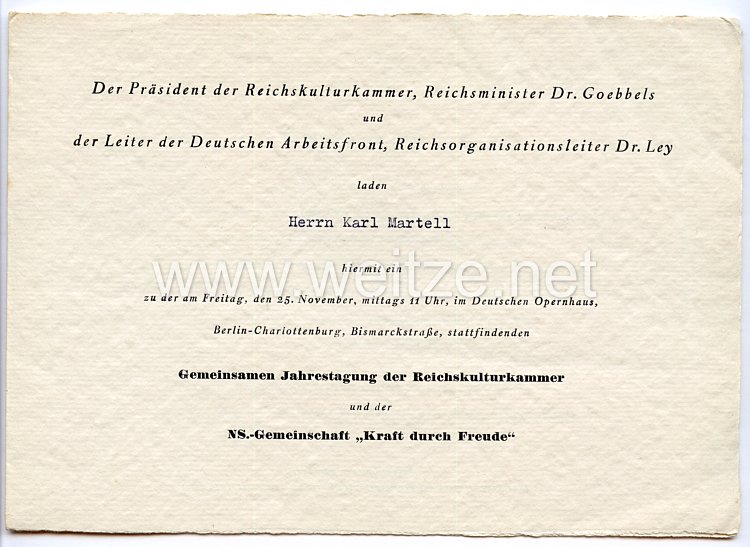
Third Reich - Reich Minister Dr. Goebbels and Reich Organization Leader Dr. Ley - Invitation Card for Actor Karl Martell

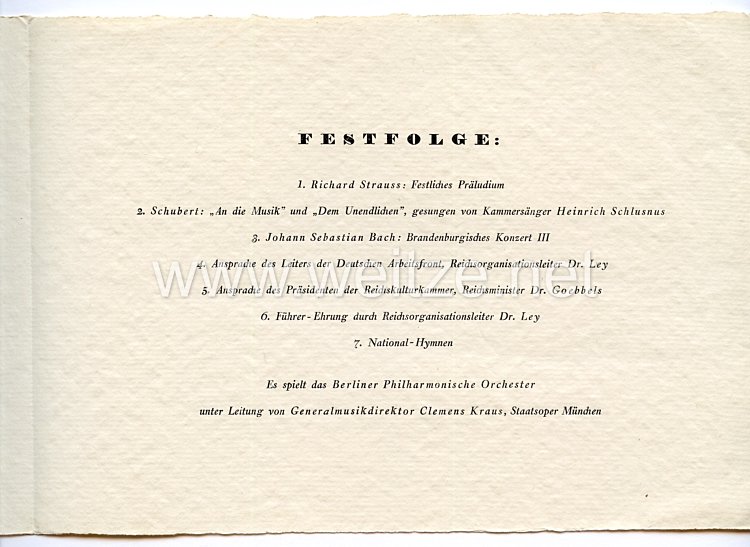
to the Joint Annual Conference of the Reichskulturkammer and the NS-Gemeinschaft “Kraft durch Freude” on November 25, 1938 at 11 o'clock at the Deutsches Opernhaus in Berlin-Charlottenburg. 15 x 21 cm folding card, interior with program of events; slightly used condition.
https://de.wikipedia.org/wiki/Karl_Martell_(Schauspieler)
349569
80,00

Third Reich - Reich Minister Dr. Goebbels and Reich Organization Leader Dr. Ley - Invitation Card for Actor Karl Martell

This invitation card to the Joint Annual Conference of the Reich Chamber of Culture and the NS Community “Strength Through Joy” on November 25, 1938, represents a significant document of National Socialist cultural policy and the institutional merger of propaganda, mass organization, and artistic control in the Third Reich.

The Reich Chamber of Culture (Reichskulturkammer) was established on September 22, 1933, through the Reich Chamber of Culture Law under the leadership of Reich Minister Dr. Joseph Goebbels. As the central institution of the Reich Ministry for Public Enlightenment and Propaganda, it served to exercise total control over cultural life in Germany. The Chamber was divided into seven individual chambers: the Reich Literature Chamber, Reich Press Chamber, Reich Radio Chamber, Reich Theatre Chamber, Reich Music Chamber, Reich Chamber of Fine Arts, and Reich Film Chamber. Membership was mandatory for all those working in cultural fields, and exclusion meant a de facto professional ban.

The NS Community “Strength Through Joy” (Kraft durch Freude, KdF) was founded in 1933 as part of the German Labour Front under the leadership of Reich Organization Leader Dr. Robert Ley. It was designed to organize and control the leisure time of German workers, pursuing the concept of promoting workforce productivity and loyalty through leisure activities, vacation trips, theatre visits, and cultural events. KdF developed into one of the largest mass organizations of the Third Reich with millions of members.

The joint annual conference of these two powerful institutions in November 1938 took place in a historically significant context. Only weeks earlier, during the night of November 9-10, 1938, the November Pogroms (euphemistically called “Reichskristallnacht”) had occurred, during which Jewish businesses, synagogues, and institutions throughout the German Reich were destroyed. This event at the end of November demonstrated the regime's unbroken display of power and the continued instrumentalization of culture for political purposes.

The venue, the German Opera House in Berlin-Charlottenburg, was itself a symbol of the cultural significance the regime wanted to attribute to such events. The house, opened in 1912 (today the Deutsche Oper Berlin), was one of Berlin's largest and most prestigious theatres and was regularly used for state representation events.

The recipient of this invitation, the actor Karl Martell (1906-1966), was a well-known German film and theatre actor of the period. His career began in the 1930s, and he participated in numerous productions. Like all professional artists, he had to be a member of the corresponding Reich Chamber of Culture to practice his profession. Such personal invitations to prominent cultural figures served to demonstrate proximity between the regime and the artistic elite.

The formal design of such invitation cards followed typical conventions of the time. The fold-out format with a size of 15 x 21 cm (approximately A5) was common for official invitations. The inside contained the “Festfolge” (program of festivities), the detailed program of the event, which presumably included speeches by the two main officials Goebbels and Ley, cultural performances, and possibly a reception.

Such documents are today important historical sources for research into National Socialist cultural policy. They document the names of participants, institutional structures, the terminology and self-representation of the regime, as well as the interweaving of culture, propaganda, and political control. The fact that two such central organizations as the Reich Chamber of Culture and KdF held joint conferences underscores the systematic coordination of all social spheres in the totalitarian state.

From a conservation perspective, such paper documents from the 1930s are frequently in varying states of preservation. The described “slightly used condition” is typical for documents that were actually used and paradoxically increases their historical value as authentic contemporary witnesses.

These invitation cards represent tangible evidence of how the Nazi regime systematically penetrated every aspect of cultural life, using prestigious events and personal recognition to co-opt artists and cultural workers into serving the propaganda apparatus. They remind us of the dangers of state control over artistic expression and the mechanisms by which totalitarian regimes seek to legitimize themselves through cultural institutions.

r