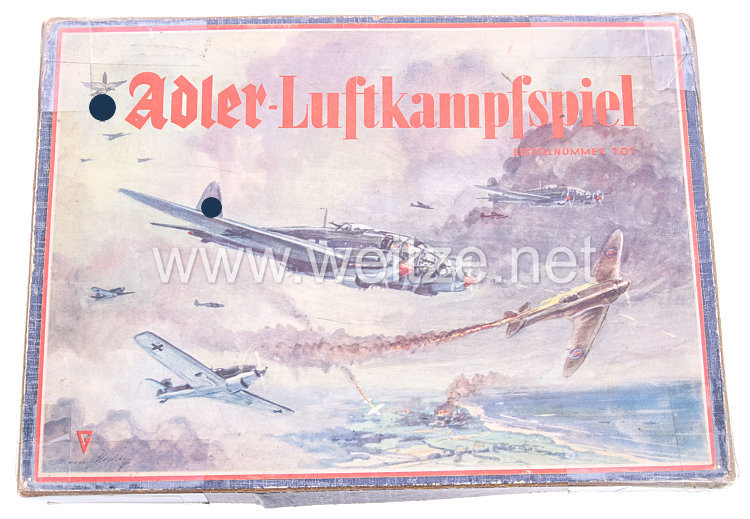
Third Reich / Luftwaffe - Board Game - “Adler-Luftkampfspiel” (Eagle Air Combat Game) - Combat Game for 2 or More Players

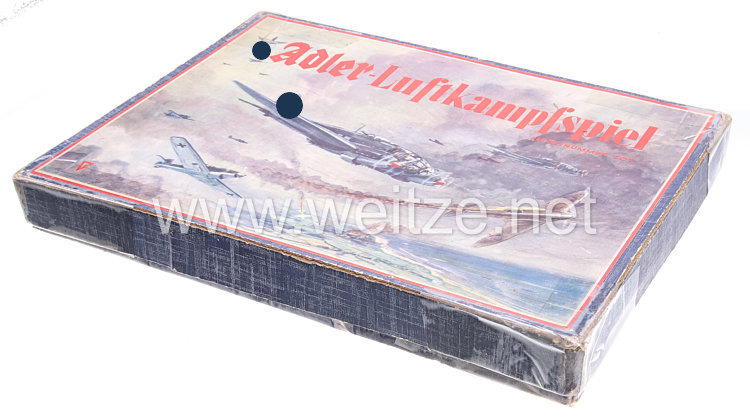
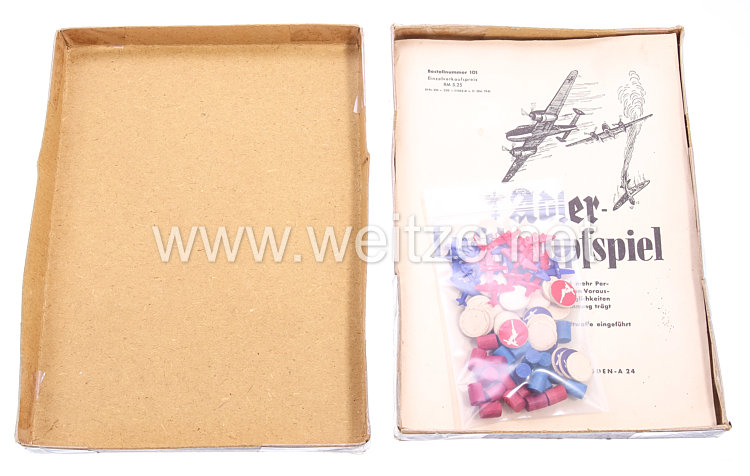
Publisher Hugo Gräfe Dresden A24, not entirely complete (missing 2 red and 1 blue aircraft, 2 red and 4 blue anti-aircraft guns, 1 blue bomb), in original packaging 31 x 22 x 2.5 cm. Condition 2-3. 
398769
140,00

Third Reich / Luftwaffe - Board Game - “Adler-Luftkampfspiel” (Eagle Air Combat Game) - Combat Game for 2 or More Players

The Adler-Luftkampfspiel (Eagle Air Combat Game), published by Hugo Gräfe Verlag in Dresden, represents a fascinating aspect of German propaganda culture during the National Socialist era. This board game for two or more players reflects the intensive militarization of German society in the 1930s and early 1940s, when military themes increasingly penetrated everyday life and leisure activities of the population.

The Hugo Gräfe publishing house was an established Dresden-based publisher that produced a variety of games, books, and propaganda materials during the Nazi period. Dresden developed as an important center of the German publishing industry, and many publishers adapted their productions to meet the ideological requirements of the regime. The address “Dresden A24” refers to the city's postal district organization of that time.

The Luftwaffe, officially established in 1935, quickly became a central element of National Socialist military propaganda. Hermann Göring, as Commander-in-Chief of the Luftwaffe, actively promoted the public glorification of this military branch. The Luftwaffe symbolized modernity, technological progress, and German superiority. This message was intended to reach not only adults but particularly the youth.

Military board games like the Adler-Luftkampfspiel served multiple purposes. Primarily, they were propaganda instruments that normalized and glorified military thinking and action. Through playful elements, they conveyed strategic thinking, tactical planning, and the concept of military competition. Players assumed the role of commanders directing air units, ships, and anti-aircraft positions.

The game components – ships in red and blue, anti-aircraft units, and bombs – suggest a scenario simulating air raids and defense. The color coding in red and blue was typical for war games of this era and symbolized opposing parties. The inclusion of ships indicates that the game possibly incorporated maritime elements, reflecting the combined warfare of that period.

Such games were mass-produced during the 1930s and early 1940s. They were part of a comprehensive strategy for military education of the German population. The Hitler Youth and the League of German Girls used similar materials to prepare young people for their future roles in society and potential wartime scenarios. Military themes were also increasingly integrated into school curricula.

Production during the war became increasingly difficult. Raw material shortages led to simplified versions of many games. Packaging and game materials had to be manufactured with limited resources. This partially explains why many surviving examples today are incomplete, as replacement parts were unavailable and components were lost.

After the war, such games were banned in Germany and largely destroyed. The Allied occupation powers conducted comprehensive denazification, which included the removal and destruction of propaganda materials. Surviving examples are therefore rare today and of considerable interest to collectors and historians.

The Adler-Luftkampfspiel is today an important historical document providing insights into the everyday culture of the Third Reich. It demonstrates how totalitarian regimes can penetrate all areas of life and instrumentalize them for ideological purposes. For military historical research, such objects are valuable for understanding the mechanisms of propaganda and social mobilization.

The preservation and scientific documentation of such objects serves exclusively historical and educational purposes. They enable subsequent generations to understand the methods of totalitarian indoctrination and learn from them.

r