Brunswick Personal Infantry Officer's Sword from the Property of Duke Wilhelm August Ludwig of Braunschweig as Colonel-in-Chief of Infantry Regiment No. 92

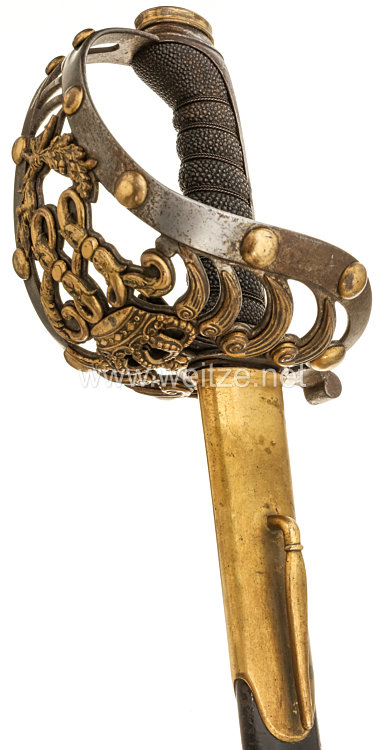
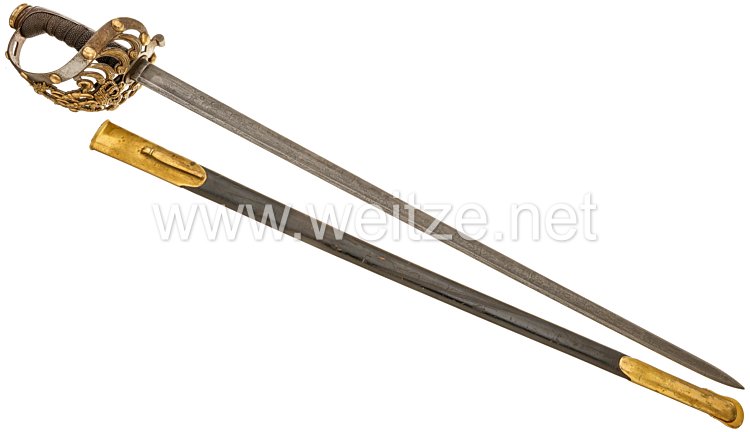
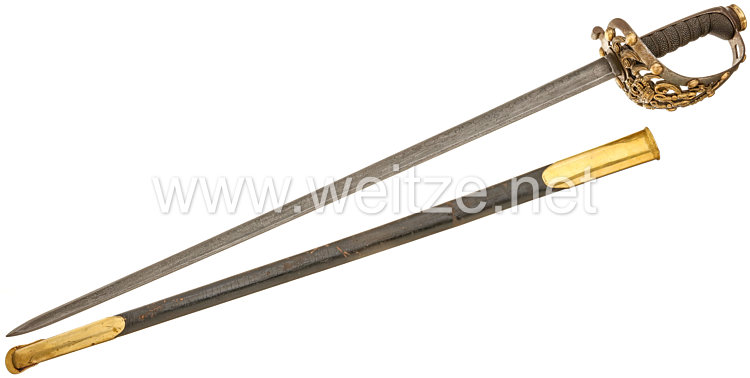
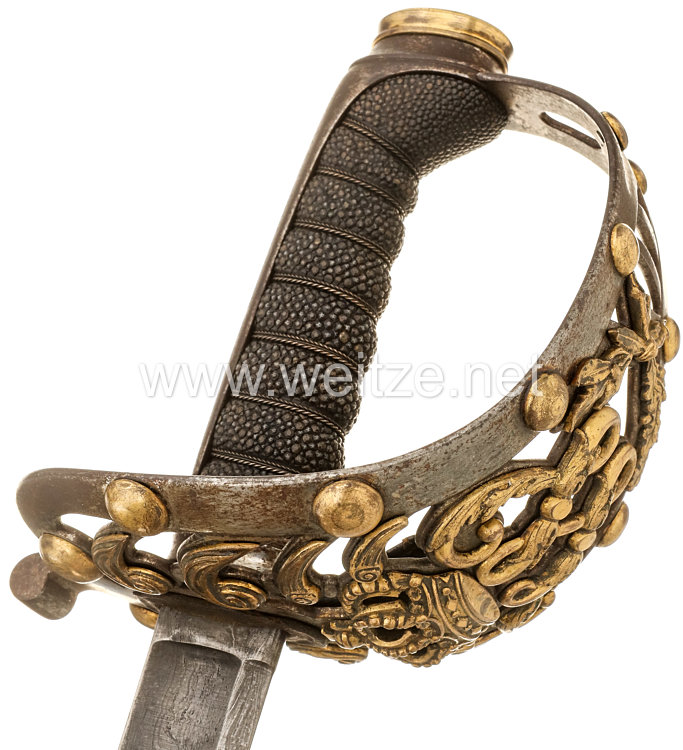
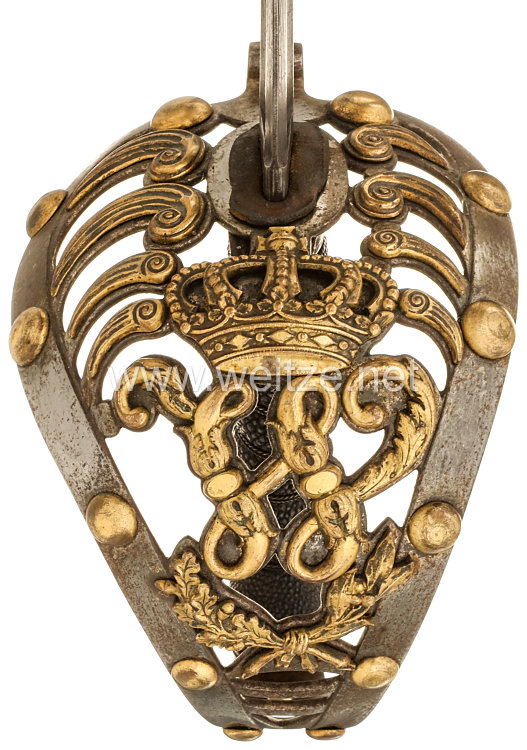
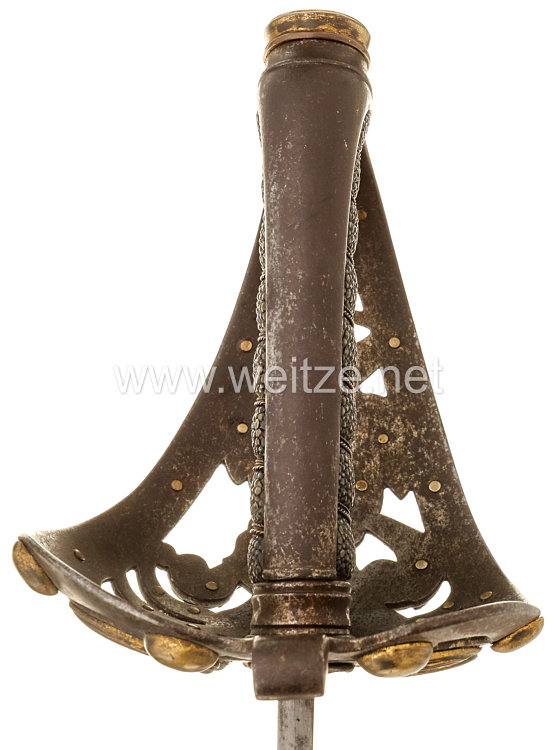
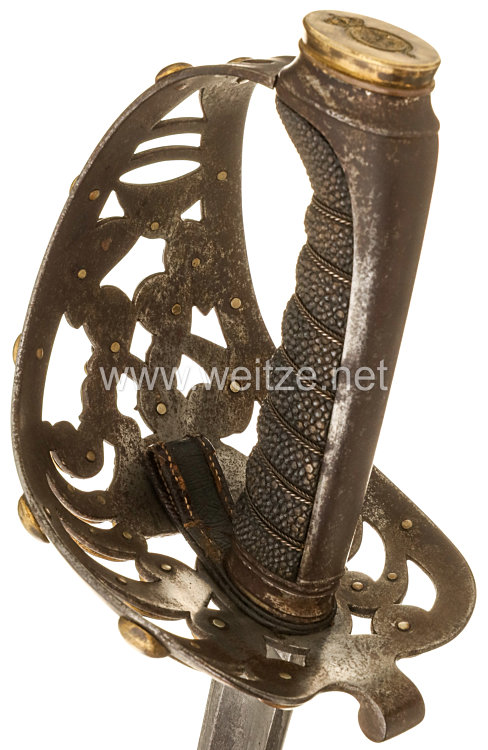
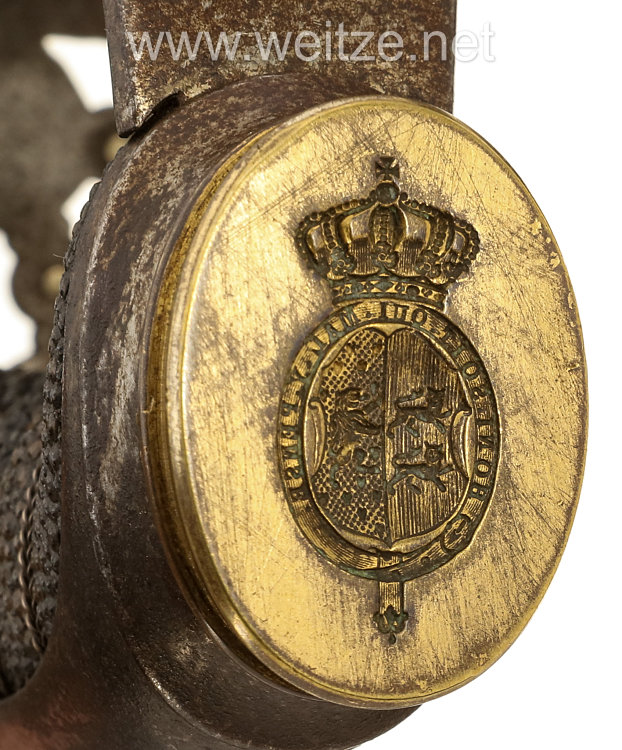
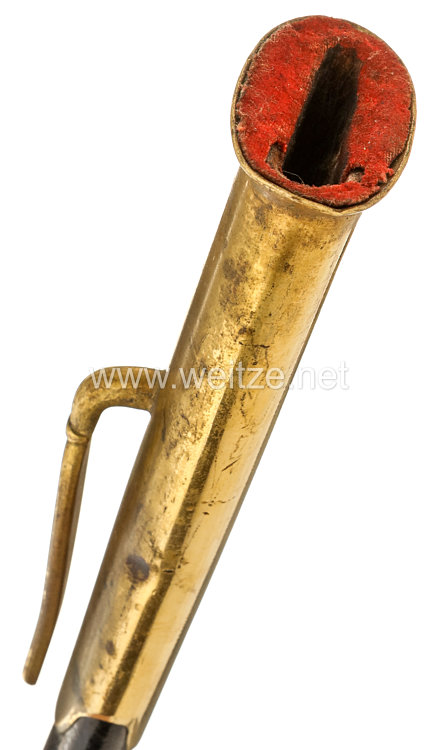
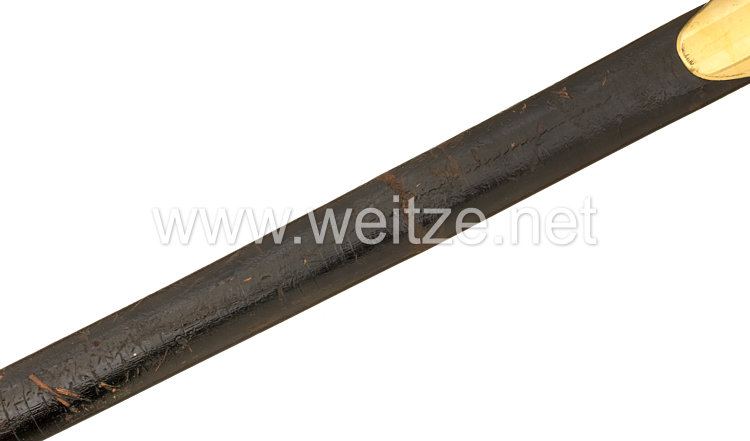
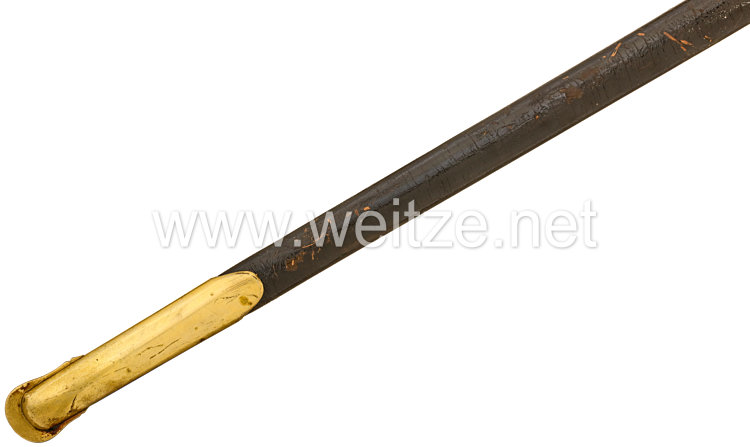
Circa 1840. Extra heavy execution as a custom-made piece for the Duke. Massive iron basket hilt, pierced work, mounted with heavy gilt brass appliqués, in the center the gilt crowned cipher “W” above an open oak leaf/laurel wreath, surrounded by heavy domed rivets. The grip with shagreen covering and intact silver wire binding, the damaged finger loop of black leather. At the top, the pommel cap of gilt brass with the Duke's personal seal. The heavy fullered blade of Damascus steel, without maker's mark. Black leather scabbard with likewise gilt brass mounts. Overall length 101 cm. Worn piece, in good untouched original condition.
An impressive weapon of museum quality.

Wilhelm August Ludwig Maximilian Friedrich (1806-1884), Duke of Braunschweig and Lüneburg as well as Oels, was Duke of Braunschweig from 1830 until his death.
358269
25.000,00

Brunswick Personal Infantry Officer's Sword from the Property of Duke Wilhelm August Ludwig of Braunschweig as Colonel-in-Chief of Infantry Regiment No. 92

This personal infantry sword from the estate of Duke Wilhelm August Ludwig of Brunswick (1806-1884) represents an exceptional example of princely militaria from the mid-19th century. This magnificent sword, crafted around 1840, embodies not only the military function of a regimental commander but also the high rank and personal authority of a reigning duke.

Duke Wilhelm of Brunswick assumed the government of the Duchy of Brunswick-Lüneburg in 1830, after his father, the eccentric Duke Charles II, had been forced to abdicate during the revolutionary turmoil of 1830. Wilhelm was known for his conservative yet effective governance and his close ties to military traditions. As chief of Infantry Regiment No. 92, he not only held a nominal position but embodied the centuries-old tradition of German princely houses holding military commands over regiments.

The custom manufacture of this sword underscores the duke's special status. Unlike standardized officers' weapons, this piece was specially commissioned for Wilhelm, which is manifest in its “extra heavy execution.” The massive iron basket hilt, pierced and decorated with heavy gilded brass overlays, displays craftsmanship of the highest quality. At the center stands the gilded, crowned cipher “W” above an open oak leaf and laurel wreath – symbols of strength, victory, and princely dignity.

The use of Damascus steel for the heavy, grooved back-edge blade was already rare in this period and refers to older forging traditions. Damascus steel, characterized by its wavy pattern, was considered particularly high-quality and resilient. The absence of a maker's mark is not unusual for custom pieces made for princely houses, as these were often crafted by court artisans whose reputation required no marking.

The grip with shagreen (ray skin) and silver wire wrapping corresponds to the standard construction of high-quality officers' weapons of the 19th century. The shagreen provided a secure, non-slip grip even when wet or when wearing gloves, while the silver wire wrapping offered additional hold and decorative value. The pommel cap bears the duke's personal seal stamp – an extraordinary detail that emphasizes the personal nature of this weapon.

Infantry Regiment No. 92 was part of the Prussian army, which also included Brunswick contingents. After the Austro-Prussian War of 1866, Brunswick became effectively part of the North German Confederation under Prussian leadership, which meant the military integration of Brunswick troops into the Prussian system. The numbering of regiments followed the Prussian system, with No. 92 designating a Brunswick regiment.

The black leather scabbard with gilded brass mounts completes the ensemble and corresponds to the typical equipment for parade weapons of high-ranking officers. The mounts not only protected the scabbard but also served the representative display at ceremonial occasions.

Infantry swords of this type increasingly became ceremonial weapons in the 19th century. The practical military significance of edged weapons decreased continuously with the development of modern firearms. Nevertheless, they remained an indispensable component of the officer's uniform, especially at parades, receptions, and official occasions. For a reigning duke, the sword symbolized his dual role as political head and military commander.

Duke Wilhelm governed Brunswick until his death in 1884, thus experiencing the profound changes that German unification brought in 1871. Although Brunswick retained its formal statehood within the German Empire, its sovereignty rights were significantly restricted. Military contingents were fully integrated into the imperial army.

The preserved condition of this sword – worn but in good untouched original state – makes it a valuable historical document. The visible traces of use testify that this was not a purely ceremonial weapon but an actually worn piece. Such personal items of reigning princes are extraordinarily rare, as they usually remained in family possession or were transferred to state collections.

As a museum object, this sword documents the interweaving of princely power, military tradition, and artisanal craftsmanship in Germany during the Restoration period and Vormärz. It represents an era when German princely houses still exercised significant political and military power before the unification of the Reich fundamentally altered these structures.

The sword's weight and construction suggest it was designed for a man of considerable physical strength, befitting a duke who took his military role seriously. The elaborate decoration, combined with the functional design, exemplifies the 19th-century aristocratic ideal of combining martial prowess with refined aesthetics. Such weapons were worn at court ceremonies, military reviews, and state occasions, where they served as visible symbols of the bearer's authority and social standing.

r