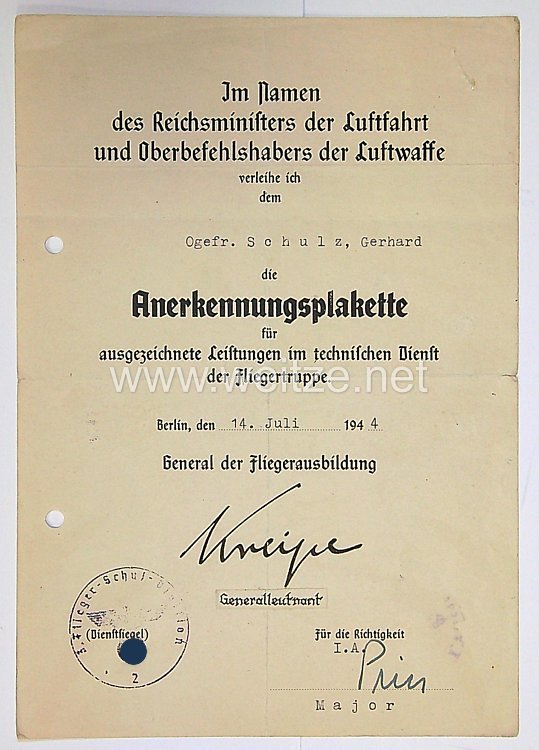
Luftwaffe - Award Certificate for the Recognition Plaque for Outstanding Achievements in Technical Service of the Aviation Troops
The Recognition Plaque for Outstanding Achievement in the Technical Service of the Air Force represents a significant, though often overlooked, award of the German Luftwaffe during World War II. This award certificate, issued on July 14, 1944 to an Obergefreiter (Lance Corporal), documents the recognition of technical excellence during a critical phase of the air war.
The Recognition Plaque was instituted by decree of Reichsmarschall Hermann Göring on February 10, 1941. Its introduction came against the backdrop of the increasing importance of technical personnel for the operational readiness of the Luftwaffe. While pilots and aircrew were honored through numerous decorations, there had long been a lack of specific recognition for ground personnel, whose work was essential to the success of air operations.
The award was directed at members of the technical service of the flying troops who had distinguished themselves through exceptional performance in the maintenance, repair, and technical support of aircraft. This included mechanics, armament specialists, radio operators, electricians, and other specialists whose expertise ensured the operational capability of aircraft.
The award criteria were strictly regulated. The Recognition Plaque could only be awarded for outstanding individual achievements or continuous above-average work over an extended period. The application had to be endorsed by the responsible Geschwaderkommodore (Wing Commander) or comparable superior and approved by higher authorities. The award was made in the name of the Commander-in-Chief of the Luftwaffe.
The physical plaque itself consisted of silver-plated zinc alloy and featured a stylized aircraft propeller in the center, surrounded by an oak leaf wreath. The reverse side was designed for engraving the wearer's name. The plaque was worn on the left breast of the uniform and had a diameter of approximately 42 millimeters.
The present document, an award certificate, constitutes an essential component of the decoration. Such certificates were printed on high-quality paper and typically bore the official seal and the signature of the awarding commander. The typical design included the Reich eagle with swastika, the name and rank of the recipient, and the date of award.
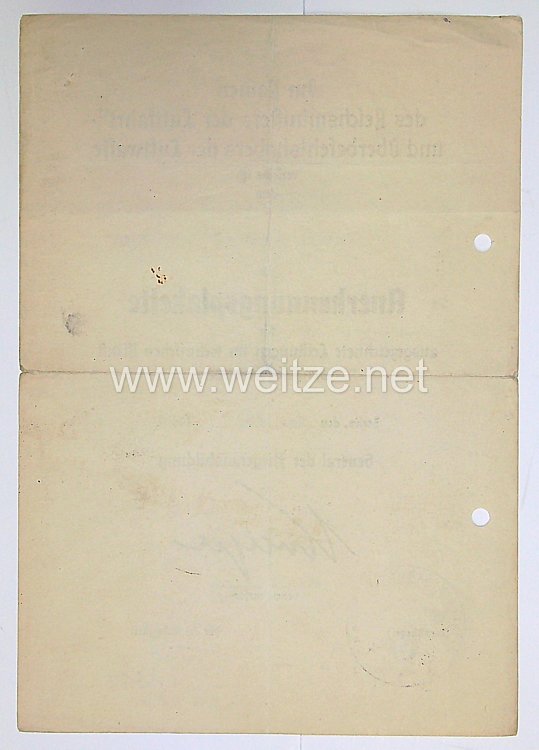
The condition of this certificate – punched and multiply folded – is characteristic of documents that were filed in military records. The punching indicates that the certificate was kept in the Obergefreiter's personnel file, while the folding may suggest later private storage.
The issue date of July 14, 1944 falls during a dramatic phase of the war. At this time, the Luftwaffe found itself in an increasingly defensive position. The Allied air forces had achieved air superiority over Western Europe, and Operation Overlord was already underway. The Soviet Operation Bagration had just begun, leading to the collapse of Army Group Center. Under these circumstances, the work of technical personnel was more important than ever to keep the remaining aircraft operational.
The rank Obergefreiter was a non-commissioned officer grade without sword knot and roughly corresponded to an experienced enlisted rank with special responsibility. The fact that a soldier of this rank received the Recognition Plaque underscores that the award was actually given based on performance rather than rank.
The rarity of this decoration made it particularly valuable. Compared to other Luftwaffe awards such as the Pilot's Badge or the Ground Assault Badge of the Luftwaffe, significantly fewer Recognition Plaques were awarded. This underscores their elite character and the high standards attached to their bestowal.
After the war's end, many such documents were destroyed or lost. Surviving examples are important historical sources today, providing insight into the personnel system and the award system of the Luftwaffe. They document not only individual achievements but also the organizational structure and the appreciation of technical competence within the German air force.
For collectors and historians, such award certificates are of considerable interest. They enable the reconstruction of military careers and offer insights into the everyday reality of war beyond combat operations. The authenticity of such documents can be verified through various features such as paper quality, printing methods, signatures, and official seals.
This particular certificate, despite its worn condition indicated by the folding and punching, remains a tangible connection to a specific moment in history when technical skill was formally recognized in the midst of Germany's greatest military crisis.