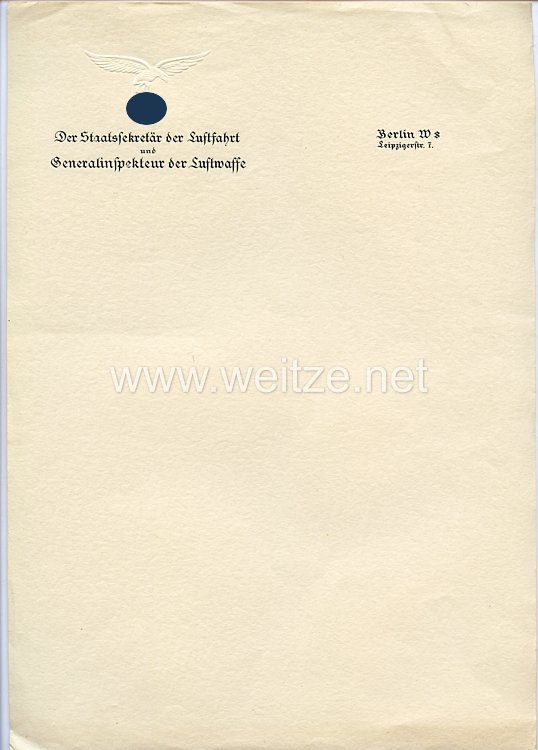
Luftwaffe - Generalfeldmarschall Erhard Milch - his personal stationery
This personal stationery of Generalfeldmarschall Erhard Milch represents a significant historical document from the leadership level of the German Luftwaffe during World War II. The embossed Luftwaffe eagle and the letterhead bearing the title “Der Staatssekretär der Luftfahrt und Generalinspekteur der Luftwaffe” (State Secretary of Aviation and Inspector General of the Air Force) date this document to the early phase of Milch's career in the Luftwaffe leadership.
Erhard Milch (1892-1972) was one of the most prominent and controversial figures in German aviation history. After his career as a fighter pilot in World War I, he became director and later chairman of Deutsche Luft Hansa in 1926, where he played a crucial role in building up civil aviation in Germany. His organizational abilities and technical understanding made him an indispensable expert for the construction of the new Luftwaffe.
With the Nazi seizure of power in 1933, Milch was appointed by Hermann Göring as State Secretary of the Reich Aviation Ministry. In this position, noted on the present stationery, he was effectively the second most powerful man in the Luftwaffe and primarily responsible for its organizational and industrial development. The address Berlin W 8, Leipziger Straße 7 designates the Reich Aviation Ministry, an imposing new building designed by Ernst Sagebiel, constructed in 1935/36 and considered one of the first major construction projects of the Nazi regime.
The official title on this stationery indicates the period between 1933 and 1938, when Milch still served as “Inspector General of the Air Force.” In February 1938, he was promoted to Generaloberst (Colonel General), and in 1940 to Generalfeldmarschall (Field Marshal). The embossed Luftwaffe eagle adorning the stationery was the official sovereign emblem of this branch of service and symbolized the authority and power of this still-young military force.
Milch's role in building up the Luftwaffe can hardly be overestimated. He was responsible for aircraft production, the development of new weapon systems, and the organizational structure of the entire air force. His relationship with Göring, however, was marked by tensions, as Milch was often critical of strategic decisions and assessed production figures and technical developments more realistically than his superior.
As Inspector General, Milch had far-reaching authority over all technical and organizational aspects of the Luftwaffe. He coordinated cooperation with the aviation industry, supervised research and development, and was instrumental in introducing new aircraft types. The aircraft developed during his tenure, such as the Messerschmitt Bf 109 and the Junkers Ju 87, shaped aerial warfare in the coming years.
This stationery is an authentic testament to the bureaucratic and representative culture of the Nazi leadership. The elaborate embossing of the Luftwaffe eagle underscores the claim to authority and power. Such official letterheads were used for correspondence with the highest government agencies, military offices, and important industry representatives.
After World War II, Milch was charged in the Milch Trial at Nuremberg (1947) with war crimes and crimes against humanity, particularly for the exploitation of forced laborers in the armaments industry. He was sentenced to life imprisonment but released in 1954 for health reasons. Milch died in Düsseldorf in 1972.
For collectors and historians, such personal documents of high-ranking Nazi officials are of particular interest, as they offer authentic insights into the administrative structure and representative culture of the Third Reich. The unfolded paper with only slight storage marks is in remarkably good condition and documents the early phase of Luftwaffe leadership under one of its most influential organizers.