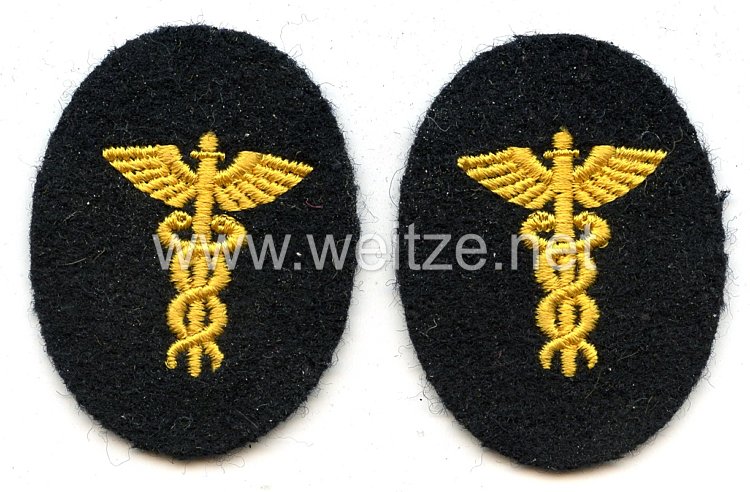
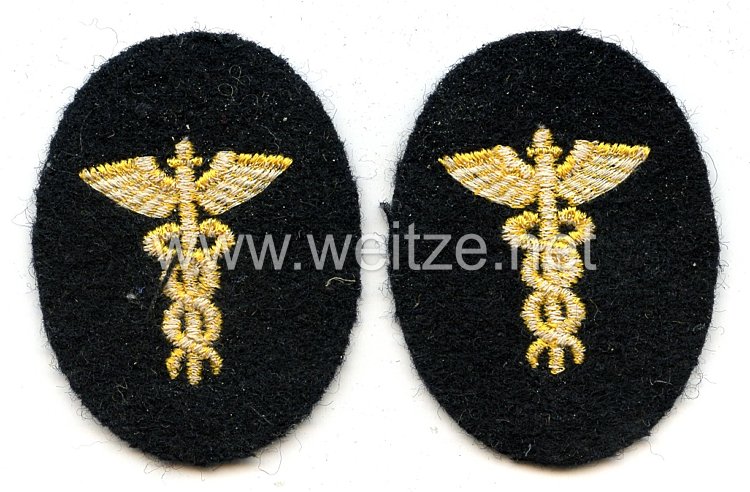
Kriegsmarine Pair of Sleeve Insignia for an Administrative Officer
The present pair of sleeve insignia for a Kriegsmarine Administrative Officer represents an important component of the uniform system of the German Navy during World War II. These machine-embroidered versions served for the quick identification of officers of the administrative service within the maritime armed forces of the German Reich.
The Kriegsmarine, officially founded on June 1, 1935, replaced the Reichsmarine, which had been severely restricted by the Treaty of Versailles. With the rearmament under National Socialist rule, a complex system of rank insignia and career branch designations was introduced, which was based on historical German naval traditions but adapted to the requirements of a modern naval force.
Administrative Officers formed an essential component of the Kriegsmarine. Their duties included economic administration, food supply management, pay matters, and all administrative concerns of the Navy. These officers belonged to the special career tracks that differed from sea officers, engineers, and other technical branches.
The sleeve insignia or sleeve patches were worn on both sleeves of service jackets according to the uniform regulations of the Kriegsmarine. They typically consisted of an oval basic form with career-specific coloring and symbolism. For administrative officers, the characteristic color was dark blue (later also referred to as “administrative blue”), which clearly distinguished them from the golden insignia of sea officers or the black ones of engineers.
The machine embroidery of these insignia suggests production during the war years, when industrial mass production of uniform items became necessary. While hand-embroidered insignia of higher quality were frequently used in the pre-war period and early war years, production increasingly shifted to more cost-effective machine manufacturing. This enabled faster production while maintaining recognizability of career branch affiliation.
The design of the administrative insignia followed the dress regulations of the Kriegsmarine, which were established in several directives between 1935 and 1945. The central regulatory framework was the “Dress Regulations for the Kriegsmarine” of 1936 with subsequent supplements and amendments. These regulations precisely specified which insignia were to be worn by which ranks and career branches.
A pair of sleeve insignia was required because these were attached mirror-image on both sleeves, typically above the sleeve stripes that indicated rank. The position was precisely prescribed and usually lay about 10 to 12 centimeters above the end of the sleeve.
The administrative career track in the Kriegsmarine was strictly hierarchical. It began with the administrative officer candidate and progressed through paymaster aspirant, paymaster, and senior paymaster to higher ranks such as naval paymaster, naval staff paymaster, and finally to senior naval staff paymaster. Training took place at special naval schools and included commercial, legal, and military content.
The practical importance of administrative officers cannot be underestimated. They were responsible for supplying crews at sea, administering naval bases on land, and the complex logistics of a modern naval fleet. Their work was fundamental to the operational readiness of ships and submarines.
The preservation of such sleeve insignia as collectibles today offers important insights into the uniform system and organizational structure of the Kriegsmarine. They document the sophistication of the military system and the importance attached to the visual identification of different service areas.
After the end of World War II in 1945, the Kriegsmarine was dissolved. The uniforms and insignia were largely destroyed or confiscated by the Allies. Preserved examples such as these sleeve insignia are therefore historical documents of a defunct military organization and its administrative structures.