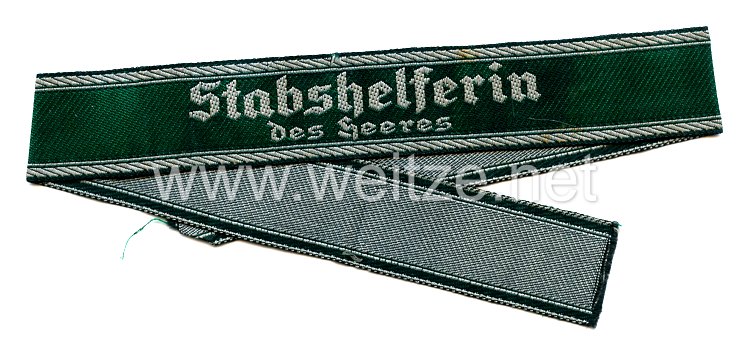
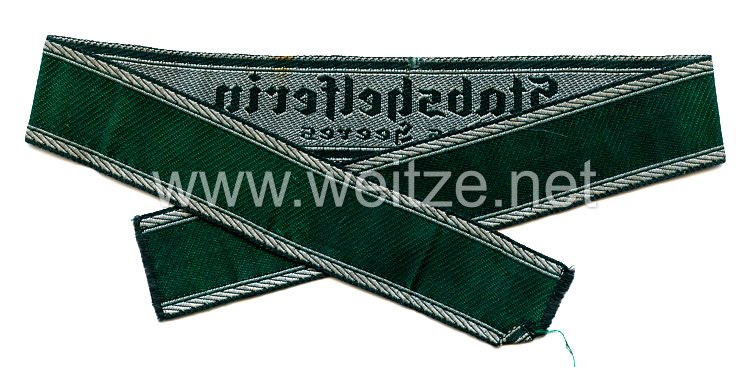
Wehrmacht Heer Cuff Title "Stabshelferin des Heeres" (Army Staff Assistant)
The Wehrmacht Army armband "Stabshelferin des Heeres" (Female Army Staff Auxiliary) represents a fascinating testament to the organizational development of the Wehrmacht during World War II. This insignia documents the increasing involvement of women in military administrative and support functions as the personnel requirements of the German armed forces grew continuously from 1940 onwards.
The Stabshelferinnen des Heeres (Female Army Staff Auxiliaries) were officially introduced by decree on November 29, 1940. These women were not soldiers in the strict sense but held the status of uniformed civilian employees. Their areas of responsibility primarily encompassed administrative and communication tasks: teletype operators, telephone operators, clerks, interpreters, and other office duties in headquarters and service posts. Their deployment was intended to free male soldiers for frontline service.
The present armband was manufactured using BeVo weaving technique. BeVo was the abbreviation for Bandfabrik Ewald Vorsteher from Wuppertal-Barmen, a company specialized in high-quality woven labels and military insignia. The BeVo technique enabled the machine production of textile emblems with precise details and durable quality. The text and design were directly woven, not embroidered, resulting in a characteristically flat, precise appearance.
The armband was worn on the left upper arm of the uniform, typically about 15 cm below the shoulder seam. The standard length of approximately 42 cm corresponded to the regulations of the time and was measured to encircle the upper arm of an average wearer. The inscription was executed in the characteristic Gothic script typical of Wehrmacht armbands, on a dark background with light text or vice versa, depending on the version and service branch.
The organizational framework for the staff auxiliaries was continuously expanded. Initially deployed only in limited numbers, their strength grew to over 450,000 women by 1944, serving in various areas of the Wehrmacht. Besides the Army, there were corresponding auxiliary corps in the Luftwaffe (Air Force auxiliaries) and the Kriegsmarine (Navy auxiliaries), each with their own armbands and uniform variations.
The uniform of the Army staff auxiliaries consisted of a field-grey skirt, blouse, army belt with buckle, and a garrison cap. A coat was also worn on special occasions. Rank insignia were attached to the shoulder straps and distinguished various ranks within the auxiliary corps, from simple auxiliary to staff auxiliary and senior supervisor.
The legal status of the auxiliaries remained ambivalent throughout the war. Although uniformed and subject to military discipline, they were not considered combatants under the Geneva Convention. This was theoretically meant to provide them with certain protections, though this proved questionable in practice during the final years of the war, especially in the eastern territories.
The collection and study of such armbands is of considerable significance for military history. They document not only the organizational structure of the Wehrmacht but also the societal mobilization during the Total War. The role of women in the German war machine was long a neglected field of research that has only been systematically addressed in recent decades.
Today, authentic staff auxiliary armbands are sought-after collector's items that offer important insights into the material culture and organization of the Wehrmacht. The BeVo weaving technique, condition, and authenticity are important evaluation criteria. Worn examples, such as the described piece, testify to actual use and lend the object additional historical authenticity.
The study of these insignia contributes to our understanding of how the Nazi regime mobilized women for war efforts while maintaining ideological restrictions on their roles. The auxiliaries represented a pragmatic compromise between military necessity and National Socialist gender ideology, which traditionally emphasized women's domestic roles. This contradiction became increasingly acute as the war progressed and Germany's military situation deteriorated.