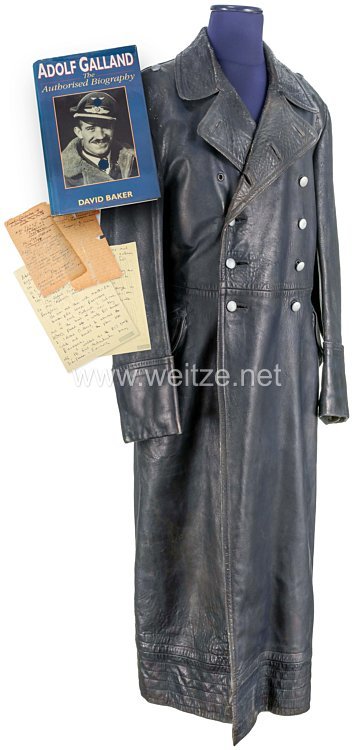
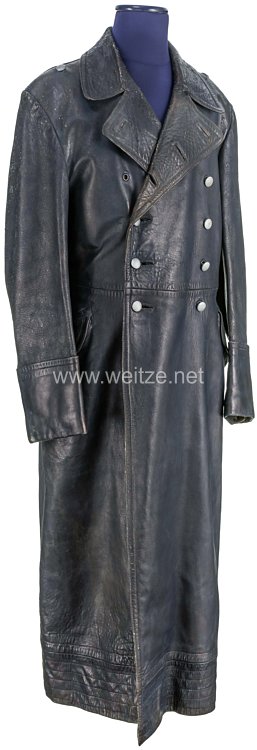
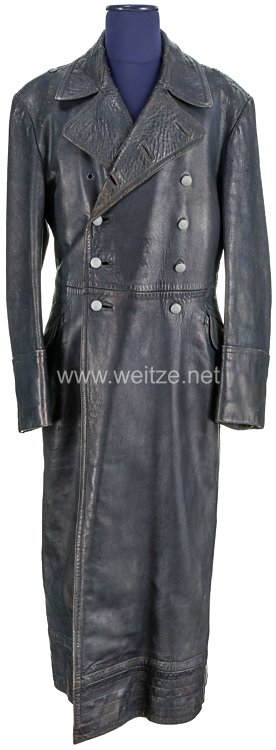
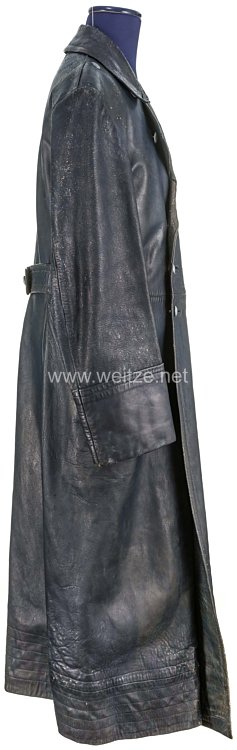
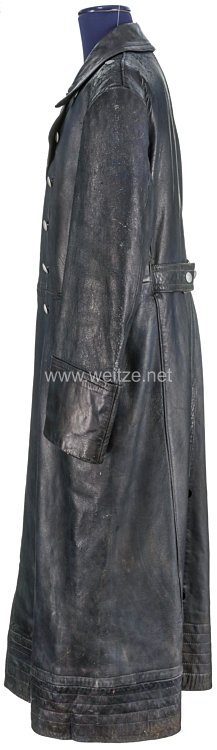
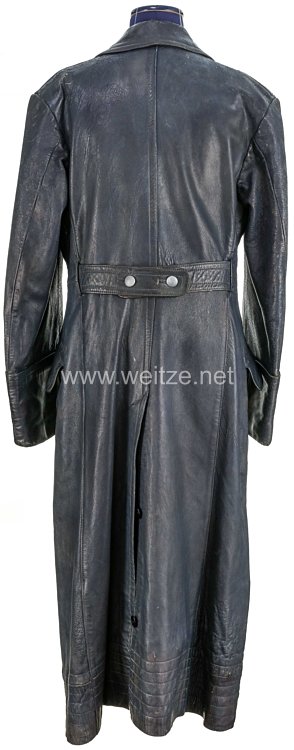
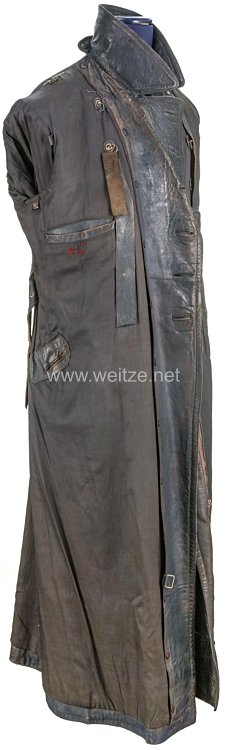
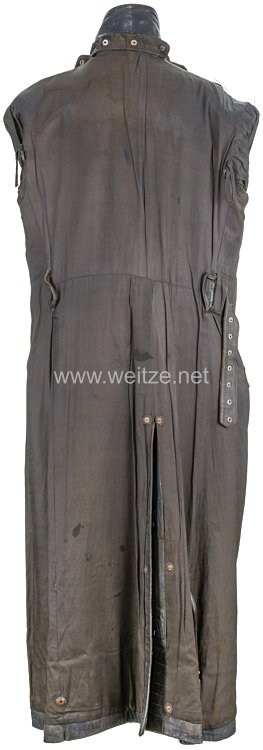
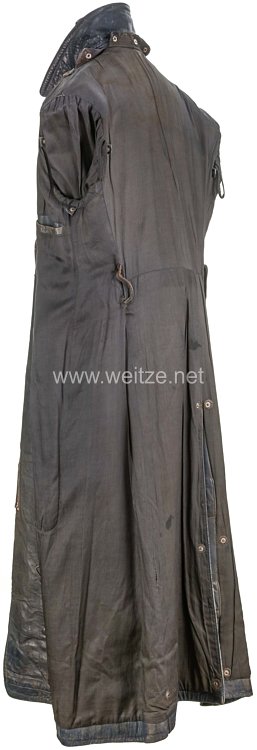
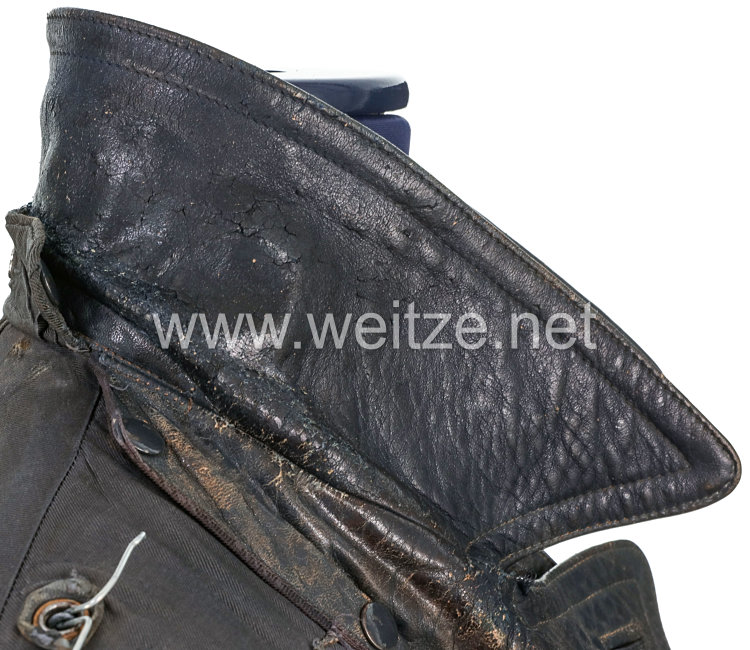
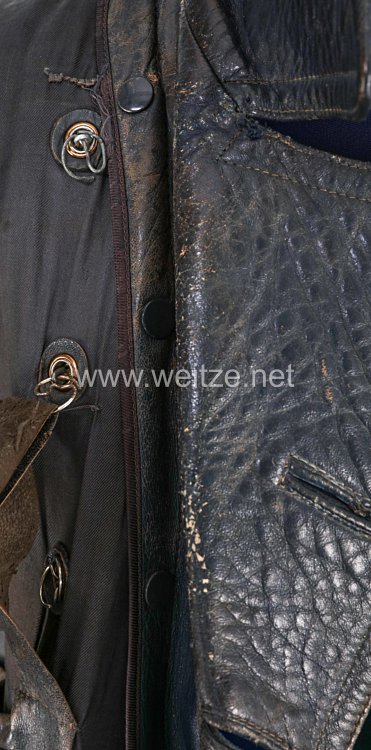
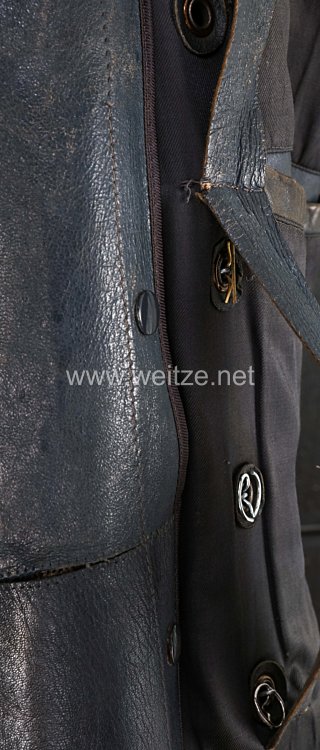
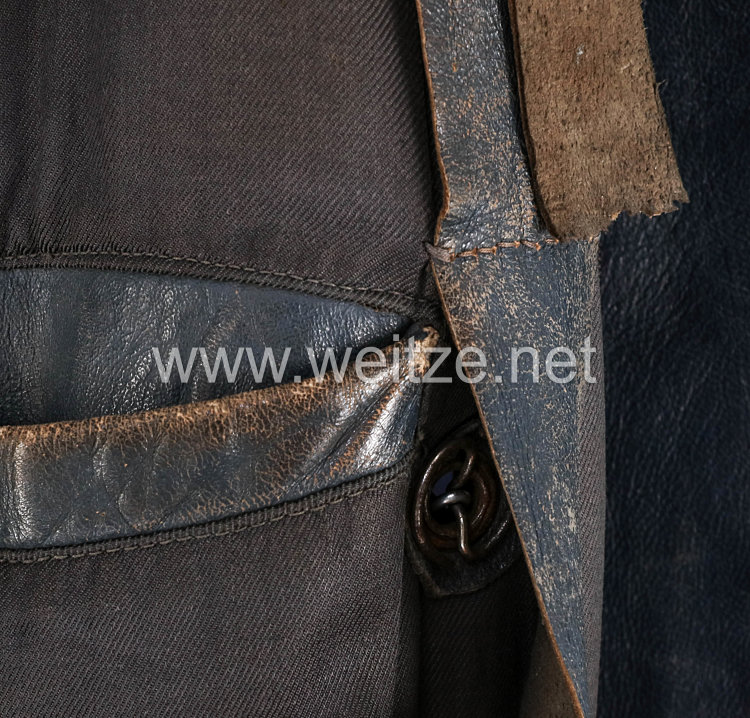
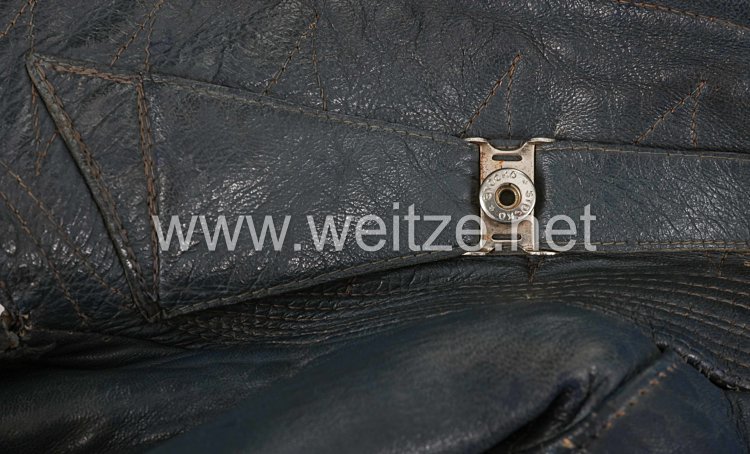
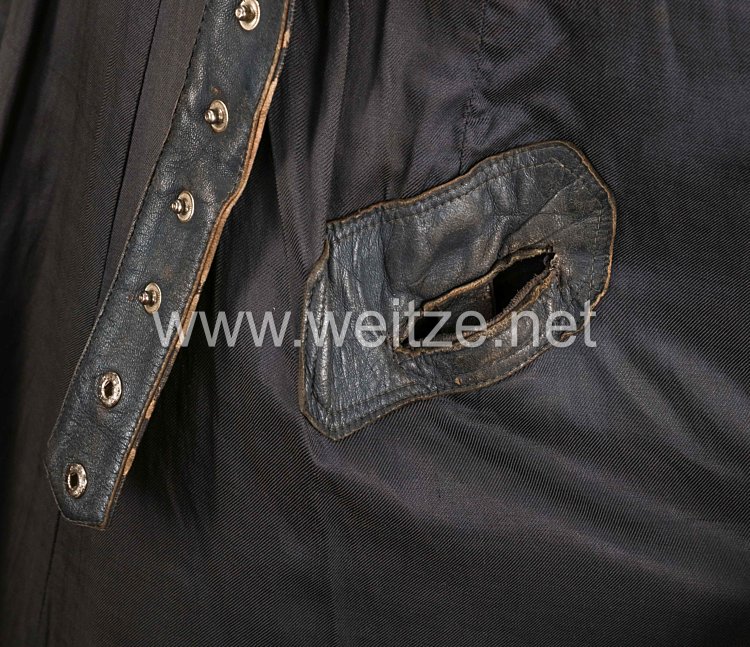
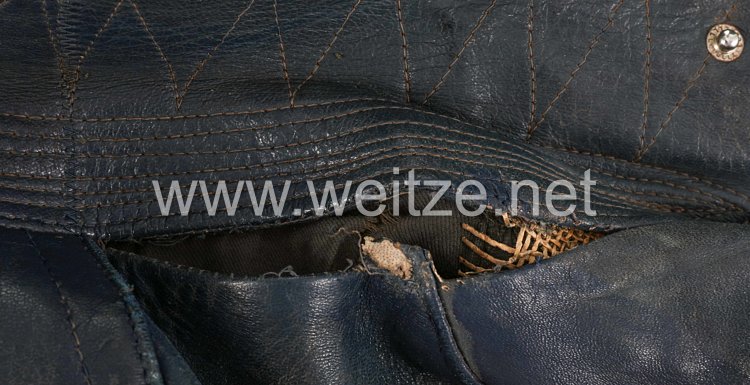
This remarkable artifact — a heavy officer's leather coat crafted from blue smooth leather — represents one of the rarest categories of World War II military collectibles: a verifiable personal uniform item belonging to Generalleutnant Adolf Galland, one of the most celebrated and highly decorated fighter pilots in the history of aerial warfare.
The Coat: Description and Construction
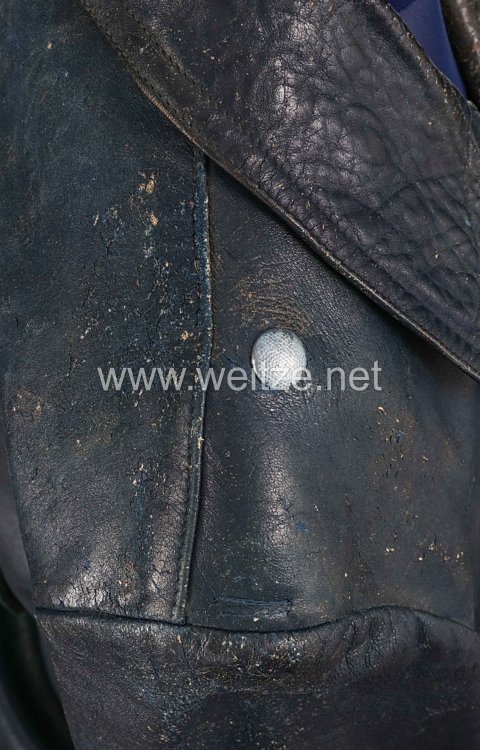
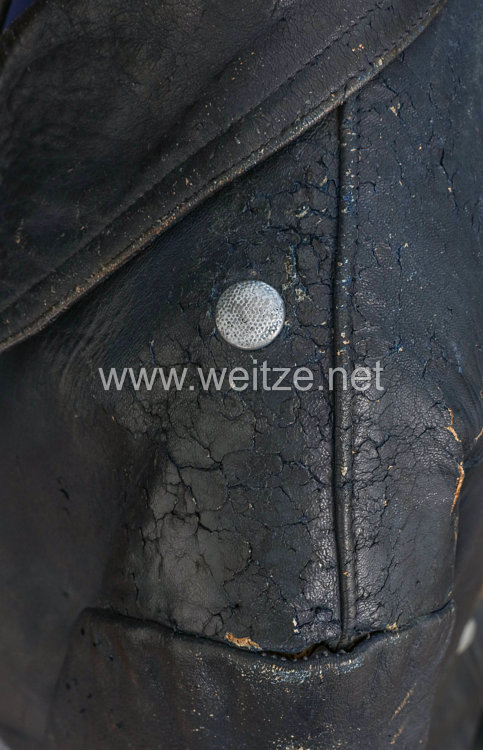
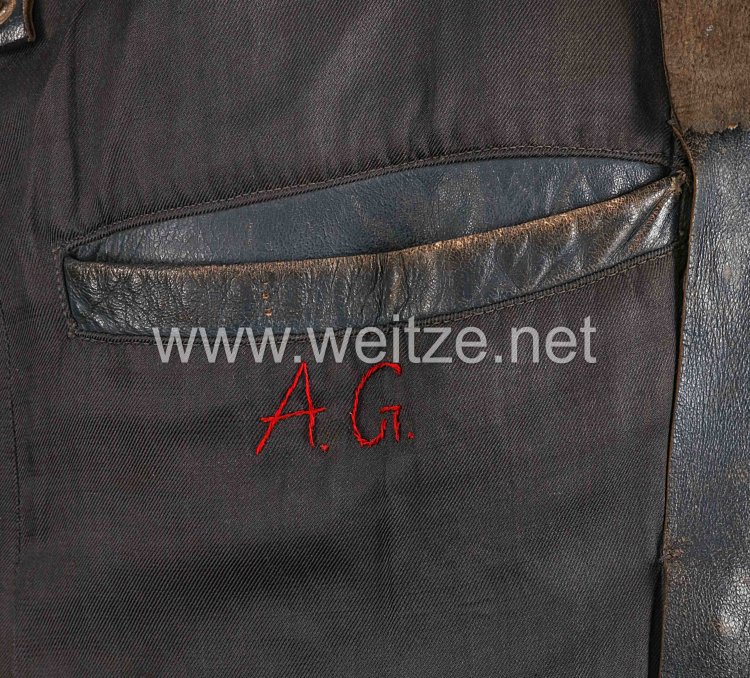
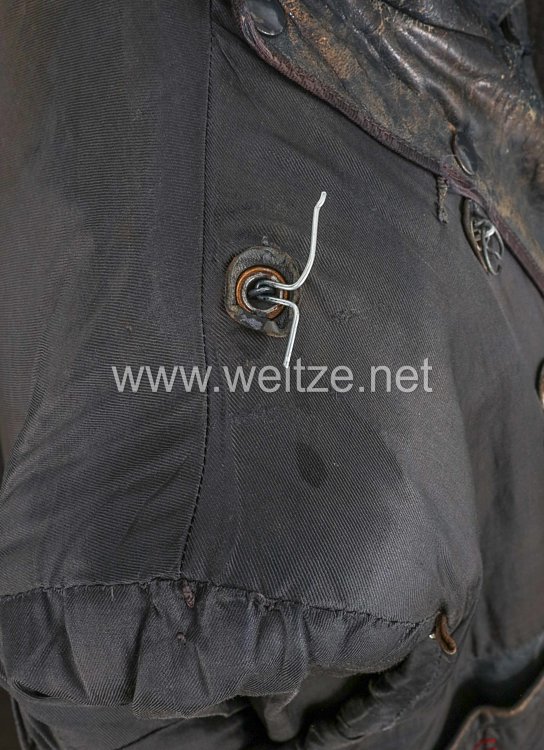
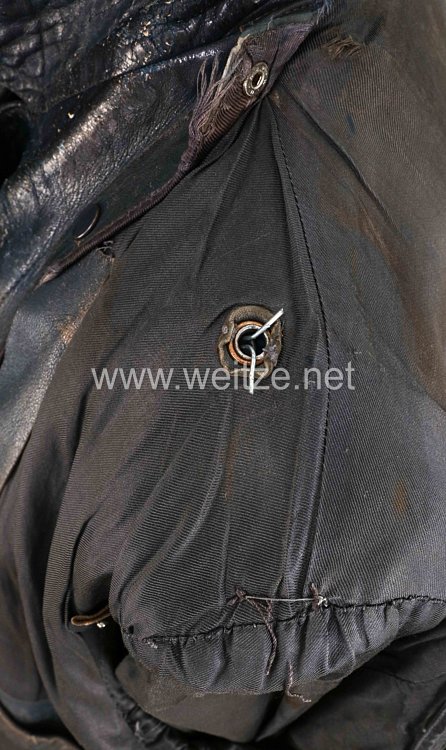
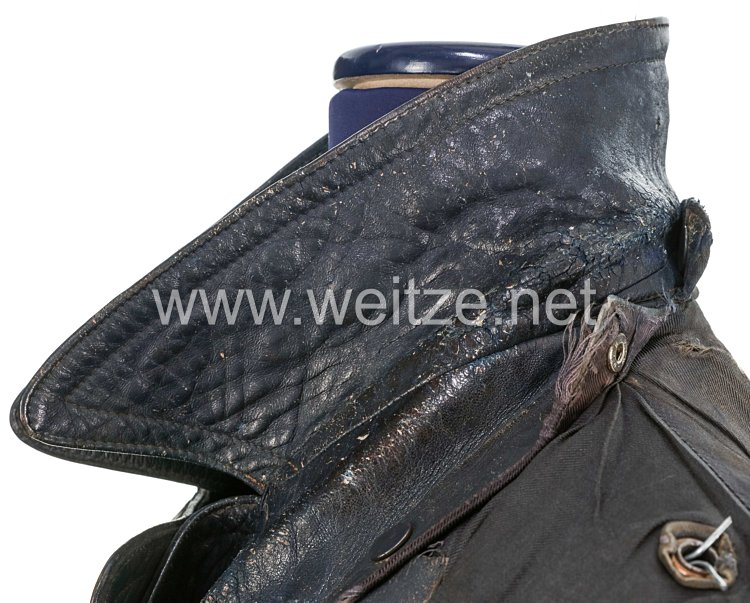
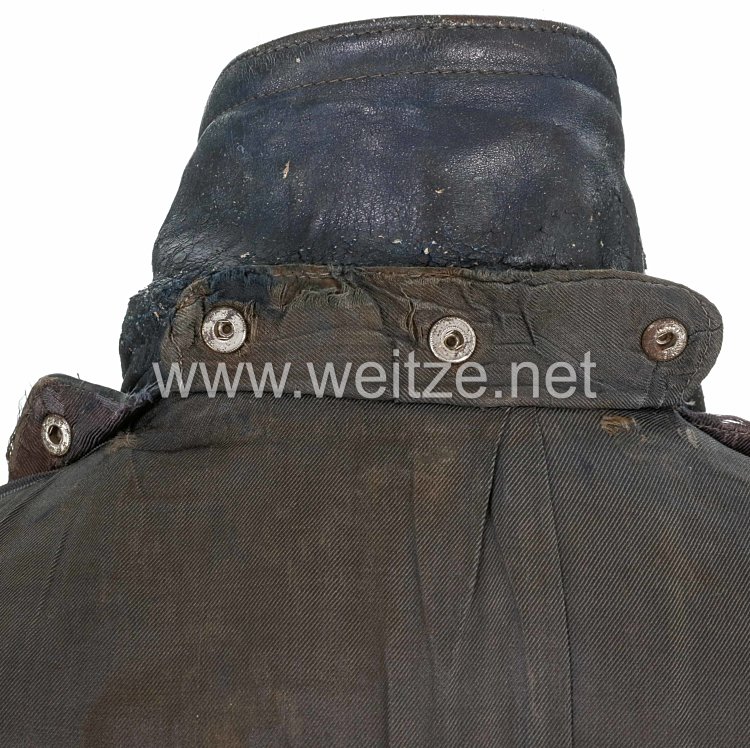
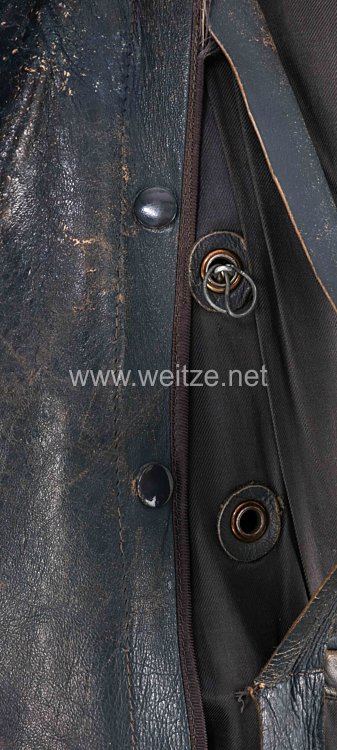
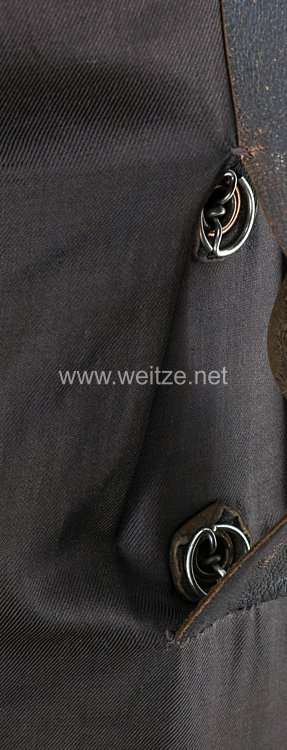
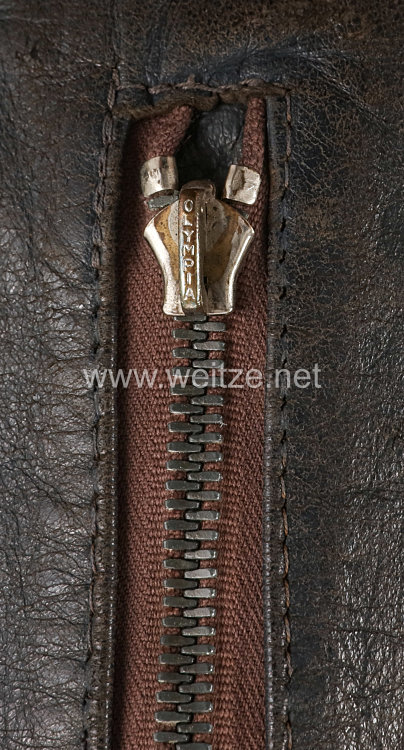
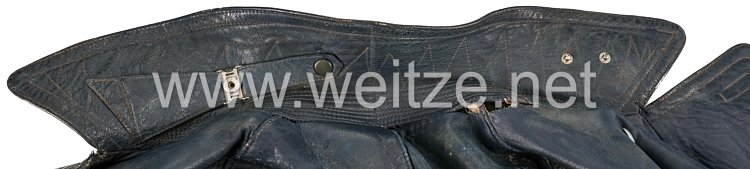
The coat is made of blue smooth leather (blaues Glattleder) and lined with blue-grey silk. It features removable silver officer's buttons along with shoulder buttons where shoulder boards were once attached — these were removed after 1945. A sewn-in slit accommodates the wearing of an officer's dagger, a characteristic detail of Luftwaffe officer uniforms. The left inner pocket bears a red monogram embroidery “A G”, pointing to its distinguished owner.
Private purchase leather coats and jackets were widely popular among Luftwaffe personnel and appear frequently in period photographs, despite being technically in contradiction of regulations. Officers and senior NCOs were responsible for purchasing their own uniforms and received a clothing allowance for this purpose, acquiring their garments from private tailors or military clothing depots. Standard Luftwaffe greatcoats were made from heavy blue-grey wool fabric, double-breasted with metal buttons. This blue leather variant represents an unusual private purchase item, reflecting the latitude that officers — particularly those of high rank and renown — exercised in their personal attire.
Adolf Galland: A Legendary Fighter Pilot
Adolf Galland (1912–1996) was a German Luftwaffe General and flying ace who served throughout the Second World War on the European theater. He flew 705 combat missions and was credited with 104 aerial victories. Rising to the rank of Generalleutnant in late 1944, he became Germany's youngest general at just 30 years of age.
From 1941 to 1945, Galland served as General der Jagdflieger (General of Fighters), a position of immense strategic importance in the direction of the Reich's fighter defenses. During the Battle of Britain, he commanded Jagdgeschwader 26 (JG 26), one of the Luftwaffe's premier fighter wings. In the war's final weeks, he took command of the elite Jagdverband 44 (JV 44), a unit equipped with the revolutionary Me 262 jet fighter, piloting the aircraft himself in combat.
Galland was one of only 27 recipients of the Knight's Cross of the Iron Cross with Oak Leaves, Swords and Diamonds, the highest grade of this decoration awarded during the Second World War. This placed him in the most exclusive circle of decorated German military personnel.
Captivity and Provenance
Captured by American forces in May 1945, Galland was imprisoned and interrogated on Luftwaffe fighter tactics. Multiple sources confirm that Galland, Günther Rall, and Hans-Ulrich Rudel arrived at RAF Station Tangmere as prisoners of war in mid-1945.
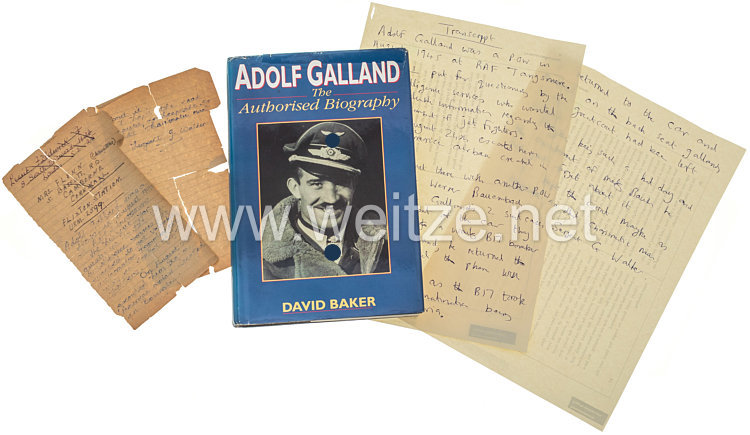
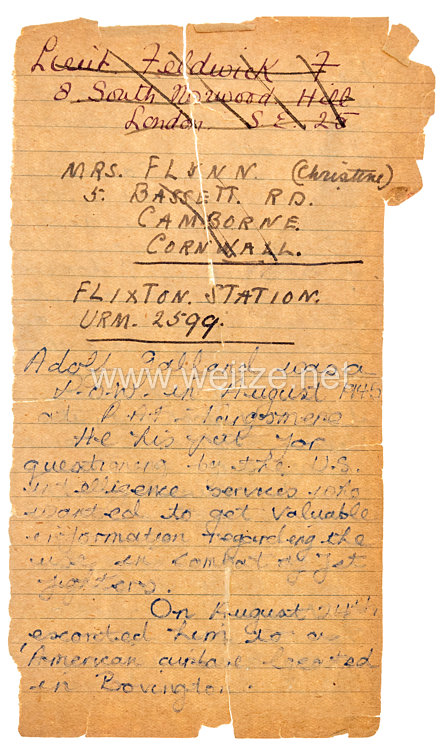
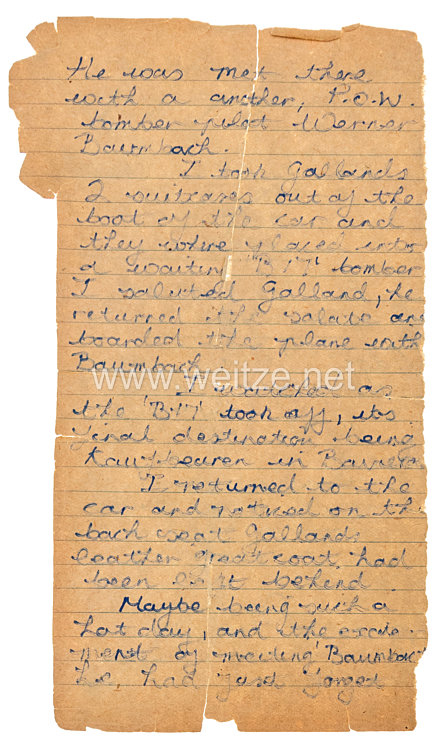
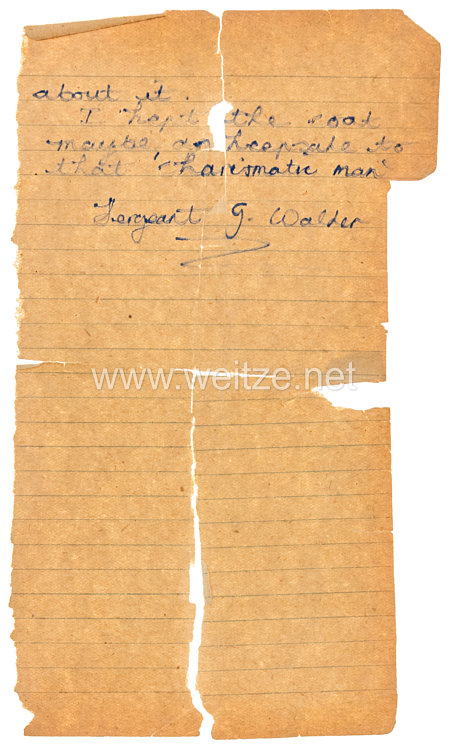
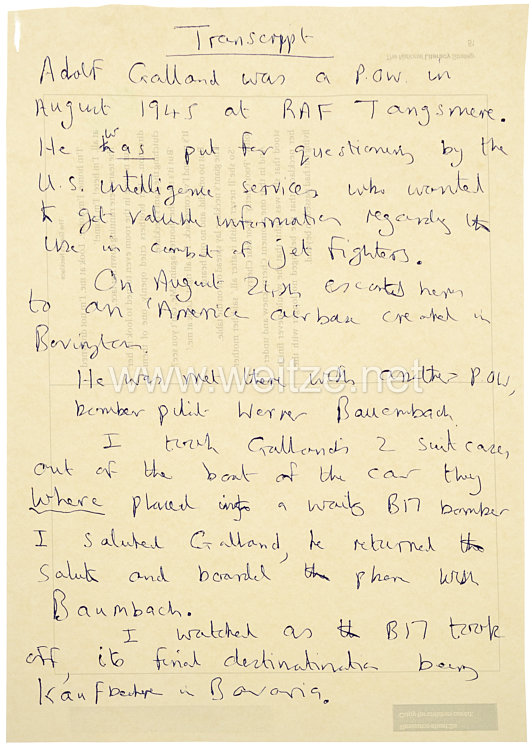
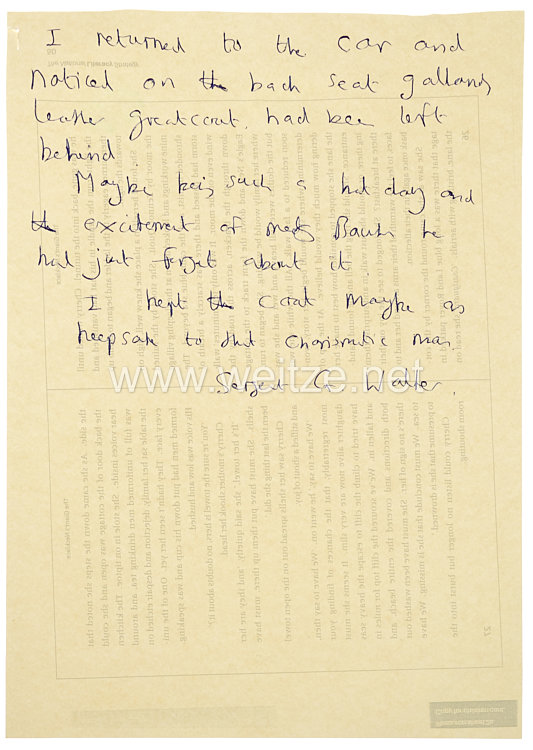
The provenance of this coat rests on the accompanying original 1945 notes and confirmation by British Sergeant G. Walter, together with a legible handwritten transcription. According to these documents, Galland was a British prisoner of war at RAF Tangmere and was transported, together with Werner Baumbach — a Luftwaffe bomber commander who also spent time as a British POW after the war — to a US base for interrogation by American intelligence regarding jet aircraft. During this transfer, Galland forgot the coat in the vehicle, whereupon Sergeant Walter took possession of it.
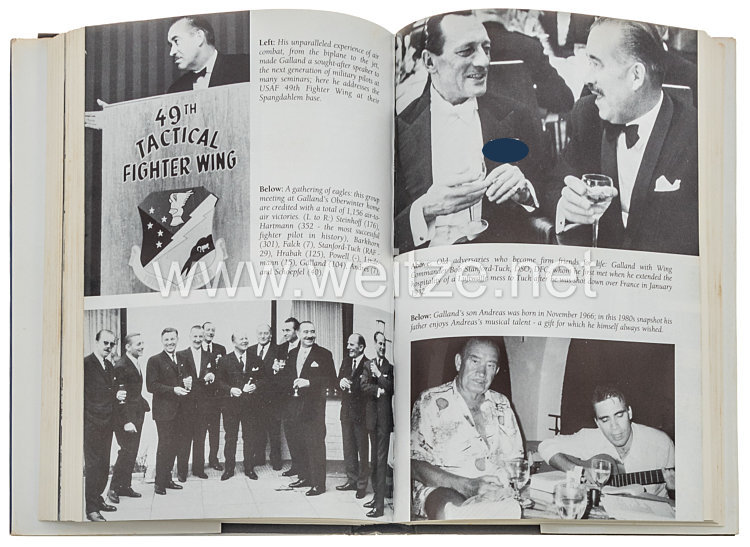
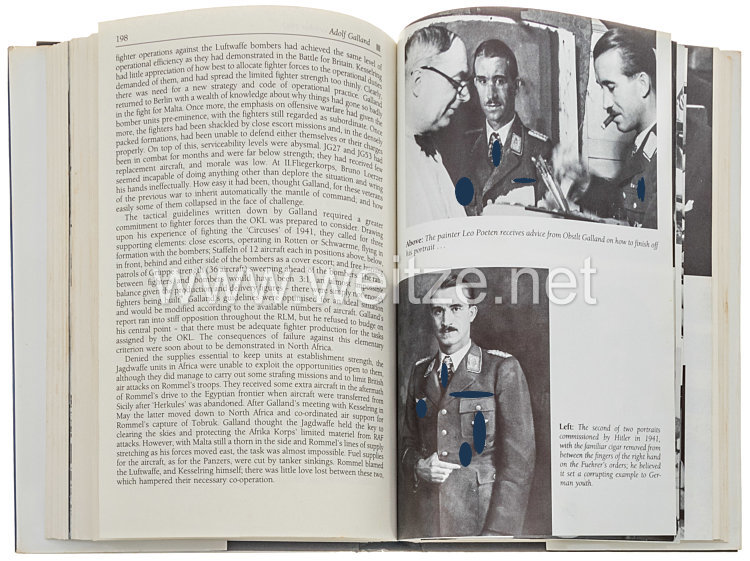
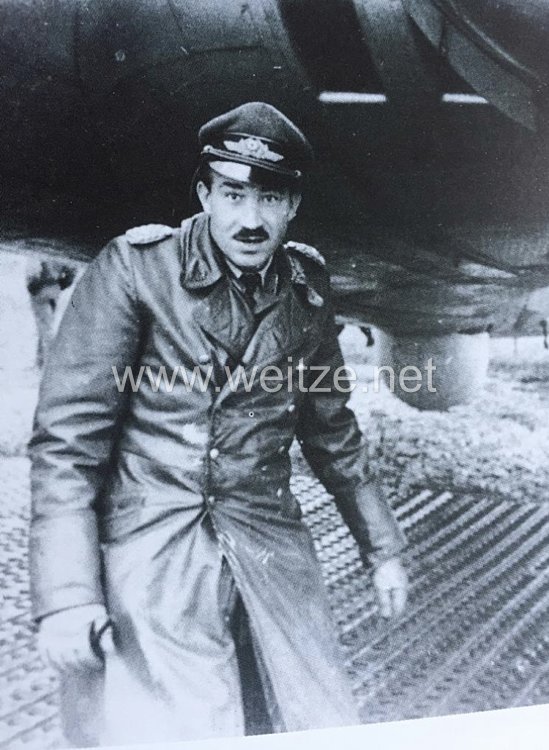
Accompanying the coat is a photograph of Galland in British captivity wearing this very garment — a compelling visual link supporting the attribution. Also included is the English-language biography “Adolf Galland — the authorized biography” by David Baker. Baker worked closely with Galland in his final years to produce this authorized account, which was published in 1996.
Post-War History
Galland was released from captivity around 1947. He subsequently worked as an aviation consultant in Argentina before eventually returning to Germany, where he died in 1996. The coat remained in private hands after 1945, passing from Sergeant Walter's possession and eventually entering the military collectibles market.
Significance for Collectors
Personal uniform items of high-ranking World War II military figures are extraordinarily rare, especially when accompanied by traceable provenance documentation. This coat brings together several critical elements: the monogram embroidery, the contemporaneous written documentation, the period photograph showing the owner wearing the garment, and the connection to one of the most iconic figures in the history of aerial combat. As a unique personal item from the possession of one of the most successful fighter aces of the Second World War, it constitutes an exceptional piece of military history.