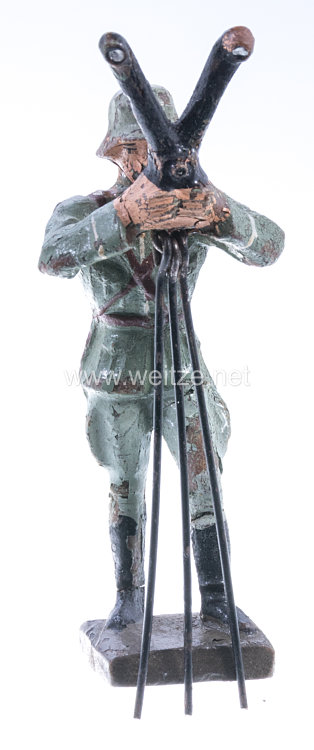
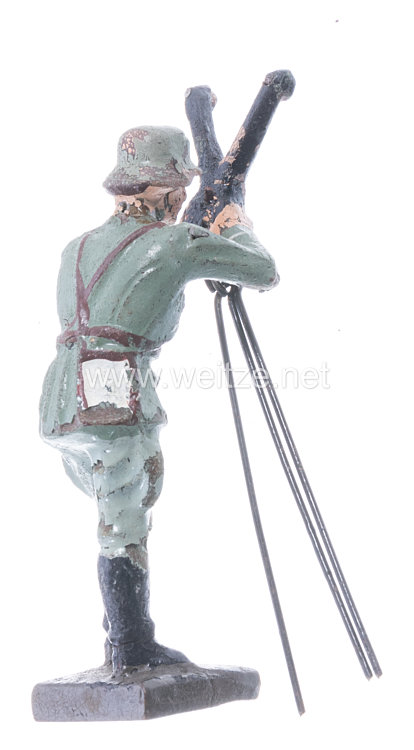
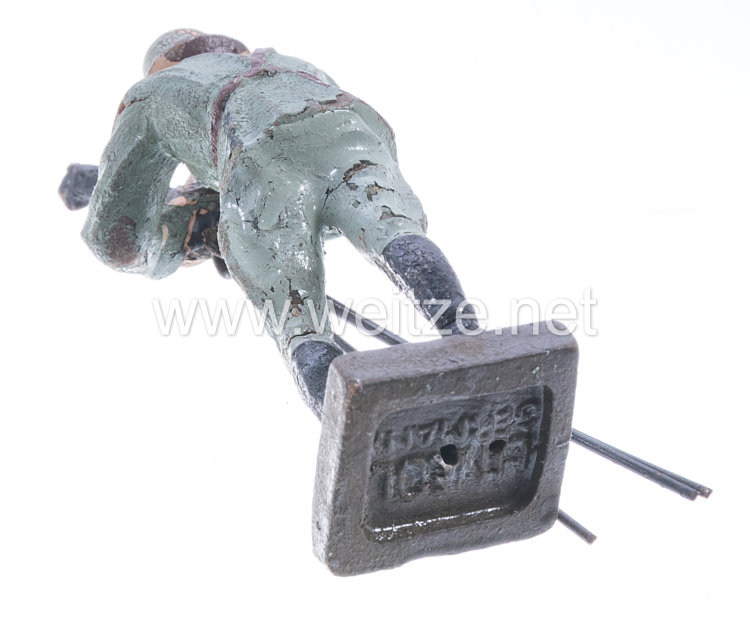
Lineol - Army Officer at Tripod-Mounted Scissor Telescope
The described Lineol figure of an army officer with a tripod-mounted scissors telescope represents a fascinating example of German toy manufacturing from the 1930s and early 1940s. The Lineol company, founded in 1906 in Brandenburg an der Havel by Oskar Wiederholt, developed into one of the most significant manufacturers of composition figures in the German-speaking world.
The figure, standing 7 cm tall, corresponds to the typical scale of Lineol productions, which usually ranged between 7 and 7.5 cm. The depicted scene shows an officer of the Wehrmacht Army conducting terrain observation using a scissors telescope, also known as a scissors periscope, mounted on a tripod stand.
The scissors telescope was an essential optical observation device of the German armed forces during both World Wars. The term “scissors” refers to the characteristic X-shaped construction of the tripod, which through its special mechanism enabled extremely stable and finely adjustable positioning. These telescopes were primarily used by artillery units, but also by infantry and reconnaissance units for terrain observation and target acquisition.
The technical development of the scissors telescope dates back to the late 19th century. During World War I, various models were introduced, including the Scherenfernrohr 08 and the Scherenfernrohr 14. During the interwar period and the rearmament phase of the 1930s, these instruments were continuously improved. The Wehrmacht utilized modernized versions such as the SF 14 Z with magnifications between 10x and 20x and various objective lens diameters.
The Lineol figures were manufactured from a special composition material, a mixture of glue, chalk, kaolin, and other additives that was pressed into molds. After drying, the figures were hand-painted, with particular attention paid to the accurate reproduction of uniforms. The quality of Lineol products was consistently high compared to competitors such as Elastolin, which was reflected in the precise execution of military details.
During the 1930s, Lineol produced an extensive range of military figures encompassing all branches of the Wehrmacht. These figures served not only as toys but also reflected the increasing militarization of German society. The depiction of officers engaged in technical activities such as telescope observation emphasized the modernity and technical competence of the armed forces.
The condition grade 2 of the described figure corresponds in collector evaluation to a very good to good state of preservation with possibly minor signs of use, but without significant damage or paint loss. This is noteworthy, as composition figures often show damage due to the inherent fragility of their material.
After World War II, production at Lineol was initially discontinued. The company later resumed manufacturing but focused on civilian themes. The military figures from the pre-war and war periods are today sought-after collectibles of both cultural-historical and toy-historical significance.
From a military-historical perspective, such figures document the equipment and gear of the Wehrmacht. The scissors telescope was part of the standard equipment of artillery observers and was precisely described in corresponding service regulations. The Heeresdienstvorschrift 130/2a, for example, regulated training on optical devices.
The collection and scholarly examination of such objects enables research into the material culture and everyday history of this era, whereby historical context and critical reflection must always remain paramount.