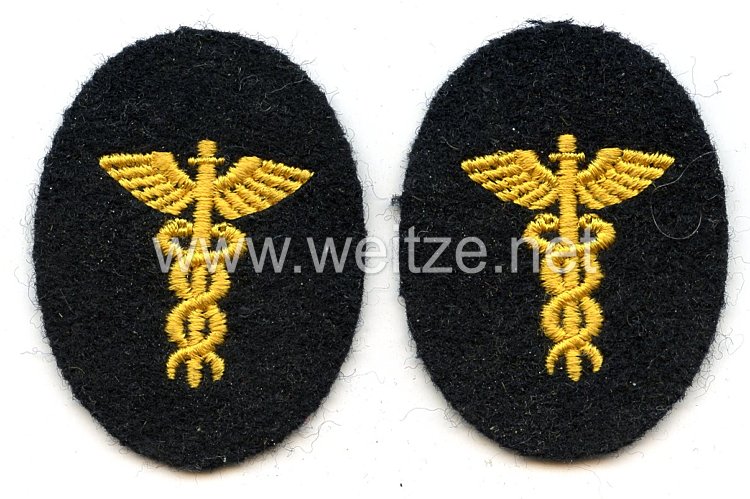
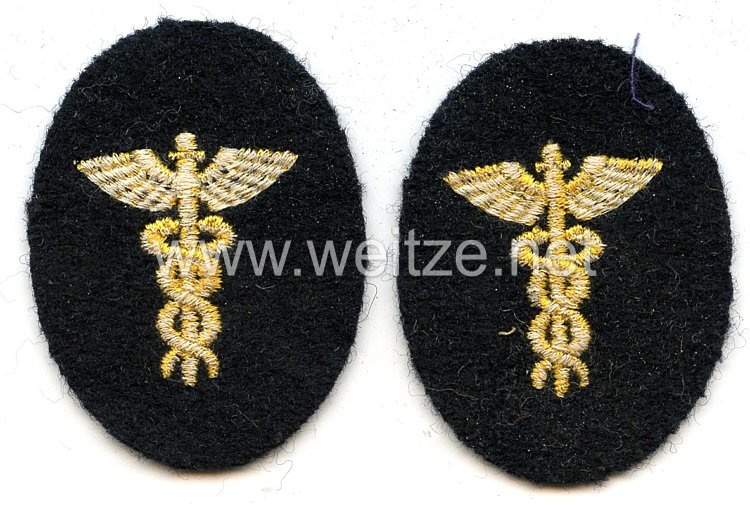
Kriegsmarine Pair of Sleeve Insignia for an Administrative Officer

machine-embroidered execution, condition 2.
441067
45,00

Kriegsmarine Pair of Sleeve Insignia for an Administrative Officer

Kriegsmarine sleeve insignia for administration officers represent an important element of German naval uniforms during World War II. These machine-embroidered badges served for immediate identification of the service branch and function of an officer within the complex organizational structure of the Kriegsmarine.

The Kriegsmarine, as the official designation of the German Navy from 1935 to 1945, developed a differentiated system of uniform insignia that built upon the traditions of the Imperial Navy. After the Nazi seizure of power in 1933 and the official renaming of the Reichsmarine to Kriegsmarine on May 21, 1935, new uniform regulations were introduced that also governed the identification of various service branches.

Administration officers formed an essential, though often overlooked, component of the naval organization. They were responsible for logistical tasks, supply, paymaster services, legal matters, and administrative management. Without their work, fleet operations would have been impossible. The identification of these officers through special sleeve insignia was therefore of great practical importance.

The sleeve insignia of administration officers differed from those of executive officers through their specific coloring and design. While executive officers wore golden rank insignia on a dark background, administration officers used a characteristic cornflower blue color (also referred to as administration color) between their golden rank stripes. This coloring was precisely specified in the Kriegsmarine dress regulations and enabled immediate distinction of ranks and career paths.

The machine-embroidered execution of these insignia was typical for officers' badges and differed from the simpler, woven versions for enlisted ranks. Machine embroidery enabled precise and durable production of the golden rank stars and stripes as well as the characteristic backing. The quality of embroidery varied depending on manufacturer and production period, with early wartime productions often being of higher quality than later versions.

A typical pair of sleeve insignia consisted of a left and right badge, arranged as mirror images and worn on both sleeves of the uniform jacket. The number and arrangement of golden stripes and stars indicated the exact rank of the wearer, from Zahlmeister-Aspirant (Paymaster Cadet) to Marinezahlmeister (Naval Paymaster) of admiral rank.

The use of these insignia was strictly regulated by dress regulations. They were worn on various uniform types, including the full dress uniform, the service dress uniform, and the working uniform. The exact positioning on the sleeve was as prescribed as the dimensions and execution of the insignia themselves.

During the war, these insignia were produced by various authorized manufacturers, who often marked their products with maker's marks. Quality and details could vary slightly between different manufacturers but remained within prescribed standards. Many officers also had their insignia privately made by specialized firms, provided they met official regulations.

After the war's end in 1945 and the dissolution of the Wehrmacht, these uniform items became historical artifacts. Today they are sought-after collector's pieces that represent important testimonies of military history. Their preservation and scientific documentation contributes to understanding the organizational structure and daily life in the German Kriegsmarine.

Research into these insignia provides insights into various aspects of military history: manufacturing techniques, uniform regulations, the organizational structure of the navy, and not least the importance of administrative services for military operations. They remind us that a naval force consisted not only of combat units but required a comprehensive administrative apparatus.

The study of such insignia also helps historians understand the complex hierarchy and specialization within the Kriegsmarine. Administration officers, though not engaged in direct combat operations, were integral to maintaining the fighting capability of the fleet through their management of resources, finances, and logistics. Their distinctive insignia reflected both their professional status and their essential role in naval operations.